Gyeongbokgung Palace has stood at the foot of Bugaksan Mountain since 1395, and in the six centuries since its founding it has burned, been rebuilt, fallen silent under occupation, and risen again. Today it is the largest of Seoul's Five Grand Palaces and the symbolic heart of the Joseon dynasty's legacy. When you walk through Gwanghwamun Gate, you are stepping into a space that has been carefully restored to evoke the rhythms of fifteenth-century court life.
But when, exactly, should you go? The answer shifts depending on what you want from the visit. A photographer chasing magnolia blossoms against vermilion eaves will have different priorities than a traveler hoping to avoid tour groups, or one who wants to see the Royal Guard Changing Ceremony in full regalia. The palace is open year-round, but the experience varies dramatically by season, day of the week, and even hour.
What follows is a practical, season-by-season guide drawn from the official schedules published by the Korea Heritage Service and Visit Korea, paired with on-the-ground observations about crowd patterns, light conditions, and what to do once you've had your fill of the palace grounds.
When Is the Single Best Time to Visit?
If you have only one visit to plan, arrive at 9:00 AM on a Monday, Wednesday or Thursday (the palace is closed on Tuesdays; if Tuesday is a public holiday, it closes the next day instead). The palace opens at this hour and remains comparatively empty for the first ninety minutes before tour buses arrive from Myeongdong and Itaewon.
Morning light in Seoul tends to be cool and diffused, particularly in the broad courtyards leading to Geunjeongjeon Throne Hall. Photographs taken before 10:30 AM capture the dancheong painted eaves without the harsh midday contrast, and you can frame the throne hall without strangers in every shot. By noon, both the main axis and the picturesque Hyangwonjeong Pavilion become considerably busier.
Gyeongbokgung opens on Mondays and on the Seollal and Chuseok holidays (admission is free on those holidays); it is Changdeokgung, Changgyeonggung and Deoksugung that close on Mondays. Check the Korea Heritage Service schedule before your trip for one-off closures (as of September 2026).
If you take the 9:00 slot you are done by lunchtime — KUT SEOUL, 20–25 minutes' walk down Jongno (5 min from Jongno 3-ga Exit 15), serves its 8-dish ₩69,000 Bar course at the counter on weekday lunches, 80 minutes, reservation only.
Spring: Cherry Blossoms and the Magnolia Window
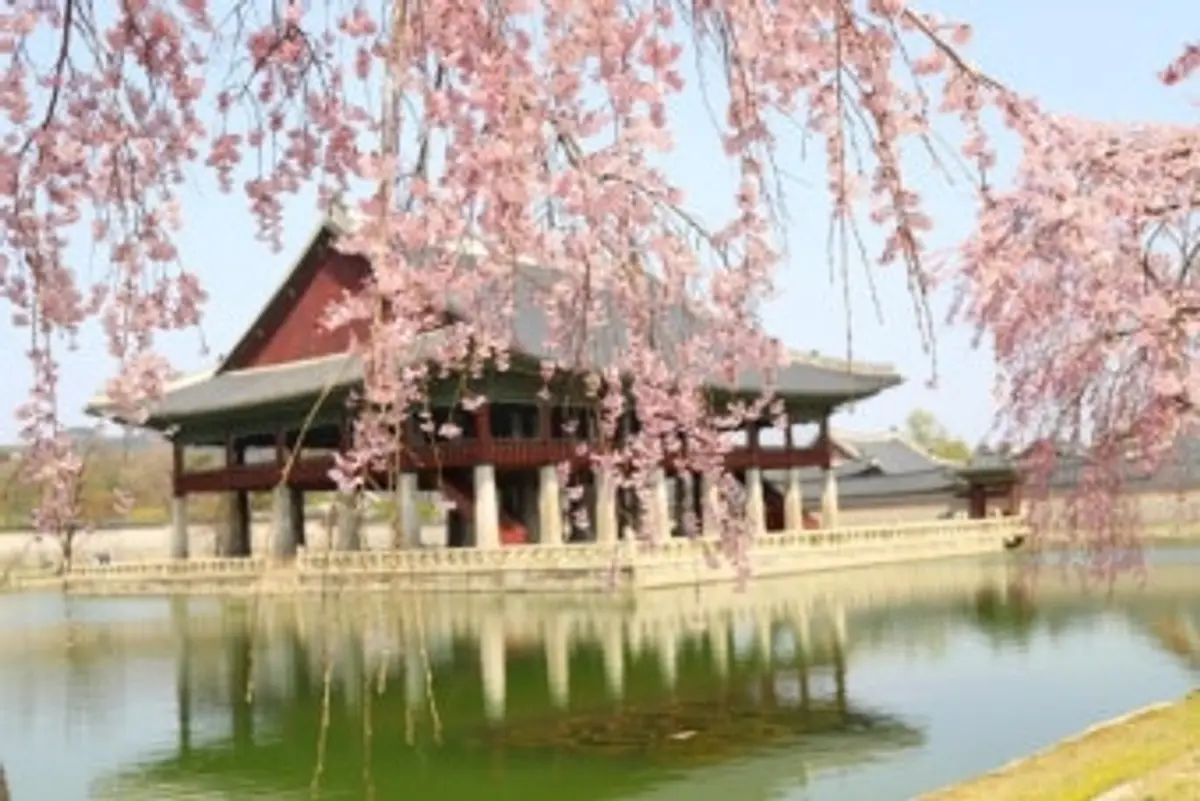
Spring at Gyeongbokgung is fleeting and worth planning around. The peak window for cherry blossoms typically falls between April 5 and April 15, though the dates shift each year with the warmth of late March.
The palace itself has fewer cherry trees than nearby spots like the National Folk Museum garden or the path along Gyeongbokgung's eastern wall toward Samcheong-dong. For the full spring effect, combine the palace with a walk to the adjacent grounds. White magnolias bloom slightly earlier, usually in late March, and forsythia line the outer walls in vivid yellow.
Spring also brings unpredictable weather. Yellow dust days, when fine particulate from Mongolia and northern China settles over Seoul, can dim the experience. Check the air quality index the morning of your visit; AQI readings above 150 are worth rescheduling for.
Summer: Long Hours and Late Light
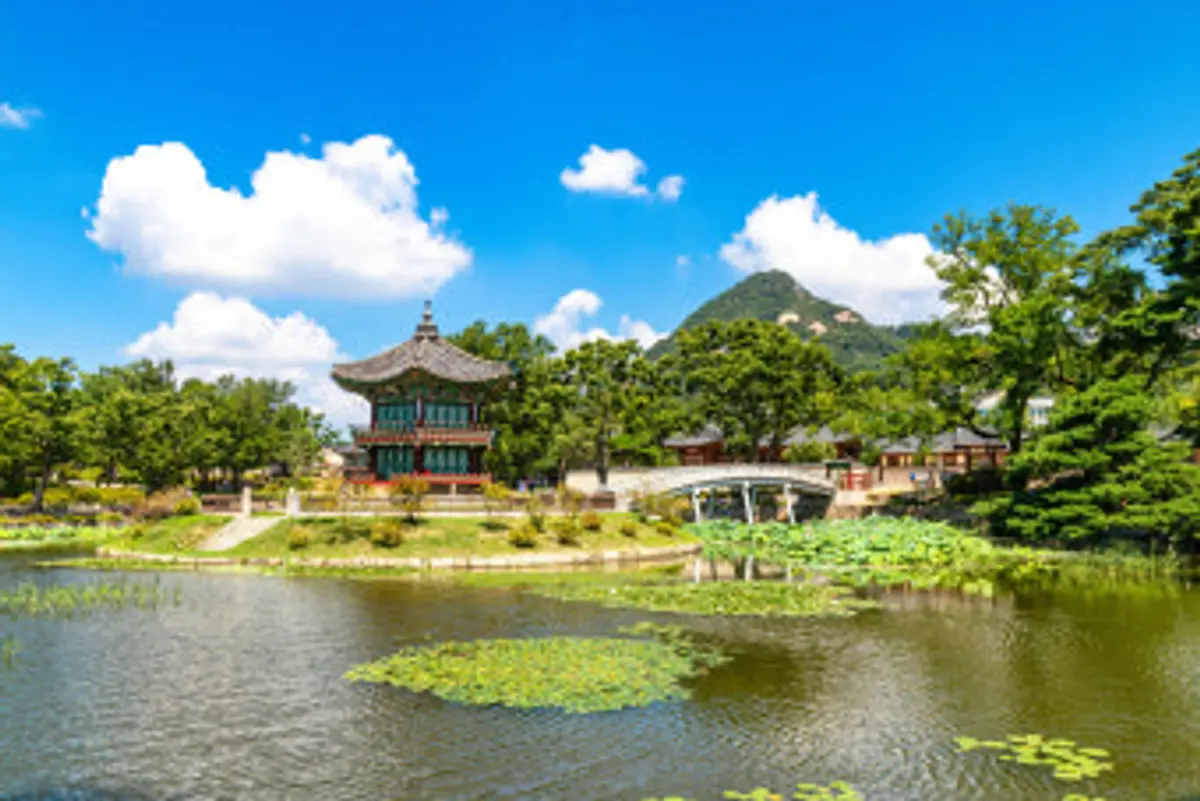
Summer offers the longest opening hours (to 18:30). The palace's evening openings run in spring and autumn only — check the official schedule for the next dates. Even without them, summer light lasts until nearly 8:00 PM in late June, allowing leisurely afternoon visits.
The heat, however, is genuine. July and August routinely exceed 32°C with humidity above 70%, and the palace courtyards offer little shade. If you visit between mid-July and late August, plan around the heat: arrive at opening, retreat to the shaded Hyangwonjeong area, and consider an early lunch indoors before returning for late afternoon. The Korean monsoon, jangma, typically runs from late June through mid-July, so pack a compact umbrella.
Autumn: The Connoisseur's Season
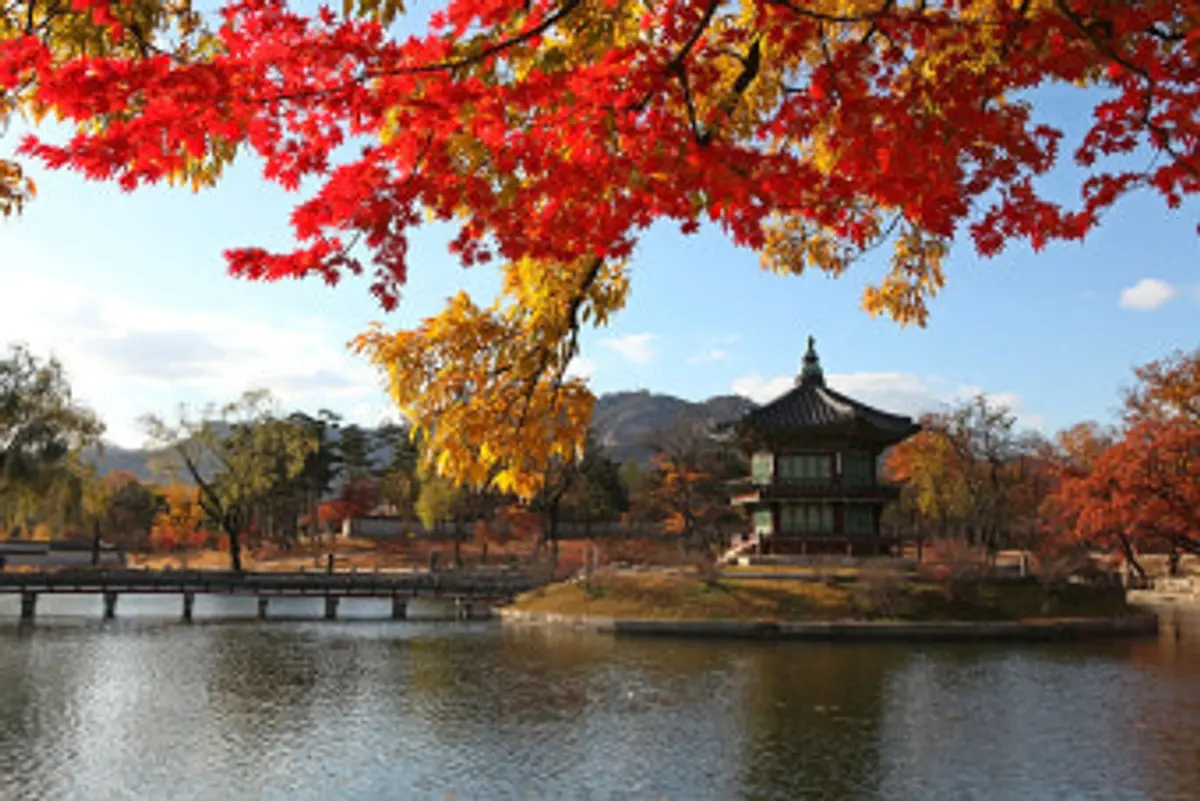
Mid-October to early November is arguably the finest time to visit Gyeongbokgung. Skies turn an almost glassy blue, temperatures hover between 12 and 20°C, and the gingko trees along Samcheong-ro outside the palace's eastern wall, and along Yulgok-ro toward Changdeokgung, ignite into deep yellow.
The palace's inner foliage reaches peak color slightly later than the surrounding streets, usually around the last week of October. The trees framing Hyangwonjeong and the rear gardens of Geoncheonggung turn russet and gold, reflecting in the still pond water. This is also when professional and amateur photographers in hanbok arrive in greatest number, lending the grounds a layered, theatrical quality.
Book accommodations in central Seoul well in advance for this window; Korean domestic tourism peaks alongside international travel in October.
Winter: Snow, Stillness, and Smaller Crowds
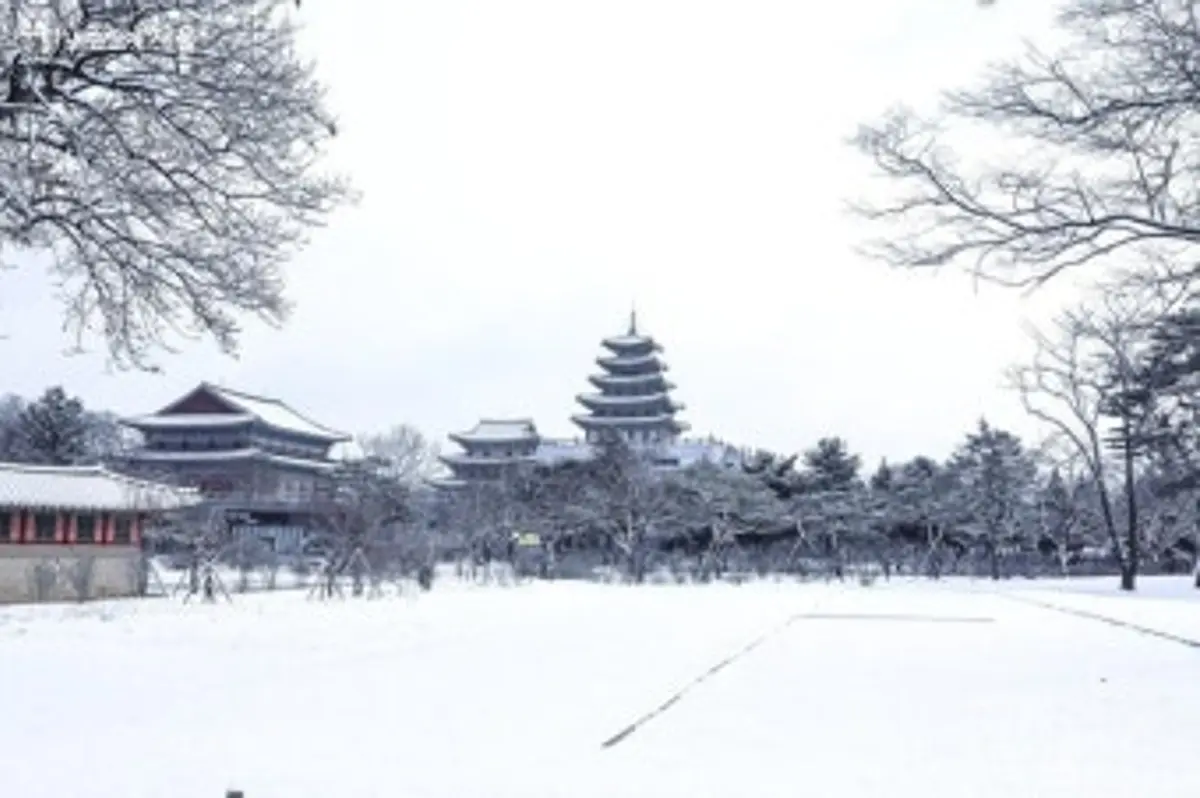
December through February sees the lowest visitor numbers, particularly on weekday mornings. Temperatures can drop to -10°C, but the trade-off is genuine: a snow-covered Gyeongbokgung is one of Seoul's rarest and most photographed scenes.
Snow days are unpredictable but most likely in January and early February. The morning after a snowfall, arrive at opening; the grounds staff clear the main paths quickly, but rooftops, courtyards, and pavilion eaves hold the snow beautifully for several hours. Dress in genuine winter layers, including thermal base layers and proper gloves, as the wind through the open courtyards is sharp.
Comparing the Seasons at a Glance
| Season | Months | Avg. Temp | Crowds | Best For |
|---|---|---|---|---|
| Spring | Apr–May | 10–20°C | High | Cherry blossoms, magnolias |
| Summer | Jun–Aug | 24–32°C | Moderate | Long daylight hours |
| Autumn | Oct–Nov | 8–20°C | Very High | Foliage, clear skies |
| Winter | Dec–Feb | -10–4°C | Low | Snow scenes, solitude |
What Are the Hours, Prices and Ceremony Times?
Gyeongbokgung Palace operates on a seasonal schedule (as of September 2026). From March through May and September through October, hours are 9:00 AM to 6:00 PM; June through August extends to 6:30 PM; November through February closes at 5:00 PM. Last admission is one hour before closing. The palace is closed on Tuesdays — if Tuesday is a public holiday, it closes the following day instead.
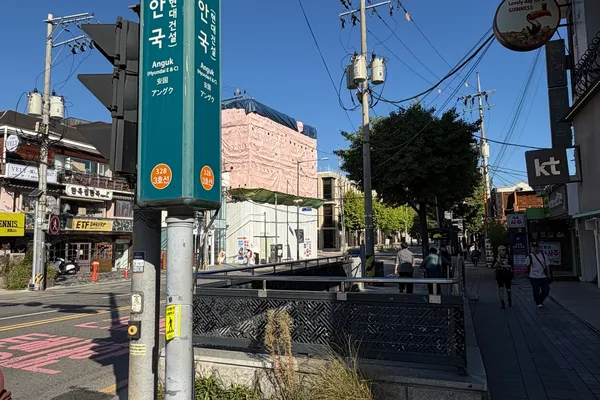
Admission is 3,000 KRW for adults. Visitors wearing hanbok enter free of charge — a worthwhile consideration if you plan to spend time photographing the grounds. Rental shops cluster east of the palace, around Anguk Station and Gyeongbokgung Station Exit 4, at roughly ₩15,000–35,000 for 2–4 hours (as of September 2026).
The Royal Guard Changing Ceremony takes place at 10:00 AM and 2:00 PM in front of Gwanghwamun Gate, lasting roughly twenty minutes. There is no ceremony on Tuesdays, and it is cancelled in heavy rain or snow and scaled down in extreme heat or cold (as of September 2026).
Getting there is straightforward: Gyeongbokgung Station (Seoul Subway Line 3), Exit 5, opens directly into the palace's western entrance. Gwanghwamun Station (Line 5), Exit 2, leaves you a six-minute walk from the front gate along the redesigned Gwanghwamun Square.
What Is Nearby After the Palace?
The surrounding district rewards extended exploration. Bukchon Hanok Village sits a ten-minute walk northeast, offering tile-roofed alleys and quiet teahouses. The National Palace Museum of Korea, immediately south of the palace grounds, provides excellent context for what you've just seen and is free to enter. Samcheong-dong, just east, has galleries, independent cafés, and slow-paced lanes ideal for an afternoon coffee. For a full route from the palace to dinner, see a perfect day in Jongno.
For a deeper grasp of the palace's history, the official Korea Heritage Service site publishes restoration timelines and architectural notes that elevate any visit.
Ending Your Day in Jongno
A full Gyeongbokgung visit, including the guard ceremony and the rear gardens, takes two to three hours. By late afternoon, most travelers find themselves drifting south down Sejong-daero and along Jongno into the broader district, where Seoul's old and new layers meet most visibly. This is where dinner becomes part of the day's narrative rather than an afterthought.
KUT SEOUL is 20–25 minutes on foot from Gyeongbokgung, or about 10 minutes on Line 3 to Jongno 3-ga — 3F Hanol Tower, 96 Jongno, next to Tapgol Park. Counter seats take the Posh course (₩175,000); private rooms start from Posh at weekday lunch, Signature (₩210,000) at dinner and on weekends, up to Royal (₩280,000); on weekdays the 8-dish ₩69,000 lunch runs 80 minutes at the counter. Reservation only on CatchTable — which seat suits your evening.
KUT SEOUL: Bar 8 dishes ₩69,000 (weekday lunch, counter only, 80 min) · Posh 11 ₩175,000 · Signature 13 ₩210,000 · Royal 15 ₩280,000 · Kids ₩45,000 (ages 7 and under). Signature and Royal are private-room only; Posh is also served in a private room at weekday lunch (counter at weekday dinner and on weekends and holidays). BMS No. 9 Hanwoo, vacuum (wet) aged four weeks — not dry-aged. Grades run 3/2/1/1+/1++; since December 2019, 1++ covers marbling scores 7–9 and the number is displayed. KUT serves No. 9 only.
3F Hanol Tower, 96 Jongno — 5–7 minutes from Jongno 3-ga Station (Lines 1·3·5) Exit 15 or Jonggak Station (Line 1) Exit 4; next to Tapgol Park; 20–25 minutes on foot from Gyeongbokgung. Lunch 11:30–15:00 (last order 14:30), dinner 17:30–22:00 (last order 19:30), closed Tuesdays. Reservation only, through CatchTable or Naver. Deposit is 100% of the order; cancellation is free two days before, 50% one day before, none on the day.