Bringing your own bottle to dinner is a quiet ritual for wine and whisky collectors visiting Seoul. A vintage carried across an ocean, a birth-year bottle from a cellar back home, a single-cask whisky picked up at a distillery in Speyside — these are exactly the bottles worth uncorking somewhere that will treat them properly. Jongno, with its concentration of quiet fine-dining rooms tucked behind the palaces and hanok alleys, is one of the more welcoming districts in the city for this kind of evening.
But Korean corkage culture is not identical to what you may know from London, New York or Tokyo. Fees are quoted per bottle rather than per person; a single bottle per group is the informal norm at higher-end venues; and — perhaps most importantly — nothing is arranged on the doorstep. You confirm it when you book, in writing, or you leave the bottle in the hotel safe.
This guide explains how corkage works in Seoul's Korean fine-dining scene, what to check before you assume a Jongno restaurant will accept your bottle, and one confirmed policy at a Hanwoo omakase counter three minutes from Jongno 3-ga Station.
What does corkage mean in Seoul?
Corkage in Seoul means the fee a restaurant charges to open, serve and pour a bottle you brought yourself. As one industry explainer puts it, the fee "compensates the restaurant for the service of opening and pouring the wine, providing glassware" and the licensed environment around it. You are not paying for the drink; you are paying for the ceremony.
In Korea, corkage sits mostly inside the world of fine dining and hotel restaurants. Everyday galbi houses and pojangmacha do not have a corkage policy because they are set up to sell beer and soju by the bottle and rarely see outside wine. It is at the upper tier — omakase counters, hanjeongsik rooms, French and Italian tasting menus — that outside bottles become a real conversation.
Three conventions are worth internalising before you walk in:
- One bottle per group is the informal Korean norm at fine-dining venues, even where the written policy does not specify a maximum. Some restaurants will accept two if you ask in advance for a larger party, but assume one until told otherwise.
- Wine, whisky and champagne are often priced differently. Spirits and champagne almost always carry a higher fee than still wine, reflecting both the pour size and the market value of the bottle.
- The bottle should not duplicate the wine list. International etiquette on this point applies in Seoul: bringing a bottle the restaurant already sells is considered ungracious.
How much is a typical corkage fee in Jongno?
There is no single Seoul-wide number. Fees at Jongno fine-dining restaurants generally sit in a band from around ₩30,000 for a modest wine at a bistro to ₩100,000 or more for spirits at a tasting-menu venue. Because policies change and many restaurants do not publish them at all, the only reliable figure is the one you receive by email or reservation note from the specific restaurant on the specific date.
As a rough hierarchy, expect:
- Casual wine bars and bistros to sit at the lower end, sometimes waiving the fee if you also order a bottle from the list.
- Mid-range hanjeongsik and modern Korean rooms to charge a flat per-bottle fee, generally in the middle of the band.
- Tasting-menu and omakase counters to publish a per-bottle fee with a strict one-bottle-per-party limit, and to charge more for whisky and champagne than for still wine.
Getting there and asking well
Most of Jongno's fine-dining rooms cluster in a narrow corridor between Gwanghwamun and Jongno 3-ga, walkable in fifteen minutes end to end. The two most useful stations are Jonggak (Line 1) and Jongno 3-ga (Lines 1, 3 and 5), each of which puts you within three or four minutes of dozens of restaurants along Jongno itself and the side streets north into Insadong and Ikseon-dong. Taxis from Gwanghwamun run about ₩5,000 to ₩7,000 during off-peak hours, and Line 3 links Anguk directly to Jongno 3-ga in one stop.
When you ask about corkage, ask in writing rather than by phone. English, Japanese and Chinese written enquiries are handled comfortably by most fine-dining reservation systems in Seoul; a spoken conversation in Korean at 6:30 pm on a busy Friday is a different matter. The two questions to include are the per-bottle fee for your specific drink type (wine vs. whisky vs. champagne) and whether more than one bottle is permitted for your party size. Confirm both in the same message and keep the reply.
At KUT SEOUL in Jongno, that sequence is served from ₩69,000 for an 8-dish weekday lunch at the counter — see what is in a Hanwoo omakase, cut by cut.
Which type of bottle should you bring?
The short answer: bring something you cannot buy in Seoul, or something with a story. Corkage is generally intended for unique, aged, or sentimental bottles rather than for mass-market wines the restaurant already sells for a fair mark-up. Bringing a supermarket Malbec to a Michelin room in order to save ₩40,000 is the kind of gesture that will be technically accommodated and quietly noted.
Some guiding principles from experienced sommeliers, which travel well to Seoul:
- A bottle from your birth year, or from a memorable trip, is always in good taste. So is a rare vintage the restaurant would not stock.
- If the venue publishes a wine list online, scan it before you leave home and choose something absent from it. This is universally regarded as the single most important corkage rule.
- For whisky and champagne, an unusual cask strength, a collector's release, or a vintage cuvée is a better fit than a widely available label.
- Never arrive with the bottle in a paper bag and no prior notice. The staff need to plan glassware, chilling and — in Korea — to record the corkage on your reservation.
If you are travelling with a party of four or more and want to open a second bottle, mention it at booking rather than at the table. A restaurant that says no to a second bottle at the door will often say yes to it a week in advance.
Corkage etiquette in a Korean fine-dining room
A few practices are specific enough to Korea that they are worth spelling out. First, tipping is not part of the corkage transaction. Korean fine dining does not operate on a tipping model, and the corkage fee is the full payment for the service around your bottle; the staff will pour, decant, chill and store without expectation of anything more. This is different from the United States, where an additional gratuity on the pour is a common courtesy.
Second, the sommelier or captain will usually offer to open the bottle at the table and present the cork, as they would with a bottle sold from the list. Accept this — it is part of what you are paying for, and refusing feels abrupt in a Korean room. If you have brought an older wine that needs decanting, mention it when you sit down, not when the bottle is already open.
Third, if the restaurant has its own wine list, ordering at least one glass or a half-bottle from the list alongside your BYO is a graceful gesture. It is not required and no venue will insist, but it changes the temperature of the evening in your favour, particularly at counters where the same staff will host you for two or three hours.
Finally, do not photograph the bottle in a way that suggests the restaurant supplied it. This is a small courtesy in the age of Instagram, and one Korean venues appreciate.
KUT SEOUL: a confirmed corkage policy in Jongno
KUT SEOUL is a Hanwoo omakase in the middle of Jongno, 3F Hanol Tower, 96 Jongno — 3 minutes from Jongno 3-ga Station (Lines 1·3·5) Exit 15 or Jonggak Station (Line 1) Exit 4; next to Tapgol Park; 20–25 minutes on foot from Gyeongbokgung. It is one of the few premium restaurants in the district that publishes its corkage terms plainly, which makes it a useful reference point even if you end up dining elsewhere.
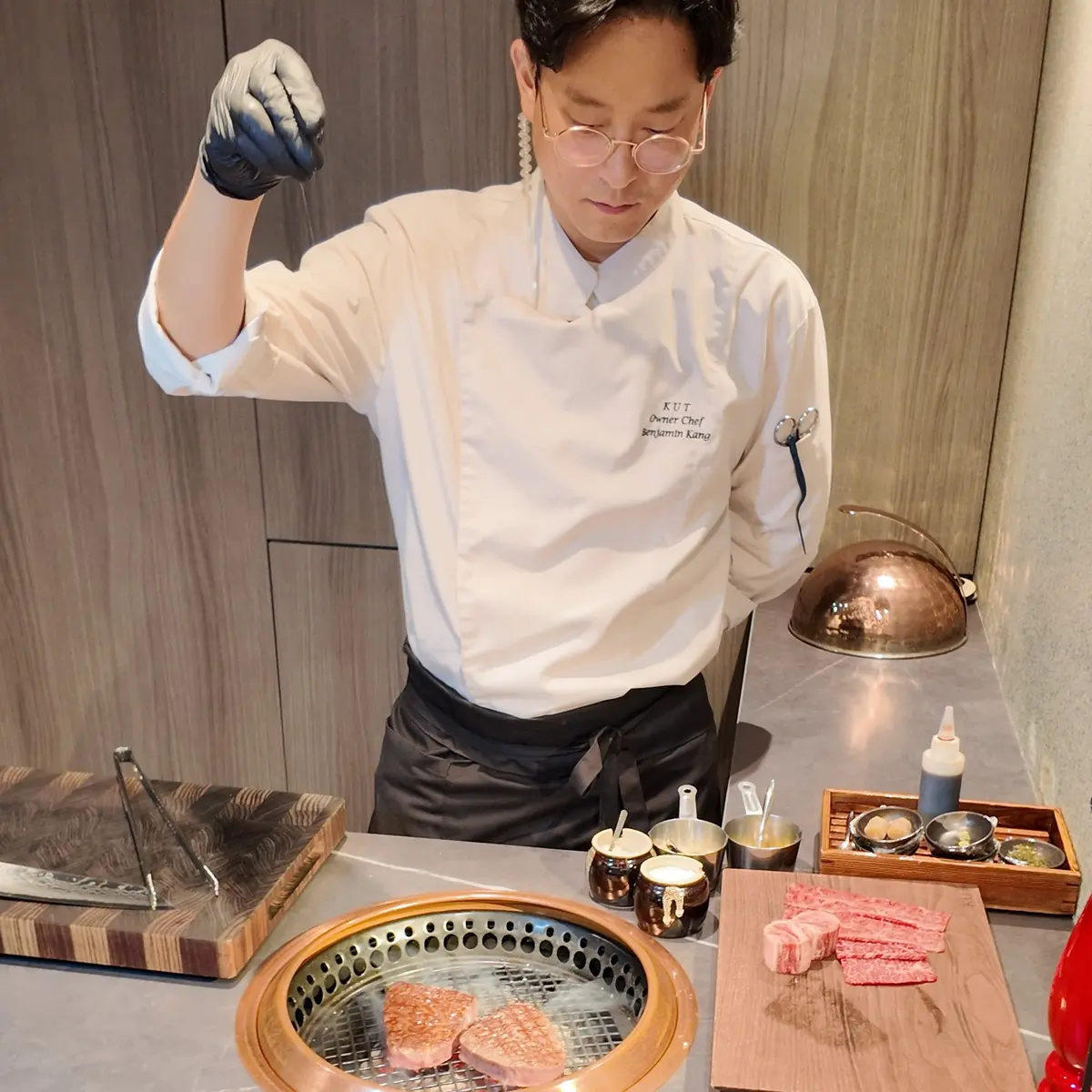
The policy is one bottle per party. Wine is ₩70,000 per bottle; whisky and champagne are ₩100,000 per bottle. There is no cake fee, and no tipping or service charge is added at any point — the listed course price is the final price. Guests planning to bring a bottle are asked to note it in the reservation the day before, either in the CatchTable or Naver Booking notes field or by email.
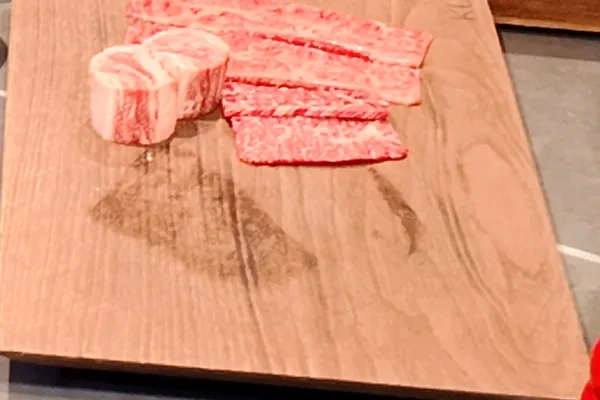
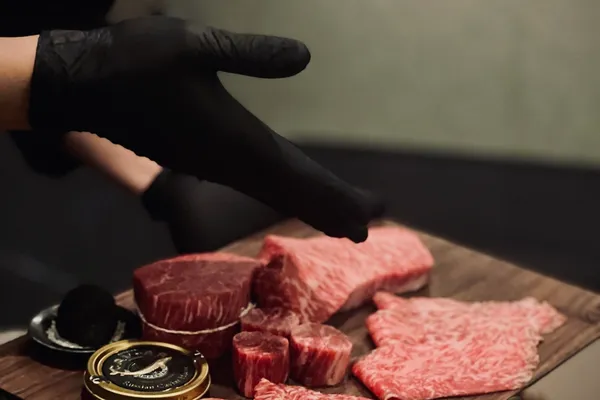
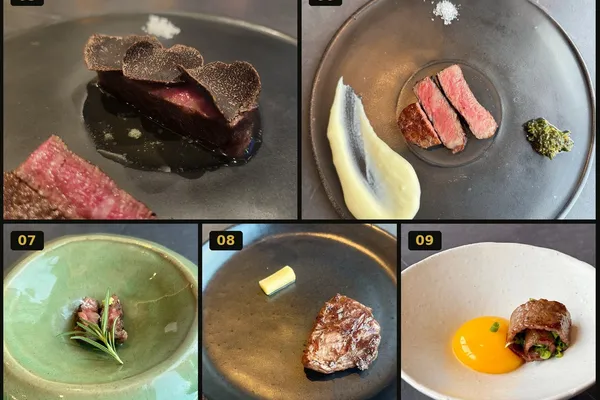
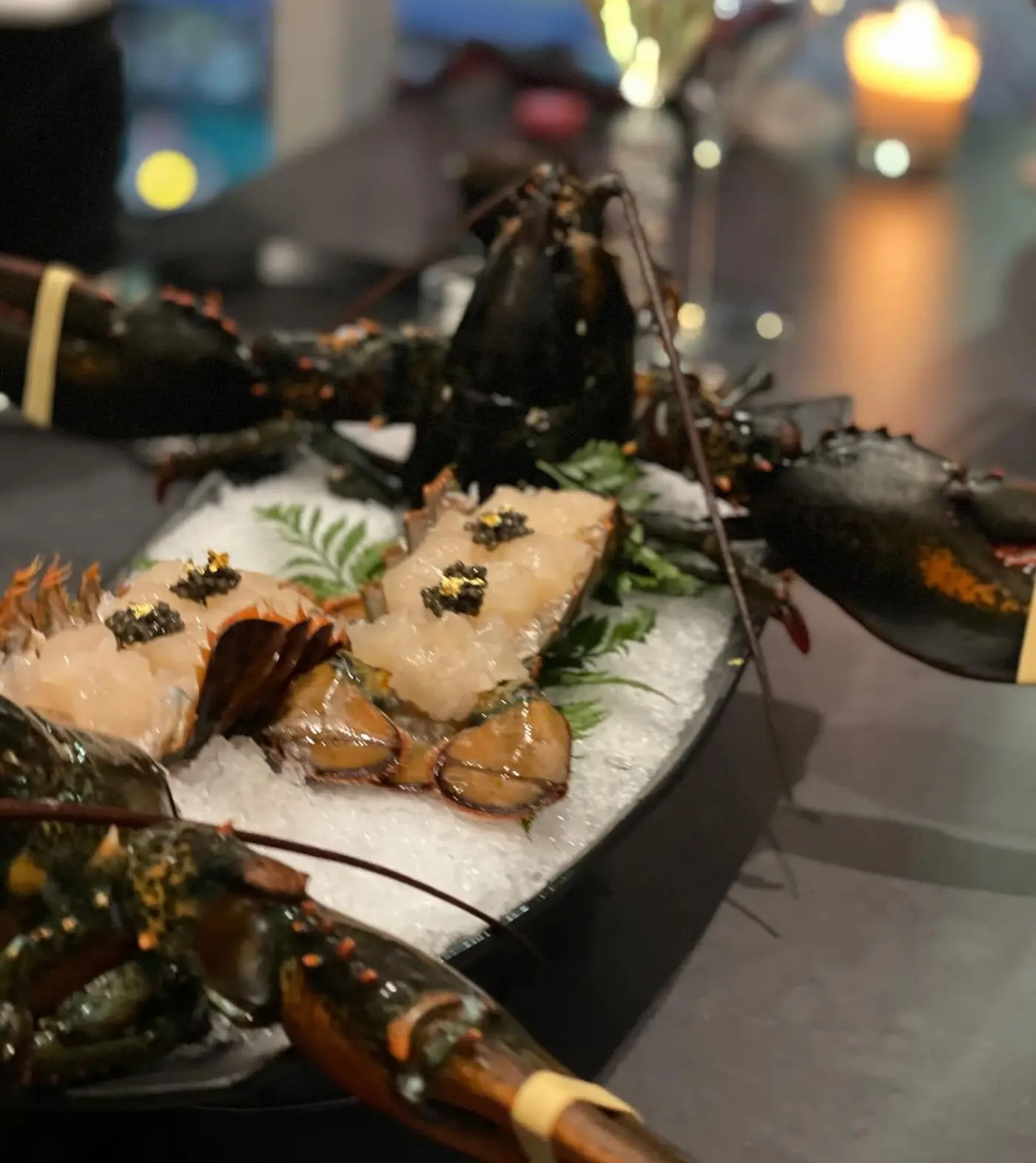
The restaurant serves five courses of BMS No. 9 Hanwoo, ranging from the eight-dish Bar Course at weekday lunch to the fifteen-dish Royal Course with live lobster sashimi and Châteaubriand. BMS No. 9 Hanwoo, vacuum (wet) aged four weeks — not dry-aged. Grades run 3/2/1/1+/1++; since December 2019, 1++ covers marbling scores 7–9 and the number is displayed. KUT serves No. 9 only.
KUT SEOUL: Bar 8 dishes ₩69,000 (weekday lunch, counter only, 80 min) · Posh 11 ₩175,000 · Signature 13 ₩210,000 · Royal 15 ₩280,000 · Kids ₩45,000 (ages 7 and under). Signature and Royal are private-room only; Posh is also served in a private room at weekday lunch (counter at weekday dinner and on weekends and holidays).
Lunch 11:30–15:00 (last order 14:30), dinner 17:30–22:00 (last order 19:30), closed Tuesdays.
For a fuller sense of how the seating and courses fit together — counter, private rooms, and which course is served where — see the counter vs. private rooms guide. Guests specifically interested in whisky pairing may find the Glenfiddich corkage episode with the rapper Choiza a useful reference for how a BYO whisky evening actually unfolds at the counter.
Reservation only, through CatchTable or Naver. Deposit is 100% of the order; cancellation is free two days before, 50% one day before, none on the day.
A short checklist before you bring a bottle to Jongno
Before you leave your hotel with a bottle in hand, run through five quick questions:
- Have you confirmed the corkage fee in writing for your specific drink type (wine, whisky or champagne)?
- Have you checked that the bottle is not already on the restaurant's own list?
- Is it clear how many bottles are permitted for your party size?
- Did you note the bottle in the reservation the day before, not on arrival?
- Are you carrying the bottle in a proper wine tote or gift box rather than a supermarket bag?
If all five answers are yes, the rest of the evening takes care of itself. A well-chosen bottle, opened without fuss in a quiet Jongno dining room, is one of the more civilised pleasures Seoul offers.
Ending Your Day in Jongno
KUT SEOUL is a 3-minute walk from Jongno 3-ga Station (Lines 1·3·5) Exit 15 — 3F Hanol Tower, 96 Jongno, next to Tapgol Park. Counter seats take the Posh course (₩175,000); private rooms start from Posh at weekday lunch, Signature (₩210,000) at dinner and on weekends, up to Royal (₩280,000); on weekdays the 8-dish ₩69,000 lunch runs 80 minutes at the counter. Reservation only on CatchTable — which seat suits your evening.