Gyeongbokgung is the grandest of Seoul's Five Grand Palaces, and after two or three hours in its courtyards most visitors emerge hungry, cold or footsore — and often hoping the next meal will be Hanwoo. The Korean beef reputation is genuine, but the geography is less obliging than the guidebooks suggest. The blocks immediately outside Gwanghwamun Gate lean toward samgyetang, knife-cut noodles and royal-court set menus. Serious Hanwoo houses cluster further south and east, in Jongno proper, and reaching them requires either a real walk or a short subway ride.
This guide sorts what is actually within reach of the palace from what is a genuine dining destination in Jongno, explains how Korean beef grading works so you can read a menu with confidence, and gives honest travel times between the two neighbourhoods. Nothing here rounds distances down to make Jongno sound closer than it is.
How Far Is Jongno From Gyeongbokgung, Really?
On foot, the walk from Gwanghwamun Gate down to the heart of Jongno takes twenty to twenty-five minutes; by Line 3 the ride from Gyeongbokgung Station to Jongno 3-ga is a little under ten minutes including platform time. Anyone who tells you it is a five-minute stroll is either measuring from the far southern edge of the palace complex or confusing Jongno with Gwanghwamun Square.
The simplest routes are three. Walk south on Sejong-daero to Gwanghwamun intersection, then east along Jongno past Jonggak Station; this is the most scenic option because it follows Cheonggyecheon's northern edge for the second half. Alternatively, take Line 3 south from Gyeongbokgung to Jongno 3-ga (two stops), where Lines 1, 3 and 5 converge. A taxi covers the same ground in five to eight minutes outside rush hour, and the base fare rarely climbs above a modest single-digit-thousand-won figure for the trip.
Gyeongbokgung itself, before you leave, is worth timing carefully. Admission for foreign adults aged 19 to 64 is ₩3,000, with last entry one hour before closing and Tuesdays as the standard weekly closure (as of 2026-09). If Tuesday overlaps a public holiday, the palace opens that day and closes the following non-holiday instead. In September and October the palace operates 09:00–18:00, with last entry at 17:00. Visitors wearing hanbok enter free — a genuinely widespread practice, given the density of rental shops east of the palace toward Anguk Station.
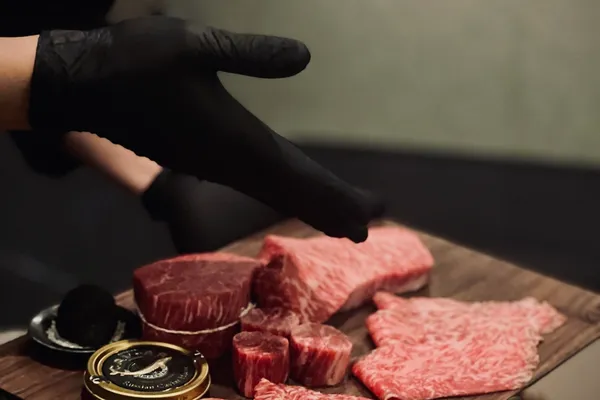
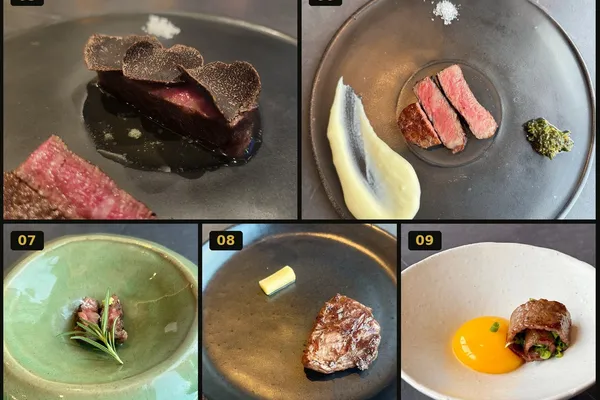
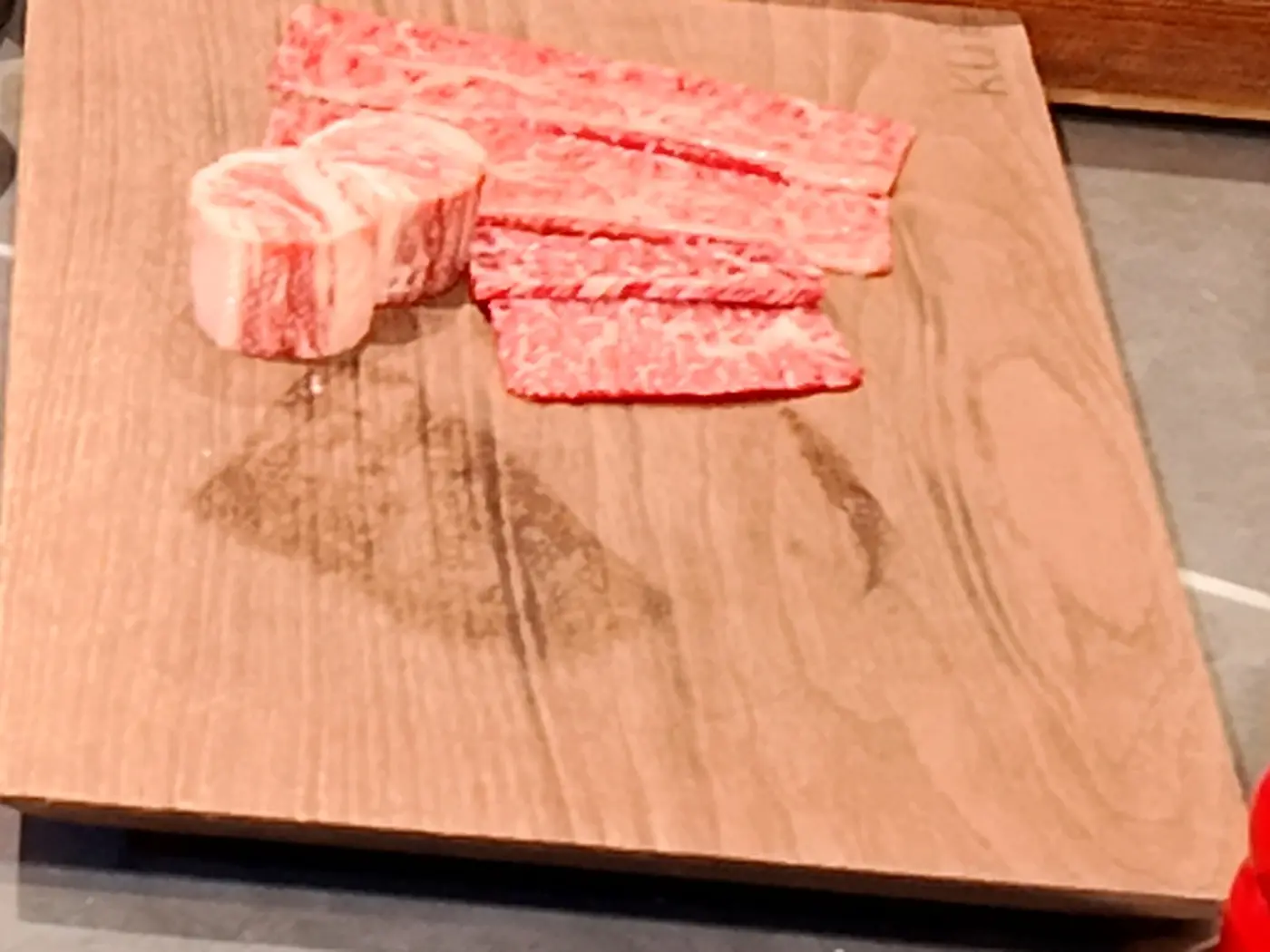
At KUT SEOUL in Jongno, that sequence is served from ₩69,000 for an 8-dish weekday lunch at the counter — see what is in a Hanwoo omakase, cut by cut.
What Kind of Food Is Actually at the Palace Gates?
Most of what surrounds Gyeongbokgung is not Hanwoo. The Seochon and Sajik-dong blocks west of the palace are known for samgyetang, most famously at Tosokchon, and for hanjeongsik set-meal restaurants housed in old hanoks. To the north-east, Samcheong-dong and Bukchon lean toward sujebi (hand-torn noodle soup), tea houses and Western fusion. The nearest Hanwoo-specialist restaurants of any repute tend to sit either in Samcheong-dong at a distance of roughly a kilometre from the palace's front gate, or south in Jongno itself.
This is worth naming honestly because the marketing gap is real. Search results for "Hanwoo near Gyeongbokgung" surface a handful of general Korean barbecue houses within the palace's postal district, but very few grade-verified Hanwoo specialists sit within a five-minute walk of Gwanghwamun Gate. For a proper Hanwoo lunch or dinner after the palace, plan on a short journey — not a spontaneous next-door stop.
How Do You Read a Hanwoo Menu?
A Hanwoo menu is legible once you know the grade grammar. Korea's carcass grading system was established in 1992 and now consists of five quality grades — 1++, 1+, 1, 2 and 3 — assessed by the Korea Institute for Animal Products Quality Evaluation (KAPE), a body operating under the Livestock Production Act. Marbling is the dominant determinant of quality grade, with other factors including meat colour, fat colour, texture and maturity.
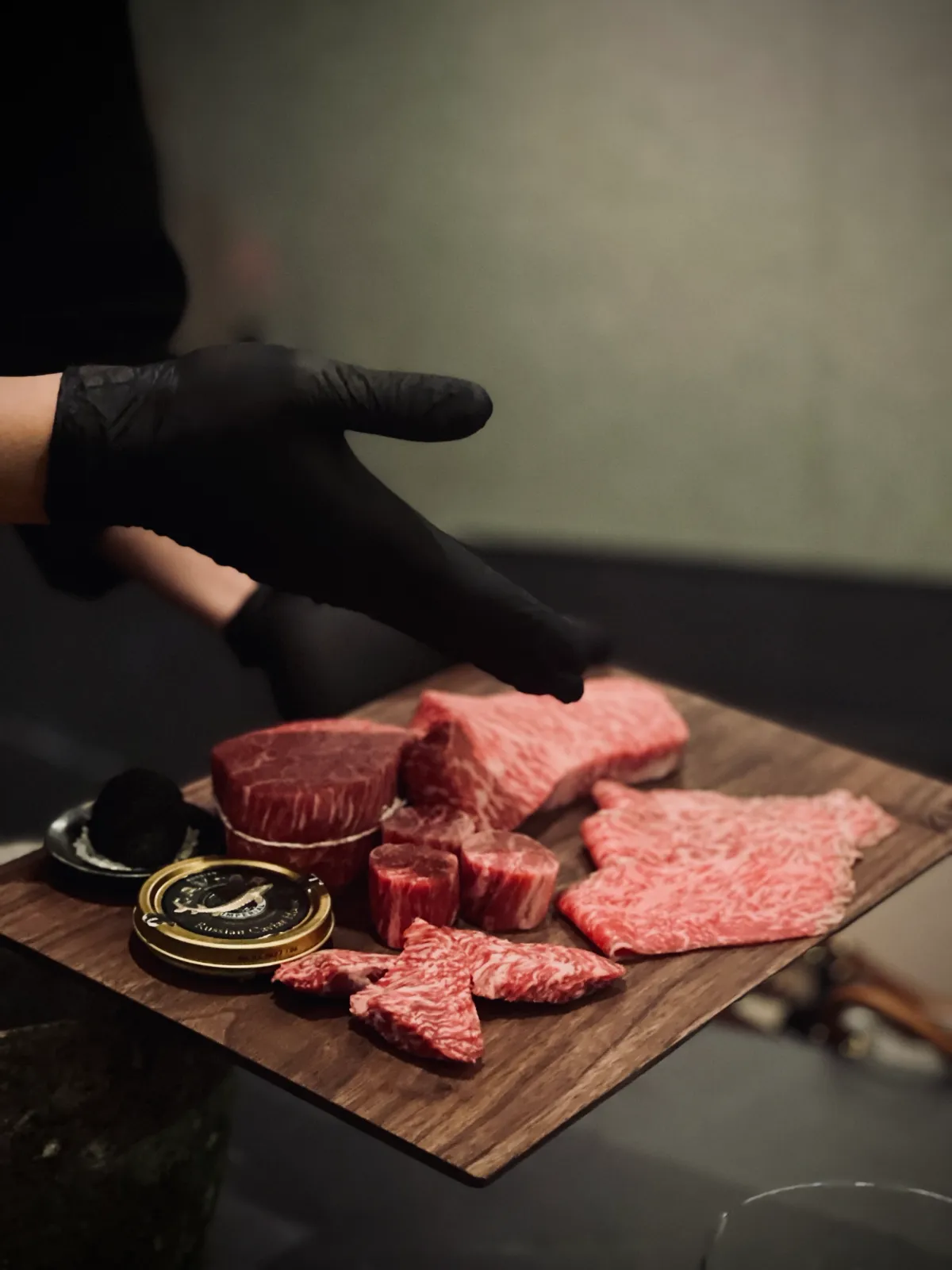
Marbling itself is scored on the Beef Marbling Standard, a scale from 1 (devoid) to 9 (very abundant). Since the December 2019 revision, grade 1++ covers BMS 7, 8 and 9; grade 1+ covers 6; grade 1 covers 4 or 5; grade 2 covers 2 or 3; and grade 3 corresponds to BMS 1. Since December 2019 the marbling number itself — not only the grade — must be shown on labelling, so a menu that reads "BMS No. 9" is telling you the top of the top.
| Quality grade | BMS score | Character on the plate |
|---|---|---|
| 1++ | 7, 8 or 9 | Densely marbled, buttery, fine grain |
| 1+ | 6 | Generously marbled, still supple |
| 1 | 4 or 5 | Balanced, leaner mouthfeel |
| 2 | 2 or 3 | Lean, firmer |
| 3 | 1 | Very lean |
One linguistic point worth settling: Hanwoo is not Wagyu. Both breeds are prized for marbling, and both are graded on marbling scales (Korea's BMS runs 1–9, Japan's 1–12), but Hanwoo (한우, literally "Korean cattle") is a distinct native breed with its own grading authority. Calling Hanwoo "Wagyu" flattens a real culinary difference.
Which Hanwoo Format Should You Choose After the Palace?
Once you have crossed into Jongno, the Hanwoo landscape opens into three broad formats. Traditional grill houses put raw cuts on a tabletop charcoal or gas grill and let the room cook. Butcher-restaurants — the jeongyukjeom model — sell you the meat at counter price and add a small cover charge for grilling. And Hanwoo omakase (or hanugeori) plates a chef-driven tasting course of multiple cuts, one at a time, at a counter or in a private room.
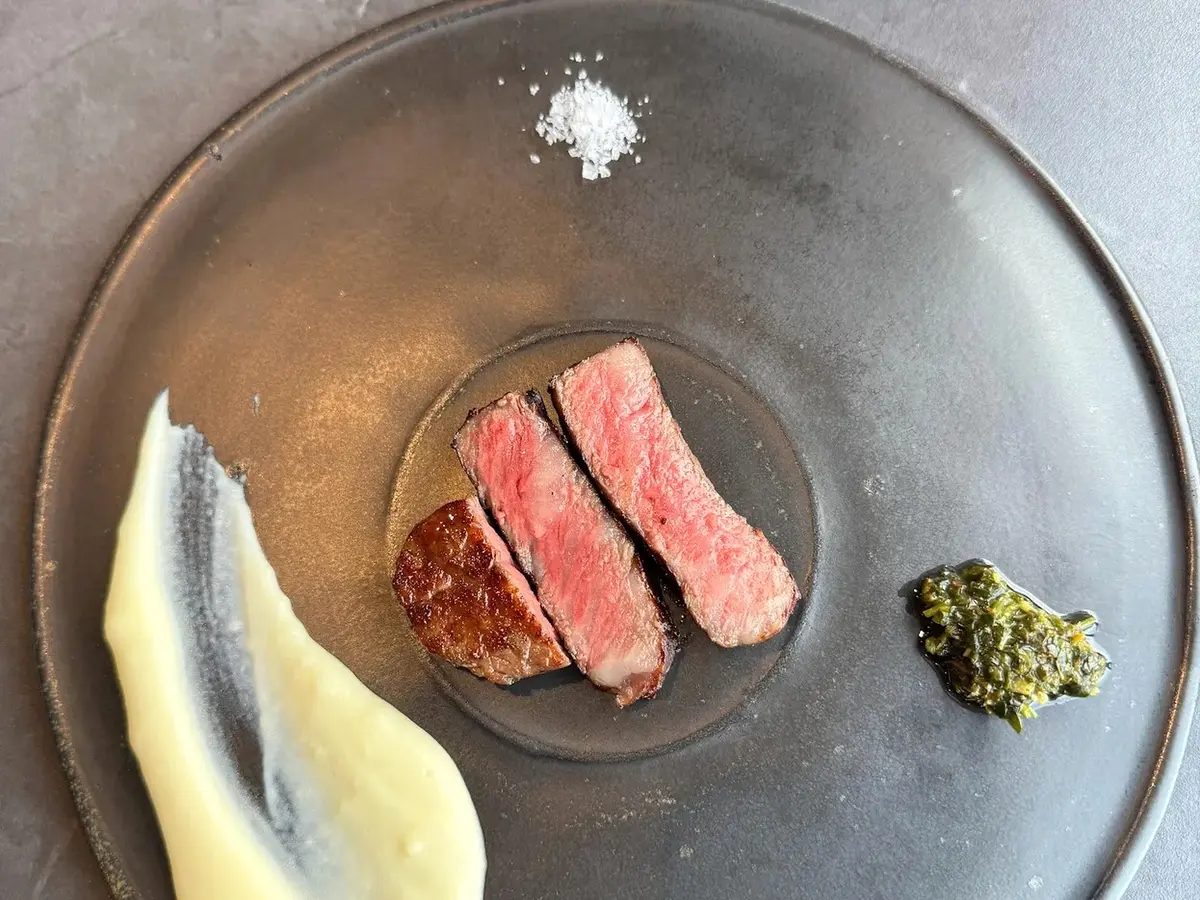
For a traveller with an afternoon at the palace behind them, the format matters as much as the grade. Grill houses are gregarious, smoky, and best in a group of four or more. Butcher-restaurants reward those who can read a Korean cut chart. Omakase is the most language-agnostic path: the chef makes the cut choices, controls the doneness, and paces the meal in courses that suit a foreign guest who does not want to negotiate over a grill. A first-timer's guide to choosing between courses is a sensible pre-read; see our first-timer's guide to Hanwoo omakase courses for how the tiers differ.
If you would rather see how a broader neighbourhood dinner map fits together, a local's picks for dinner around Gyeongbokgung and Jongno covers samgyetang, ox-bone soup, royal-court cuisine and Hanwoo omakase in one route.
What Should You Know About Grade 1++ and Aging?
The two variables that separate a serious Hanwoo restaurant from a merely competent one are grade sourcing and aging discipline. On sourcing: because grade 1++ covers BMS 7 to 9 and No. 9 is its top band, and because that band is a small fraction of the national kill, restaurants that claim BMS No. 9 across every cut are making a supply commitment, not a marketing claim. Ask, and any credible house will show you paperwork.
On aging: Korean restaurants generally use one of two methods. Dry aging exposes primal cuts to controlled cold air for weeks, concentrating flavour and losing weight to evaporation. Wet aging vacuum-seals the meat and allows enzymatic tenderisation without weight loss or the characteristic funk of dry aging. For heavily marbled Hanwoo, wet aging is often preferred because it preserves the delicate fat structure that gives BMS No. 9 beef its texture, while giving the muscle four weeks or so to relax. Neither method is intrinsically better; they suit different beefs and different chefs.
Getting Back to the Palace District Afterwards
One practical point about Jongno dinners: last trains on Lines 1, 3 and 5 run until roughly midnight, and taxis are easy to hail on Jongno itself at almost any hour. If you are staying near Bukchon or Samcheong-dong, a taxi from Jongno back to Anguk takes about ten minutes; on foot it is fifteen to twenty. If you are heading to Myeongdong or Euljiro, walk south across Cheonggyecheon; the stream itself is a restored 5.84-kilometre walk and makes a slow, pleasant post-dinner amble in warm weather.
For a longer view of how the palace, the hanok villages, the stream and dinner join up into a full day, a one-day itinerary from Gyeongbokgung to Cheonggyecheon traces the route in the order most visitors find comfortable.
Ending Your Day in Jongno
KUT SEOUL is 20–25 minutes on foot from Gyeongbokgung, or about 10 minutes on Line 3 to Jongno 3-ga — 3F Hanol Tower, 96 Jongno, next to Tapgol Park. Counter seats take the Posh course (₩175,000); private rooms start from Posh at weekday lunch, Signature (₩210,000) at dinner and on weekends, up to Royal (₩280,000); on weekdays the 8-dish ₩69,000 lunch runs 80 minutes at the counter. Reservation only on CatchTable — which seat suits your evening.