Walk into a butcher's window on a Jongno side street, or read the first page of a Hanwoo omakase menu in Gangnam, and you will see the same shorthand: two characters, sometimes three. 1++. Occasionally a letter after it — 1++ A. Sometimes a further number in small type: *BMS No. 9*. To a Korean diner these markings are as legible as a wine vintage. To a visitor, they can look like a code without a key.
The code is not arbitrary. Korea has graded every carcass of beef sold in the country through a single national system since 1992, and the marks on the menu correspond exactly to marks stamped on the carcass at the slaughterhouse. Understanding what they mean turns an opaque price tag into a legible one, and turns a menu written in the vocabulary of Korean beef into something you can read confidently.
This guide explains the quality grade and the yield grade, the marbling score behind them, why grade 1++ is really three tiers in one, and how to read all of this on a real Seoul menu.
Who Grades Hanwoo, and How?
Every carcass of Korean beef is graded at the slaughterhouse by a government-affiliated body — the Korea Institute for Animal Products Quality Evaluation, usually abbreviated KAPE — before the meat enters distribution. KAPE ranks every carcass on two scales: a quality grade that looks at marbling, meat color, fat color and texture and runs from 3 at the bottom up through 2, 1, 1+, and 1++ at the top, and a yield grade that evaluates how much usable meat the carcass produces, labeled A, B, or C.
The two grades are independent. A carcass can score at the top of one and the middle of the other. When you see a butcher's sign that reads *1++ A*, you are looking at the highest quality grade paired with the highest yield grade — a rare combination on a single animal.
The quality grade is determined mainly by the marbling score, and additionally by color of lean meat and fat, texture and firmness of lean meat, and maturity of the exposed longissimus dorsi muscle at the 13th rib interface. In practice, marbling does the heavy lifting: the other factors adjust the result, but the amount and fineness of intramuscular fat is what sets the tier.
At KUT SEOUL in Jongno, that sequence is served from ₩69,000 for an 8-dish weekday lunch at the counter — see what is in a Hanwoo omakase, cut by cut.
What Is BMS, and Why Does It Matter?
BMS stands for Beef Marbling Standard. It is a visual chart with nine reference patterns, numbered 1 to 9, that map onto the cross-section of the rib eye after the carcass is opened at the 13th rib. On the standard, 1 means devoid of intramuscular fat and 9 means very abundant. Under the pre-2019 scheme, BMS No. 8 or 9 corresponded to grade 1++, No. 6 or 7 to grade 1+, No. 4 or 5 to grade 1, No. 2 or 3 to grade 2, and No. 1 to grade 3.
That mapping was the standard for years. It changed at the end of 2019. The Korean government changed the beef grading system from December 1, 2019, and one of the revisions widened the range of BMS scores that fall inside grade 1++. Since 2004 the beef marbling index in Korea has comprised nine beef marbling standards, and their combinations yield five quality grades — 1++, 1+, 1, 2 and 3; after the revision, quality grade 3 includes BMS 1, quality grade 2 includes BMS 2 and 3, quality grade 1 includes BMS 4 and 5, quality grade 1+ includes BMS 6, and quality grade 1++ includes BMS 7, 8 and 9.
The practical consequence, and the reason travelers should care: since the reform, the raw BMS number must be displayed alongside the quality grade. That is why a well-run Seoul restaurant will write *1++ (No. 9)* on its menu rather than simply *1++*. Two carcasses can both be graded 1++ and be very different pieces of meat — one at BMS 7, one at BMS 9. The number tells you which.
The Grade Table, at a Glance
| Quality grade | BMS score (since Dec 2019) | Marbling character |
|---|---|---|
| 1++ | 7, 8 or 9 | Fine, abundant intramuscular fat |
| 1+ | 6 | Generous marbling, cleaner finish |
| 1 | 4 or 5 | Moderate marbling, beef-forward |
| 2 | 2 or 3 | Light marbling, leaner |
| 3 | 1 | Minimal marbling |
The yield grade sits alongside this, on its own axis. Carcass yield grade is classified on a scale of A, B, or C depending on a yield index calculated from carcass weight, back-fat thickness, and ribeye area. Yield grade does not describe how the beef will taste — a lean carcass produces more usable meat per kilogram, so grade A tends to correlate with less marbling. For eating quality, the quality grade and the BMS number are the figures to read; the yield grade matters more to butchers and traders than to diners.
Why Is Grade 1++ Not One Thing?
Because of the December 2019 revision, three different marbling scores now live under the same 1++ headline. Quality grade 1++ includes BMS 7, 8, and 9. BMS 7 is already exceptional beef by any global standard; BMS 9 is the maximum, with fat woven so finely through the muscle that the lean almost disappears under it.
The gap between BMS 7 and BMS 9 is not a rounding error. It is the difference between rich beef and something closer to a study in fat. Grade 1++ muscles had the highest fat contents in analyses of Hanwoo striploin, followed in descending order by grade 1+, 1, 2, and 3 — understandable because the most predominating parameter to determine the quality grade is intramuscular fat content. Within the 1++ band itself, a BMS 9 carcass sits at the top of that curve.
This is why the more careful restaurants and butchers name the BMS number as well as the quality grade. A menu that reads *Hanwoo 1++ BMS No. 9* is telling you the meat is at the ceiling of the Korean grading system — not just at the top tier, but at the top of the top tier.
How Do You Read This on a Seoul Menu?
Most premium restaurants in Seoul follow the same convention. The quality grade comes first, in a large character; the BMS number, when disclosed, follows in parentheses or in smaller type. A menu that names both is being transparent about what it is serving. A menu that names neither is asking for trust — sometimes deservedly, sometimes not.
A short glossary of what you are likely to see:
- *한우 1++ (No. 9)* / *Hanwoo 1++ (No. 9)*: top quality grade, top marbling score. The tier expected at a premium Hanwoo omakase counter.
- *한우 1++ (No. 7)*: also 1++, but at the entry of that band. Still excellent beef.
- *한우 1+*: one step below, with BMS 6. Common in mid-range Korean barbecue.
- *등심 1++ / 안심 1++*: the same grade attached to a specific cut — *deungsim* is sirloin, *ansim* tenderloin.
The yield grade letter is less often printed on restaurant menus than on butcher windows. When it appears, treat it as supplementary information about the carcass, not about how the meat will eat.
For a broader introduction to Hanwoo as a category — how it differs from Japanese Wagyu, what to expect on the plate — our traveler's guide to Hanwoo covers the essentials. This article stays with the grading system itself.
Where Does Aging Fit In?
Grading happens at the slaughterhouse, within 24 hours of slaughter. Aging happens afterward, at the restaurant or the specialist butcher, and it is a separate variable. A carcass graded 1++ BMS No. 9 can be served fresh, or it can be aged — dry-aged in a controlled cabinet, or wet-aged in vacuum packaging under refrigeration. The grade does not change; the eating experience does.
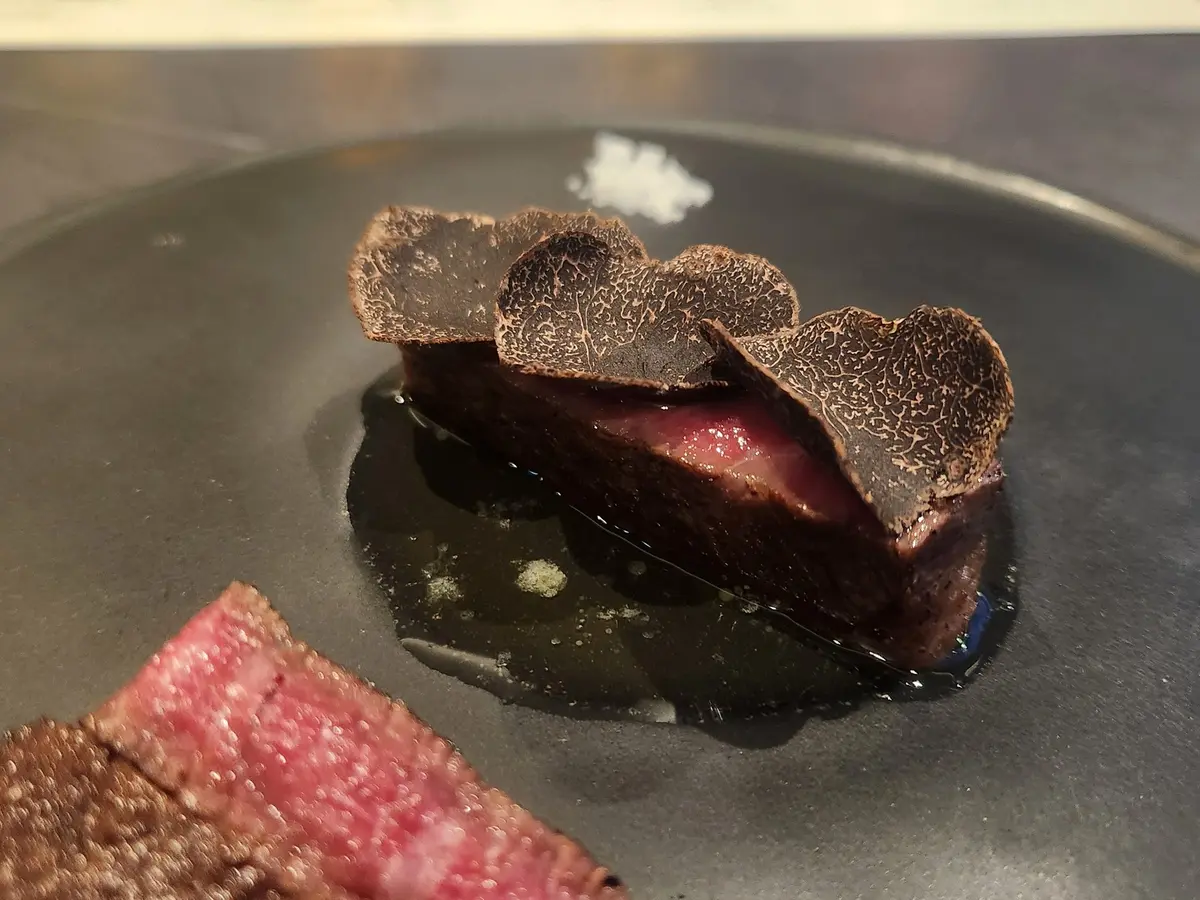
For a high-marbling carcass at BMS 8 or 9, wet aging is often the more considered choice. Dry aging concentrates flavor by drawing moisture out and encouraging enzymatic breakdown at the surface — a technique that suits leaner beef and produces a pronounced, nutty character. Wet aging, by contrast, keeps the meat sealed in its own moisture, protecting the delicate intramuscular fat that gives 1++ Hanwoo its identity, while enzymes still tenderize the muscle from within. For a full account of how one Jongno restaurant handles this — and why it chose wet aging for its Hanwoo — see our note on wet aging versus dry aging.
How Does Hanwoo 1++ Compare to Japanese Wagyu?
A fair question, and one worth answering carefully. The two systems are not equivalent, and the meat is not the same. Korea grades beef on a 1++ to 3 scale with 1++ at the top; Korean 1++ roughly corresponds to BMS 7–8 in the Japanese system — high quality, but not reaching the extremes of Japanese A5 BMS 10+.
That is a technical statement about marbling scores. It is not a value judgment. Japanese A5 Wagyu at BMS 10, 11 or 12 carries more intramuscular fat than any Hanwoo — often dramatically more. Hanwoo at 1++ BMS No. 9 is designed for a different kind of meal: multi-cut, longer-form, with rice and side dishes and the possibility of a second serving. The fat is present and generous, but not to the point where two slices are the entire meal.
Which is why 1++ Hanwoo, and specifically BMS No. 9 within it, is the tier that anchors Seoul's Hanwoo omakase scene. It has the marbling to justify the ceremony, and the balance to sustain a thirteen- or fifteen-course tasting menu without exhausting the palate.
A Note on the Grade at KUT SEOUL
BMS No. 9 Hanwoo, vacuum (wet) aged four weeks — not dry-aged. Grades run 3/2/1/1+/1++; since December 2019, 1++ covers marbling scores 7–9 and the number is displayed. KUT serves No. 9 only.
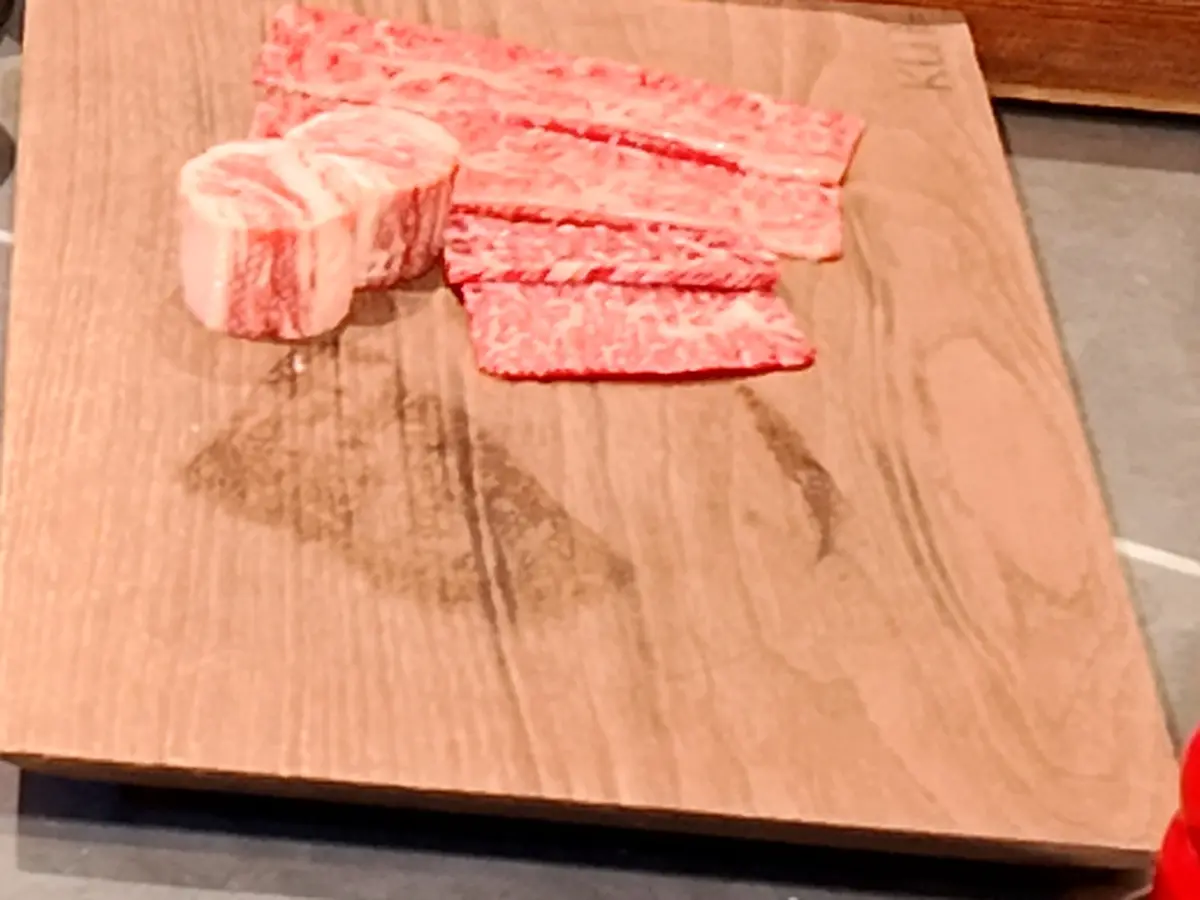
Every cut on the menu — from tenderloin and sirloin through Châteaubriand and the specialty cuts served in the longer courses — is drawn from the same grade. The number is not a marketing flourish; it is the entry ticket for the kitchen's aging program and the reason the courses can be built around a single carcass tier rather than a mix of grades.
For the practical questions of how the courses are structured around this grade, our first-timer's guide to choosing a Hanwoo omakase course is the place to start.
Ending Your Day in Jongno
KUT SEOUL is a 3-minute walk from Jongno 3-ga Station (Lines 1·3·5) Exit 15 — 3F Hanol Tower, 96 Jongno, next to Tapgol Park. Counter seats take the Posh course (₩175,000); private rooms start from Posh at weekday lunch, Signature (₩210,000) at dinner and on weekends, up to Royal (₩280,000); on weekdays the 8-dish ₩69,000 lunch runs 80 minutes at the counter. Reservation only on CatchTable — which seat suits your evening.