Among the gastronomic treasures Korea has guarded across centuries, few carry the cultural weight of Hanwoo—the country's native cattle breed, raised under conditions that have made it the centerpiece of Korean fine dining. To the foreign palate trained on American steakhouse cuts or Japanese A5 Wagyu, the first encounter with properly grilled Hanwoo is a small revelation: cleaner, sweeter, and possessed of a distinctly nutty finish that lingers without weight.
For travelers arriving in Seoul with an interest in serious food, Hanwoo deserves the same considered attention one might bring to Burgundy in Beaune or sushi in Tokyo. It is not simply Korean steak. It is a category of its own, with its own grading authority, its own butchery vocabulary, and its own ceremonial logic at the table.
What follows is a guide to understanding Hanwoo before you order it—what it is, how it is graded, how it differs from its more globally famous Japanese cousin, and how to experience it in its most refined form.
What Exactly Is Hanwoo?
Hanwoo (한우, 韓牛) refers specifically to Korea's indigenous cattle breed, raised on Korean soil and graded by the Korea Institute for Animal Products Quality Evaluation (KAPE) under Ministry of Agriculture standards; the Korea Hanwoo Board is the industry's promotion body. It is not a marketing term applied to any beef raised in Korea; the designation is genetic and geographical, protected in a manner comparable to the controls governing Kobe beef in Japan or Aberdeen Angus in Scotland.
The breed traces back more than two millennia. According to records preserved by the [Korea Heritage Service](https://www.khs.go.kr), Hanwoo cattle appear in agricultural and ceremonial contexts as early as the Three Kingdoms period (57 BCE–668 CE), when they served as both draft animals for rice cultivation and offerings in royal rites. For most of Korean history, beef was a rare luxury reserved for nobility and major holidays—a scarcity that shaped the country's deep reverence for the meat and the elaborate vocabulary of cuts that survives to this day.
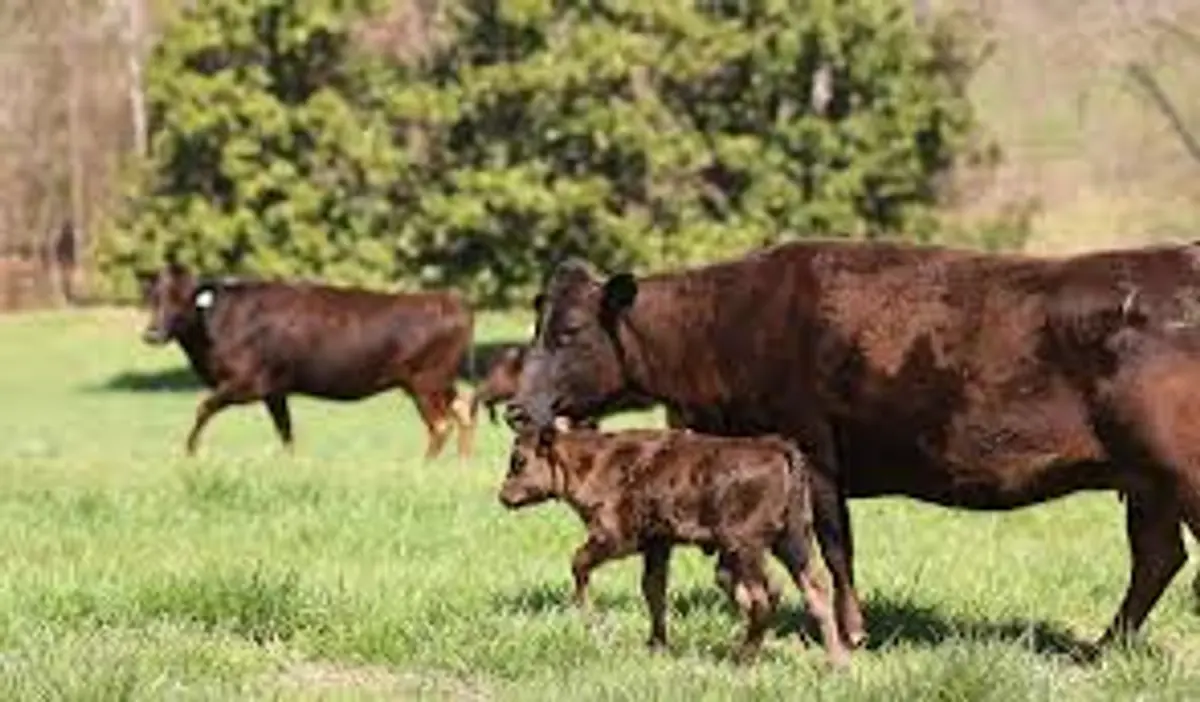
Modern Hanwoo cattle are typically raised for 28 to 32 months on a controlled diet that includes rice straw, grain, and mineral supplements. The result is a meat with intramuscular fat that melts at a lower temperature than beef tallow elsewhere, producing the silken texture for which the breed is known.
How Is Hanwoo Graded?
The short answer: Hanwoo is graded on the Beef Marbling Standard (BMS) from 1 to 9, with BMS No. 9 representing the highest concentration of intramuscular fat and the most prized tier of meat.
The Korean grading framework, administered by the Korea Institute for Animal Products Quality Evaluation, evaluates beef on two axes: a quality grade based on marbling, meat color, fat color, texture, and maturity; and a yield grade based on carcass composition. For travelers, the marbling score is the figure to know.
| BMS Score | Quality Grade (as of September 2026) | Description |
|---|---|---|
| 7–9 | 1++ | Exceptional marbling, reserved for premium dining and omakase |
| 6 | 1+ | Heavily marbled, common in upscale restaurants |
| 4–5 | 1 | Well-marbled, standard for quality grilling houses |
| 2–3 | 2 | Moderate marbling, everyday dining |
| 1 | 3 | Lean, typically for stews and braises |
Since December 2019, grade 1++ spans marbling scores 7, 8 and 9, and the number must be displayed — which is why serious restaurants state the score, not just the grade.
BMS No. 9 (within the 1++ classification) is the tier most often encountered in Seoul's premium omakase establishments. It represents roughly the top several percent of Hanwoo slaughtered in Korea, and its scarcity is reflected in both pricing and the reverence with which it is handled at the table.
Hanwoo Versus Wagyu: A Quiet Distinction
Foreign travelers often arrive expecting Hanwoo to taste like Japanese Wagyu. The two share certain visual cues—generous marbling, rosy flesh, a soft texture—but the flavor profiles diverge meaningfully.
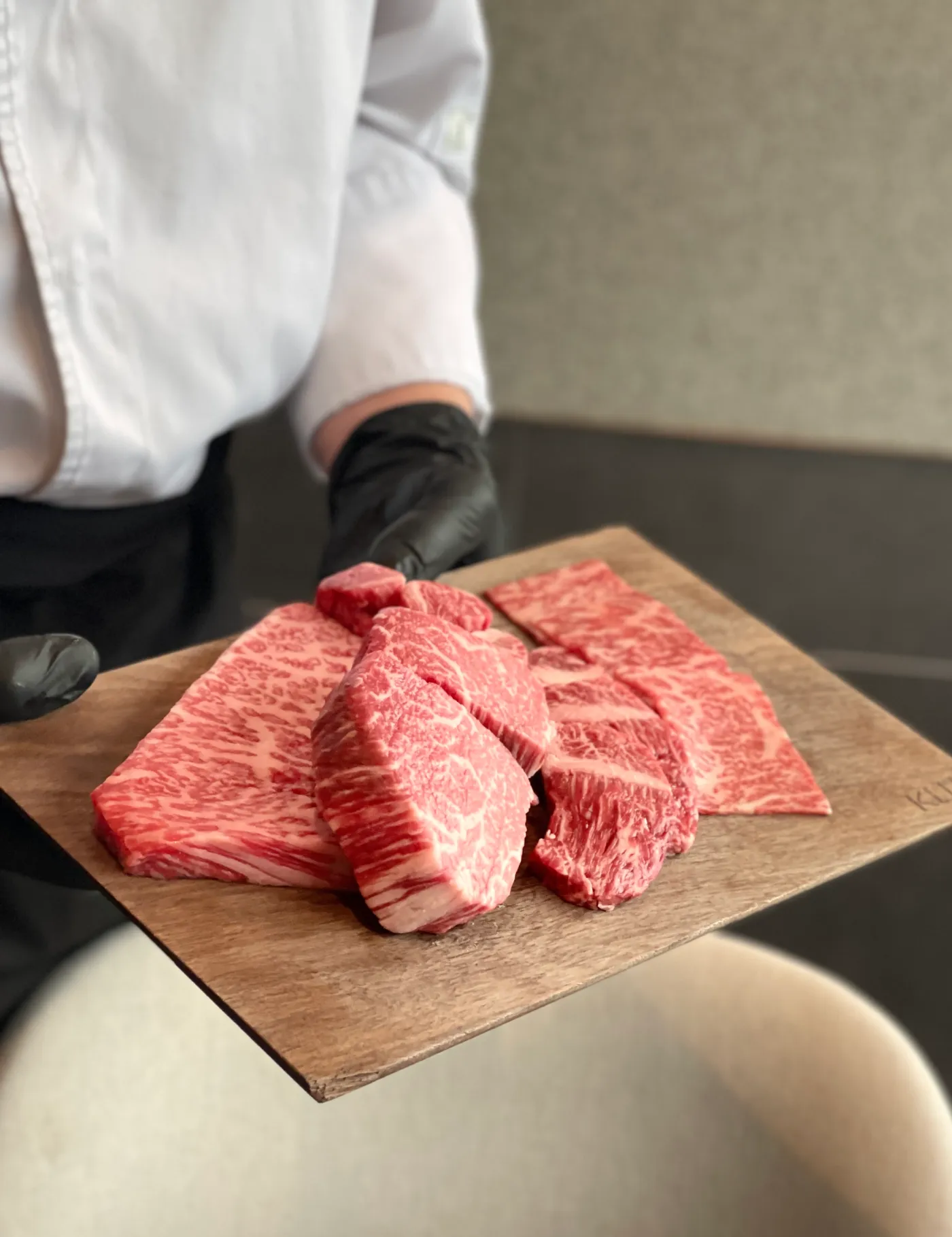
Wagyu, particularly the A5 grades, is defined by an opulent richness; its high oleic acid content and exceptionally fine fat distribution produce a melting, almost buttery sensation that some diners find overwhelming after a few bites. Hanwoo, by contrast, carries less aggressive fat. The marbling is present and abundant at BMS No. 9, but the flavor leans cleaner and noticeably sweeter, with a distinctive nuttiness that emerges most clearly when the meat meets a hot grill.
This nuttiness—often compared by chefs to roasted chestnut or brown butter—is considered Hanwoo's signature. It is most pronounced in cuts grilled briefly over charcoal, served without heavy seasoning so the meat's own character can speak. Where Wagyu invites awe, Hanwoo invites a second piece.
| Attribute | Hanwoo (BMS 9) | Japanese Wagyu (A5) |
|---|---|---|
| Flavor profile | Sweet, nutty, clean finish | Rich, buttery, intensely fatty |
| Marbling style | Generous but defined | Ultra-fine, web-like |
| Ideal preparation | Brief charcoal grilling | Brief searing, often raw or near-raw |
| Portion tolerance | Higher; suited to multi-cut tastings | Lower; richness limits volume |
Neither breed is superior in absolute terms. They are different expressions of what premium beef can be, and a serious gastronome will want to know both.
The Cuts That Define Korean Beef
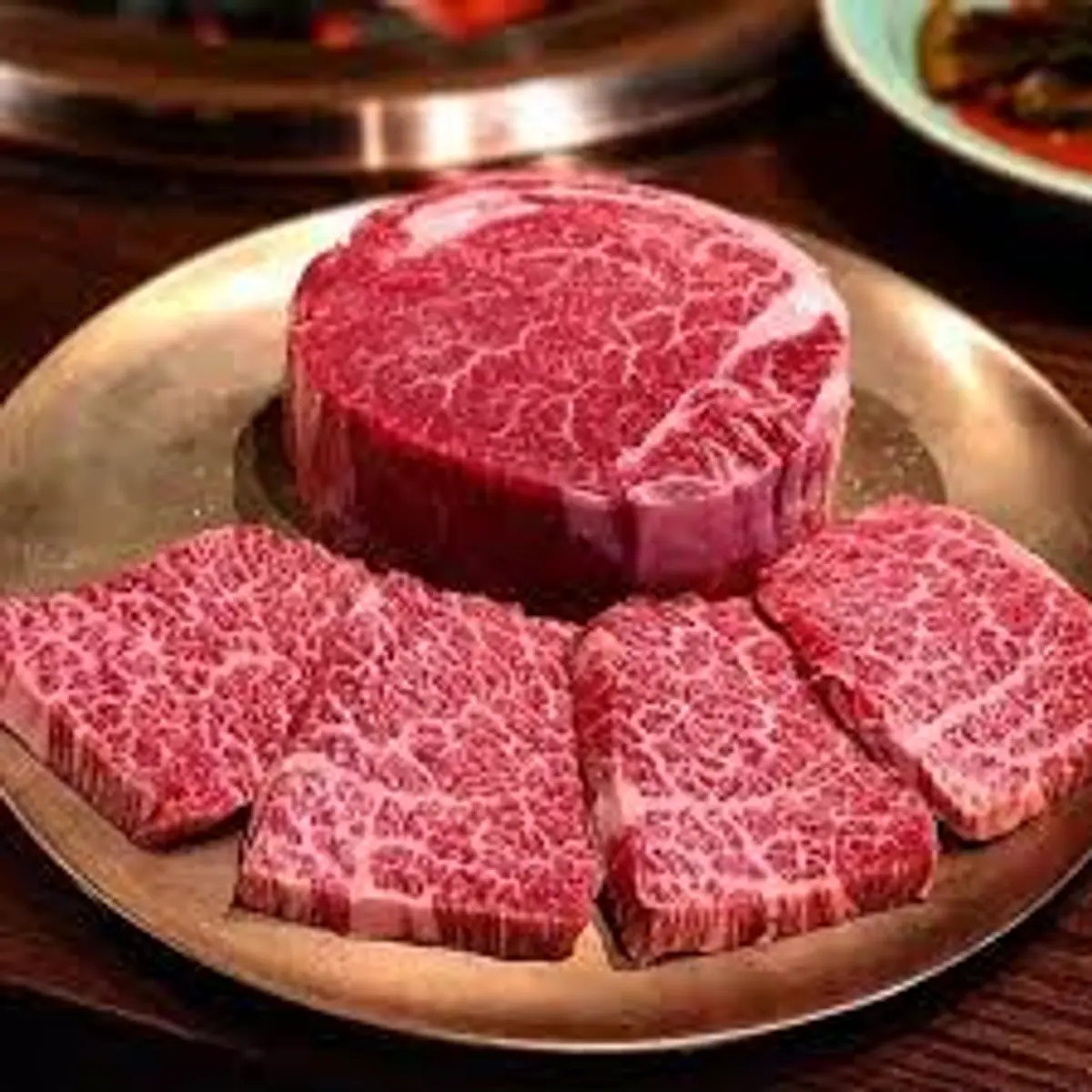
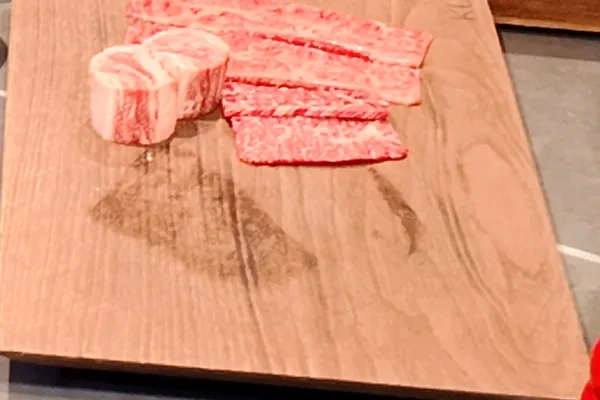
Korean butchery treats the cow with extraordinary granularity—reportedly more than 120 distinct cuts compared to roughly 40 in most Western traditions. For Hanwoo dining, a handful of cuts dominate the premium experience.
**Chuck flap (살치살, salchisal)** is taken from the upper shoulder and is among the most marbled cuts on the animal. It carries the breed's signature nuttiness most clearly and is typically served early in a tasting to set the tone.
**Ribeye (꽃등심, kkotdeungsim)** —literally "flower sirloin" for its blossoming marbling pattern—is the cut most familiar to Western diners. In Hanwoo, the ribeye expresses both depth and elegance, balancing fat with structure.
**Brisket point (차돌박이, chadolbagi)** is the prized end of the brisket, sliced paper-thin and seared briefly. Its rendered fat produces an almost dessert-like richness, and it is often used as a midpoint cut in omakase to refresh the palate's interest.
**Chuck roll (목심, moksim)** sits along the neck and yields slices with a more pronounced beef flavor and a satisfying chew. It is frequently used to close a savory progression before any final rice or noodle course.
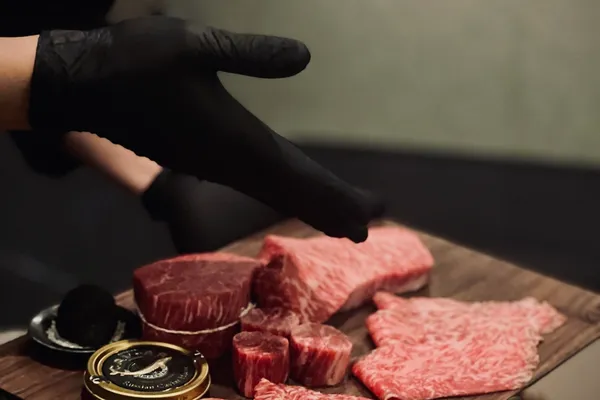
Other cuts—tongue, skirt, tenderloin, and the various inner rib muscles—appear in skilled omakase menus, sequenced to take the diner through a deliberate arc of fat, texture, and intensity.
For the exact sequence served at KUT SEOUL — 8, 11, 13 or 15 dishes from ₩69,000 to ₩280,000 — see every cut in the KUT omakase.
The Omakase Format: Hanwoo at Its Most Considered
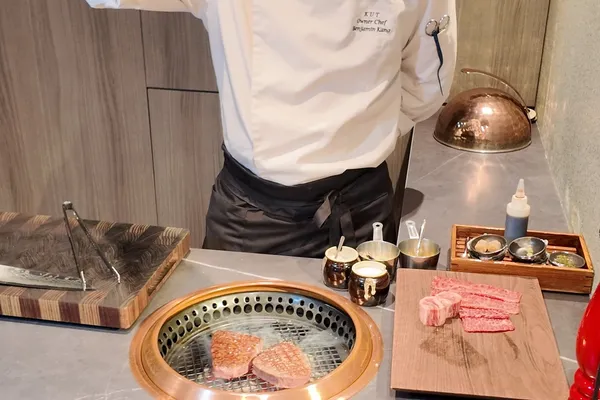
The most refined way to encounter Hanwoo is in an omakase format, where a chef selects and grills a progression of cuts in sequence, often at a counter directly before the diner.
The format borrows its name from the Japanese tradition but has evolved into something distinctly Korean. Rather than a single cut served as a steak, the diner moves through five to ten preparations—each cut chosen to highlight a different facet of the animal. A meal might begin with a delicate slice of tongue or chuck flap, move through ribeye and brisket point, arrive at a more assertive chuck roll, and close with a small course of seasoned rice or cold noodle to settle the palate.
Publications including the [Michelin Guide](https://guide.michelin.com/en/kr/seoul/restaurants) and [Eater](https://www.eater.com) have noted Seoul's emergence as a serious destination for this style of dining, with a generation of chefs treating Hanwoo with the same precision once reserved for sushi or French tasting menus. The format suits the breed: because Hanwoo's fat content is more moderate than A5 Wagyu, a diner can comfortably taste multiple cuts in a single sitting without palate fatigue.
Where Can You Eat Premium Hanwoo in Seoul?
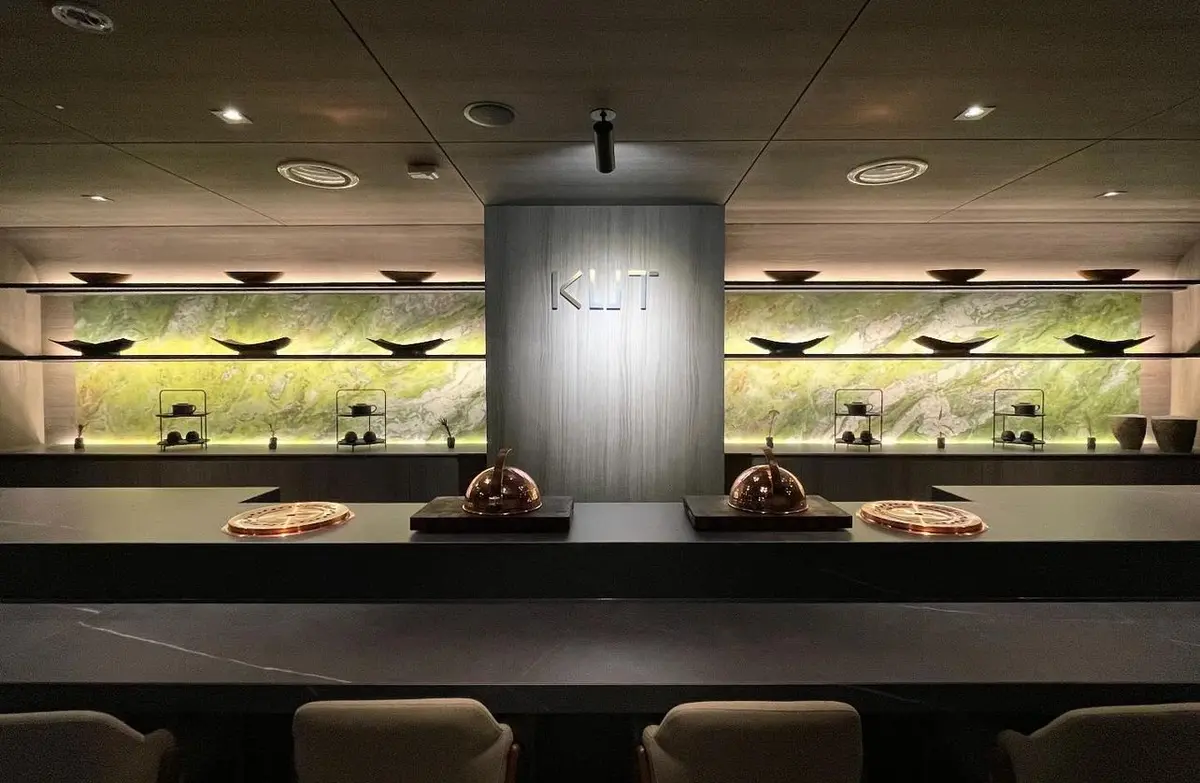
Premium Hanwoo restaurants cluster in several neighborhoods: Gangnam and Cheongdam for contemporary fine dining; Hannam-dong for design-led modern spaces; and Jongno, the old royal quarter, for establishments that frame the meal within a sense of Korean tradition.
For travelers building an itinerary around Seoul's historic core—Gyeongbokgung Palace, Bukchon Hanok Village, Insadong's galleries and tea houses—Jongno offers the rare combination of cultural depth by day and serious dining by night. The neighborhood is well served by Lines 1, 3, and 5 of the Seoul Metro, and most major sights are within a fifteen-minute walk of one another. For how to read a Jongno menu and choose a format, see our Jongno Hanwoo restaurant guide.
When selecting a restaurant, the markers of a serious Hanwoo establishment are consistent: published BMS scores rather than vague claims of "premium beef"; a chef who grills at the counter rather than at the table; a defined cut progression rather than à la carte ordering; and private rooms suited to unhurried conversation.
KUT SEOUL, for example, works only with BMS No. 9 and vacuum-ages every cut for four weeks rather than dry-aging — see Wet-Aged, Not Dry-Aged.
Ending Your Day in Jongno
After an afternoon spent among the pavilions of Gyeongbokgung or the lanes of Bukchon, the natural close to a day in old Seoul is a long, considered dinner nearby.
KUT SEOUL is a 5-minute walk from Jongno 3-ga Station (Lines 1·3·5) Exit 15 — 3F Hanol Tower, 96 Jongno, next to Tapgol Park. Counter seats take the Posh course (₩175,000); private rooms start from Posh at weekday lunch, Signature (₩210,000) at dinner and on weekends, up to Royal (₩280,000); on weekdays the 8-dish ₩69,000 lunch runs 80 minutes at the counter. Reservation only on CatchTable — which seat suits your evening.
KUT SEOUL: Bar 8 dishes ₩69,000 (weekday lunch, counter only, 80 min) · Posh 11 ₩175,000 · Signature 13 ₩210,000 · Royal 15 ₩280,000 · Kids ₩45,000 (ages 7 and under). Signature and Royal are private-room only; Posh is also served in a private room at weekday lunch (counter at weekday dinner and on weekends and holidays). BMS No. 9 Hanwoo, vacuum (wet) aged four weeks — not dry-aged. Grades run 3/2/1/1+/1++; since December 2019, 1++ covers marbling scores 7–9 and the number is displayed. KUT serves No. 9 only.
3F Hanol Tower, 96 Jongno — 5–7 minutes from Jongno 3-ga Station (Lines 1·3·5) Exit 15 or Jonggak Station (Line 1) Exit 4; next to Tapgol Park; 20–25 minutes on foot from Gyeongbokgung. Lunch 11:30–15:00 (last order 14:30), dinner 17:30–22:00 (last order 19:30), closed Tuesdays. Reservation only, through CatchTable or Naver. Deposit is 100% of the order; cancellation is free two days before, 50% one day before, none on the day.
For travelers seeking to understand Hanwoo not as a curiosity but as one of Korea's defining culinary achievements, an evening here serves as a fitting conclusion—both to a day in Jongno, and to the broader question of what Korean beef, at its most considered, can be.