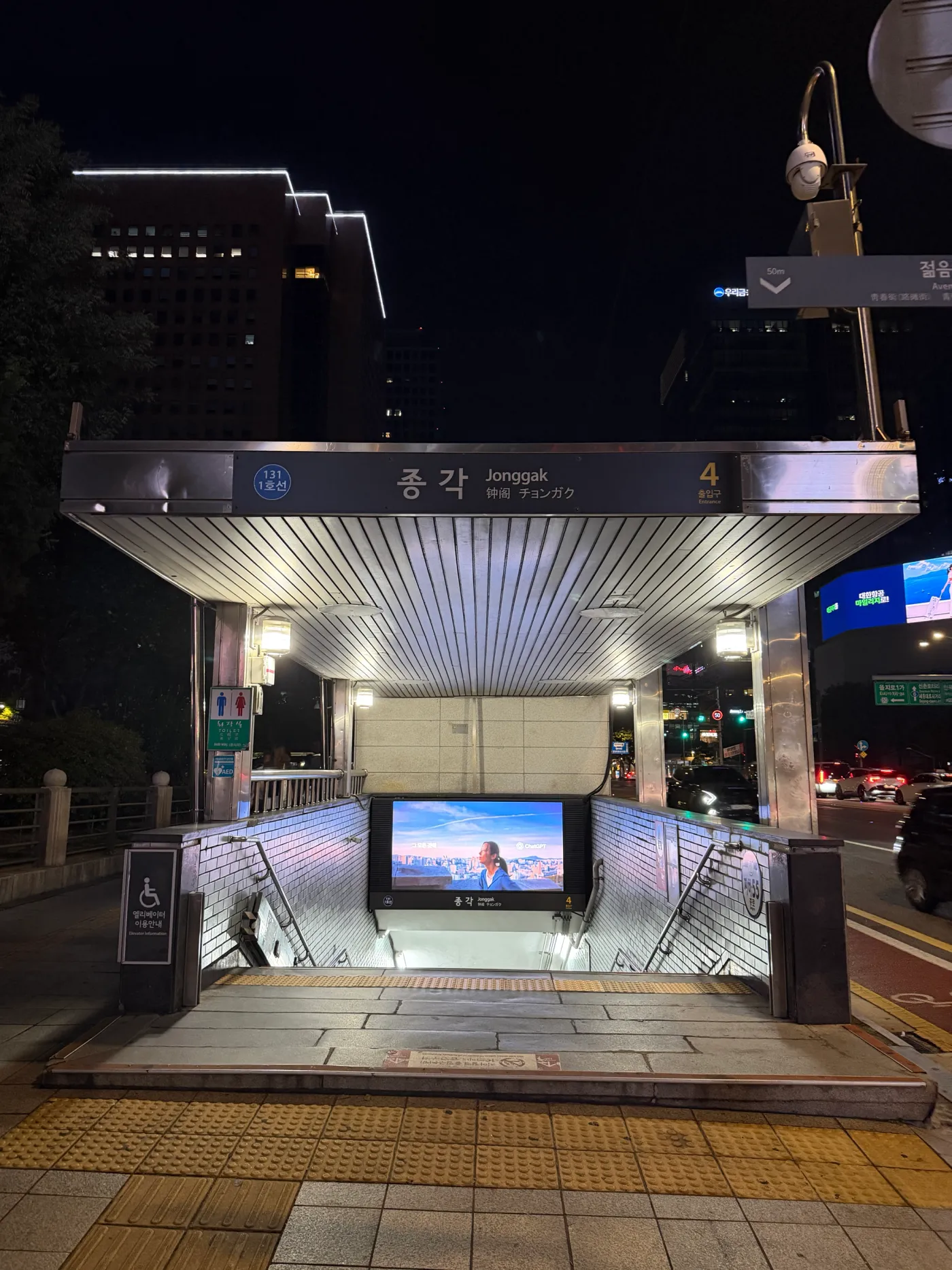
Step out of Jonggak Station and the first thing you see is a two-storey pavilion of red pillars and green eaves, marooned on a corner between glass towers. This is Bosingak — the bell pavilion that named a street, a district, and, in a quiet sense, the rhythm of an entire capital. Six hundred years ago its bronze bell told Hanyang when to sleep and when to wake. Today it stands almost unnoticed by the commuters flowing past its base.
Jonggak is not the flashy end of Jongno. The neighbourhood immediately around Exit 4 is office buildings, old bookstores, ginseng shops, and a scatter of restaurants that have quietly survived the district's changes. It rewards a slow evening: a look at the pavilion before the light goes, a walk east along the old bell street, then dinner in one of the small upstairs rooms that Jongno hides so well.
This guide is written for travellers who want to end the day in old Jongno rather than the tourist grid of Insadong or Bukchon. The route is short — barely a kilometre from bell to table — but it moves through six centuries of the city.
What Is the Bosingak Bell, and Why Does It Matter?
Bosingak is the pavilion whose bell gave Jongno its name. In English, Jongno means Bell Street, and the bell in question hung here from the earliest years of the Joseon dynasty.
The original pavilion dates to 1396, in the reign of Taejo, the first Joseon king. In the Joseon period the bell was struck to announce the opening and closing of the four great gates around the capital: 33 tolls at dawn to open them, 28 at night to close them. It was also used as a fire alarm. The bell measured out the day for everyone who lived within the city walls — a public clock, kept by the government, audible across the whole of Hanyang.
The pavilion was destroyed and rebuilt many times over the centuries by war and fire. Emperor Gojong gave it the name Bosingak in 1895. The structure you see today is a reconstruction from 1979, in the traditional red-and-blue-green dancheong palette. The bronze bell inside is not the ancient one either: the original, cast in 1468, is now preserved at the National Museum of Korea, and the bell in the pavilion is a modern replica made in the 1980s.
In ordinary use the bell is silent. It is rung at midnight on New Year's Eve — 33 tolls, a tradition revived in 1953 — and the ceremony is one of the largest public gatherings of the Seoul calendar. On that night, Line 1 trains famously skip Jonggak Station because the crowds are simply too dense to safely load.
A daytime citizen bell-ringing programme normally lets visitors climb the pavilion and take part in a short noon ceremony, but check the official Seoul city schedule before you go: the programme is paused for pavilion renovation work in late 2026, and dates can shift.
Which Exit at Jonggak Station Is Closest?
Exit 4 of Jonggak Station on Line 1 opens directly onto the Bosingak corner. You surface and the pavilion is right there — cross a short forecourt of stone paving and you are at its base.
Jonggak Station is served only by Line 1 (the dark blue line), which runs east–west under Jongno. From Seoul Station it is two stops toward Cheongnyangni; from Incheon Airport the AREX All-Stop or Express to Seoul Station, then Line 1, is the most direct rail route (check the official AREX site for current fares).
A short set of practical facts for the corner:
| Detail | Bosingak / Jonggak |
|---|---|
| Nearest station | Jonggak Station, Line 1, Exit 4 |
| Pavilion address | 54 Jongno, Jongno-gu |
| Pavilion interior | Not open for casual entry; view from the plaza |
| Bell-ringing | Midnight, 31 December (main event); citizen noon programme when scheduled |
| Time to appreciate | 15–25 minutes at the plaza |
There are benches on the pavilion's forecourt, and it is one of the few places on Jongno where the pace slows enough to sit for a moment. The pavilion is floodlit after dark, which makes early evening a particularly good time to arrive — the red columns take the light well against the office towers behind.
KUT SEOUL is a 3-minute walk from Jonggak Station (Line 1) Exit 4 — on weekday lunches its 8-dish ₩69,000 Bar course runs 80 minutes at the counter, reservation only.
A Walking Route from Jonggak to Old Jongno
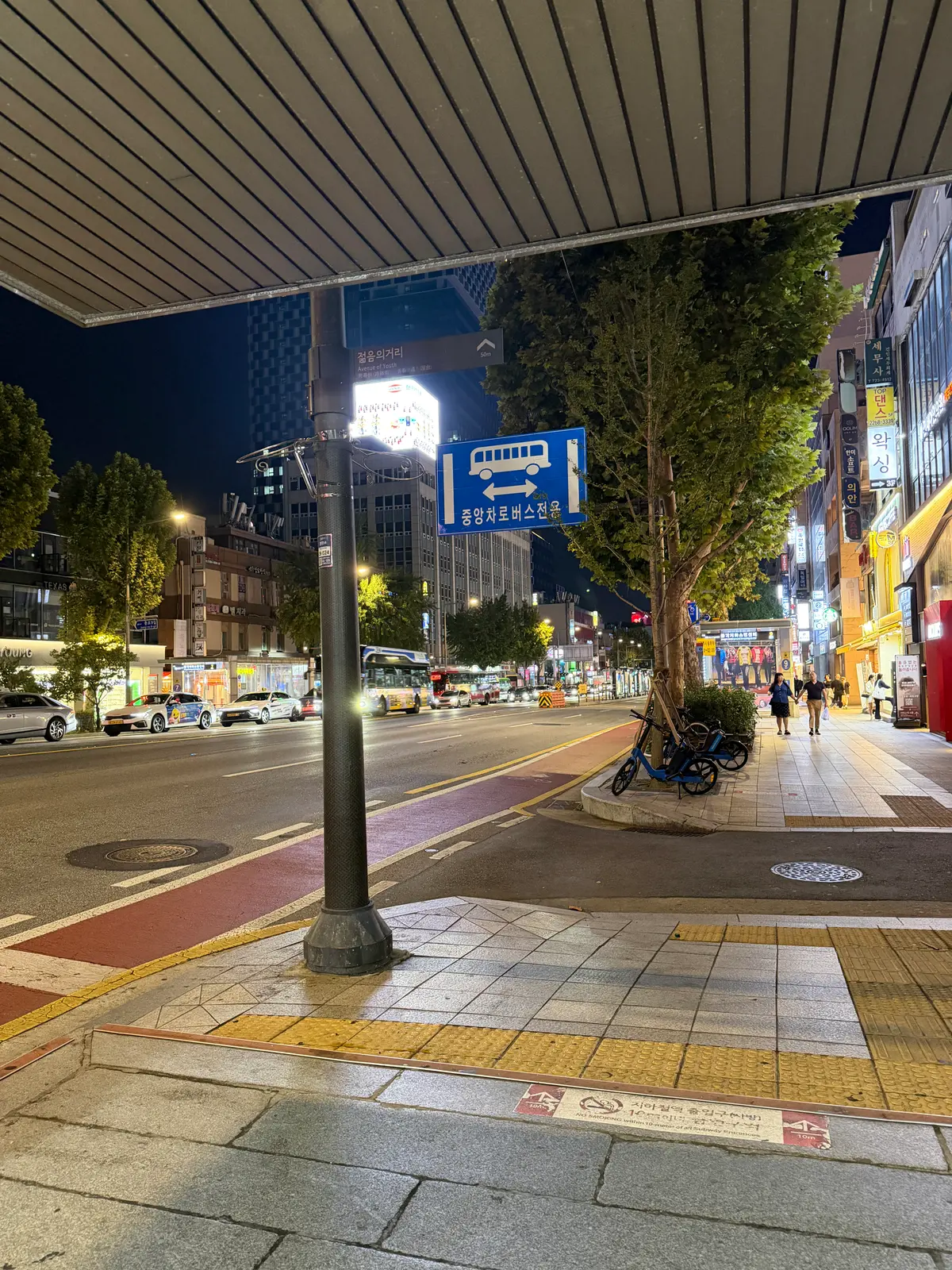
From the Bosingak corner, turn east and walk along Jongno itself — literally along the bell street the pavilion named. Within a few minutes you pass Jongno Tower on your left, then a stretch of small shops selling ginseng, herbal medicine, glasses and camera gear that has changed remarkably little in twenty years.
About five minutes on, you reach Tapgol Park on your left. This is where the March 1st Independence Movement was declared in 1919, and its ten-storey Wongaksa Pagoda from 1467 sits under a modern glass canopy at the centre of the grounds. The park is small — a single, quiet block — but it is one of the most historically dense pieces of ground in the city. It is open 09:00–18:00 March to October and 09:00–17:00 November to February, free of charge (as of 2026-09).
Across Jongno, the southern end of Insadong-gil begins. If you have time, a brief detour north into Insadong for a pot of tea or a look at a stationery shop is worthwhile; on Saturdays after 14:00 and all day Sunday from 10:00 the street is closed to cars, and the atmosphere shifts noticeably.
Back on Jongno, KUT SEOUL is directly beside Tapgol Park, on the third floor of Hanol Tower at 96 Jongno. From Bosingak the walk is about eight to ten minutes at an unhurried pace, or you can simply ride Line 1 one stop east to Jongno 3-ga if the weather is against you. For a deeper wander through the surrounding blocks after dinner, our evening guide to Jongno 3-ga sketches a longer loop.
Where to Have Dinner near Jonggak Station?
The blocks between Jonggak and Jongno 3-ga are one of Seoul's most reliable areas for an unshowy, well-made dinner. Grilled fish houses, old-school jokbal counters, Pimatgol alley taverns and modern chef-led rooms sit within a few minutes of one another. What the Jonggak side lacks in obvious tourist infrastructure it makes up for in longevity — many of the restaurants here have been in place for decades.
For a refined evening within a three-minute walk of Exit 4, KUT SEOUL sits on the third floor of Hanol Tower, its windows overlooking Tapgol Park. It is a Hanwoo omakase in the fuller sense of the phrase: a fixed-course tasting menu built entirely around Korean beef, aged in-house and served in either counter seats or one of five private rooms. If you are weighing seat types before you book, our note on counter seats versus private rooms sets out the practical differences.
KUT SEOUL: Bar 8 dishes ₩69,000 (weekday lunch, counter only, 80 min) · Posh 11 ₩175,000 · Signature 13 ₩210,000 · Royal 15 ₩280,000 · Kids ₩45,000 (ages 7 and under). Signature and Royal are private-room only; Posh is also served in a private room at weekday lunch (counter at weekday dinner and on weekends and holidays).
BMS No. 9 Hanwoo, vacuum (wet) aged four weeks — not dry-aged. Grades run 3/2/1/1+/1++; since December 2019, 1++ covers marbling scores 7–9 and the number is displayed. KUT serves No. 9 only.
Lunch 11:30–15:00 (last order 14:30), dinner 17:30–22:00 (last order 19:30), closed Tuesdays.
Reservation only, through CatchTable or Naver. Deposit is 100% of the order; cancellation is free two days before, 50% one day before, none on the day.
How Should You Time the Evening?
Aim to reach Bosingak by mid-to-late afternoon. Twenty minutes at the pavilion, ten minutes for the walk east along Jongno with a pause at Tapgol Park, and you can be seated at KUT SEOUL comfortably by 17:30 or 18:00 — the ideal early dinner slot for a private room, which runs about three hours from welcoming tea to dessert.
If you are attending the New Year's Eve bell-ringing, plan the reverse. Dinner first, then walk down to the pavilion in the late evening. The crowds around Bosingak that night are dense enough that Line 1 trains skip Jonggak Station entirely, so arriving on foot from a nearby restaurant is easier than trying to fight the transit system.
On any other evening, the area is quiet after office workers head home. The pavilion is lit, the plaza is calm, and old Jongno reveals itself as one of the more meditative parts of central Seoul — a strange, welcome quiet in the middle of a city of ten million.
Ending Your Day in Jongno
KUT SEOUL is a 3-minute walk from Jonggak Station (Line 1) Exit 4 — 3F Hanol Tower, 96 Jongno, next to Tapgol Park. Counter seats take the Posh course (₩175,000); private rooms start from Posh at weekday lunch, Signature (₩210,000) at dinner and on weekends, up to Royal (₩280,000); on weekdays the 8-dish ₩69,000 lunch runs 80 minutes at the counter. Reservation only on CatchTable — which seat suits your evening.