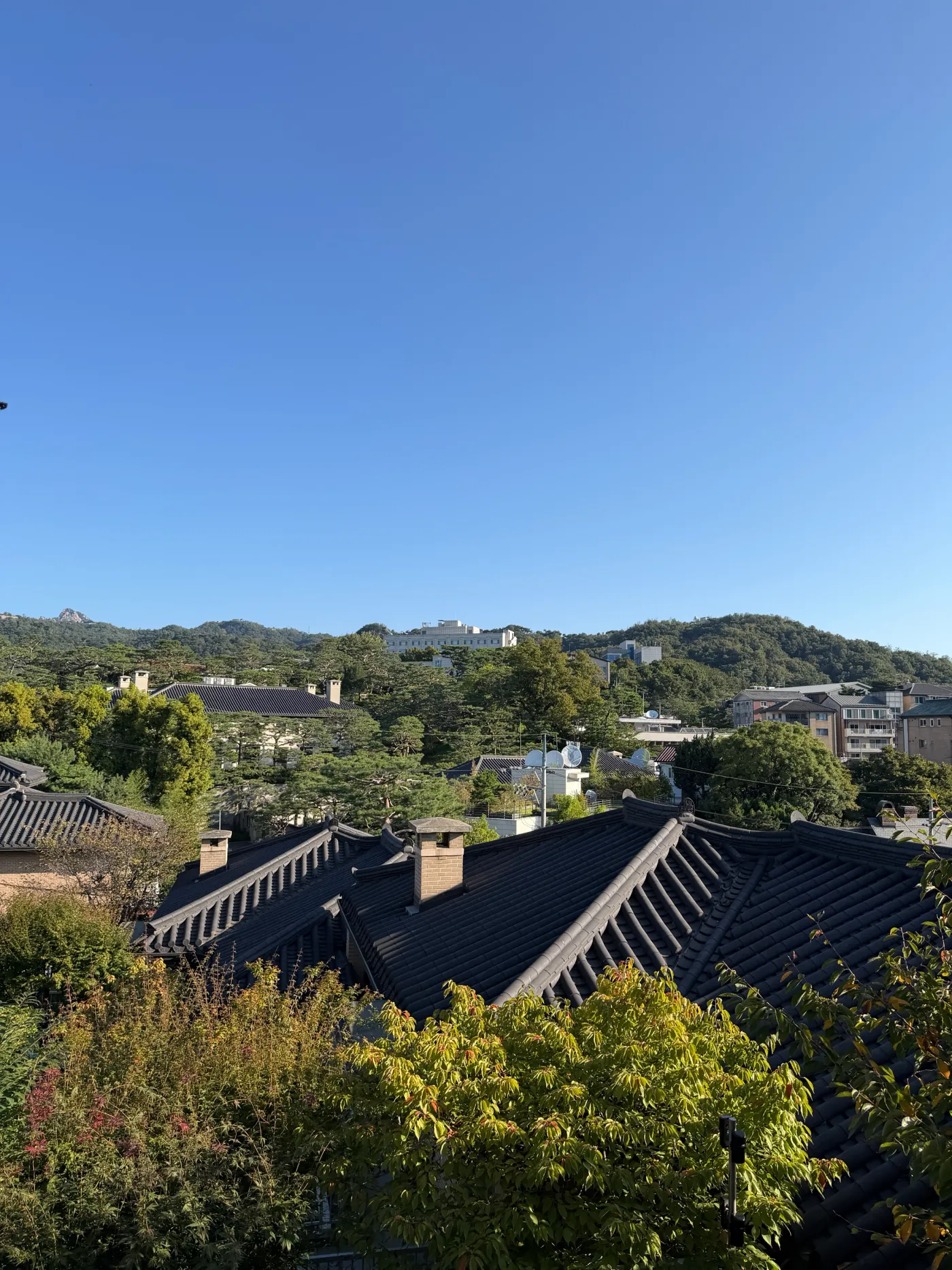
There is a particular moment in Bukchon Hanok Village, just before five in the evening, when the light goes gold across the tiled roofs and the day-trippers begin drifting toward Anguk Station. It is the moment most first-time visitors realise they have not planned dinner. The neighbourhood they came to see is, in a very literal sense, about to close.
Since March 2025, the residential heart of Bukchon — a compact grid of hanok along Bukchon-ro 11-gil — has been off-limits to tourists between 5 PM and 10 AM, with a ₩100,000 fine attached to violations. The rule exists to give the roughly six thousand residents of the Special Management Area their evenings back, and the district's Bukchon Guardians walk the lanes at dusk to enforce it politely. The good news for anyone hungry at 6 PM is that four excellent dining neighbourhoods lie within a fifteen-minute walk downhill: Samcheong-dong to the west, Anguk directly south, Insadong across Yulgok-ro, and Jongno beyond Cheonggyecheon. Each has its own tempo, its own price band, and its own way of ending a day among the hanok.
What follows is a practical guide to eating well after the alleys close, arranged by neighbourhood rather than by restaurant category — because the question is rarely 'what do I want to eat' but 'where do I go next' once the guards have gently turned you around.
What exactly closes at 5 PM, and what stays open?
Only the residential core closes. The commercial edges of Bukchon, along with every restaurant, café and shop on Bukchon-ro, Samcheong-ro and Yulgok-ro, keep normal evening hours.
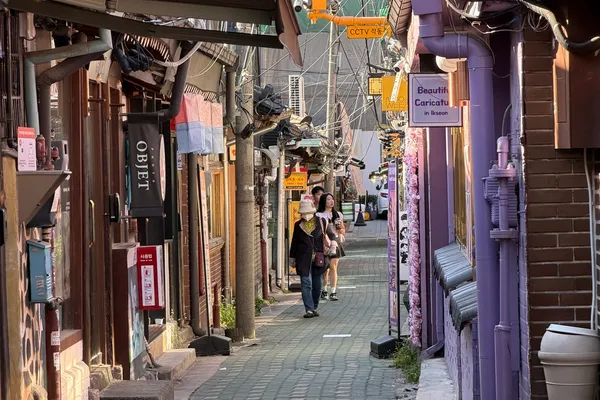
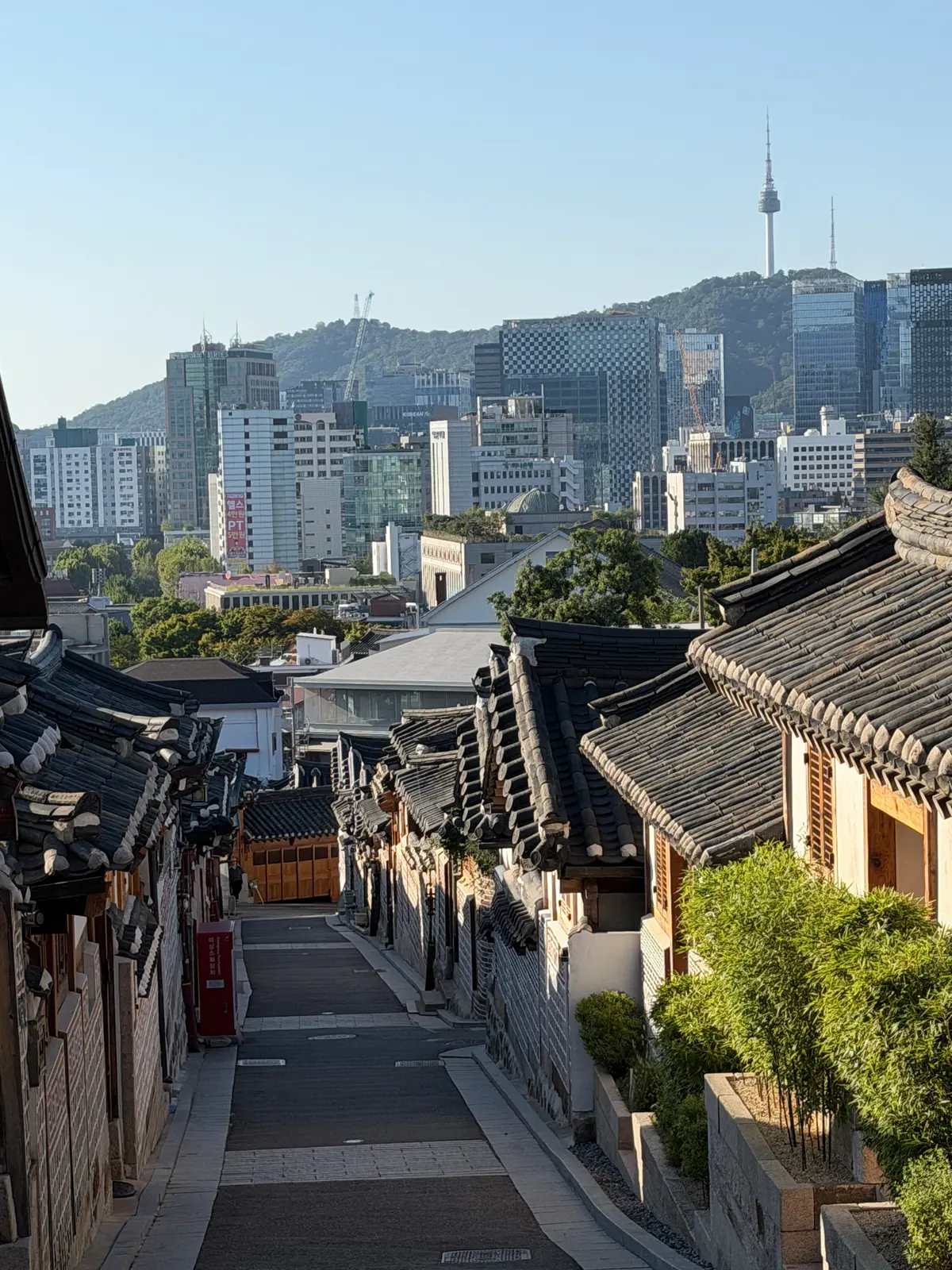
The Seoul Metropolitan Government designated a specific 34,000-square-metre area around Bukchon-ro 11-gil as the Red Zone. Tourist visits there are restricted from 5:00 PM to 10:00 AM the following day, based on Article 48-3 of the Tourism Promotion Act and a Jongno-gu ordinance. Enforcement with the ₩100,000 fine began on 1 March 2025 after a four-month guidance period. This is the photogenic sloping alley almost every Bukchon photograph is taken from — the one that descends toward the N Seoul Tower in the distance. After five, it belongs to the people who live there.
Adjacent lanes are treated differently. Bukchon-ro 5-gil and Gyedong-gil, where hanok sit alongside cafés, shops and restaurants, are classified as an Orange Zone with no time restriction; staff patrol for noise but there is no curfew. Bukchon-ro 12-gil is a Yellow Zone, monitored but unrestricted. In practice this means you can still walk from a Samcheong-dong restaurant back toward Anguk Station in the evening on the main roads and the commercial lanes — you simply cannot wander into the residential grid to look at private houses.
At KUT SEOUL in Jongno, that sequence is served from ₩69,000 for an 8-dish weekday lunch at the counter — see what is in a Hanwoo omakase, cut by cut.
Which exit is closest to dinner from Bukchon?
Anguk Station on Line 3 is the anchor for every dinner option in this guide. Exit 1 for Samcheong-dong and the Bukchon commercial spine; Exit 2 for the walk down to Insadong-gil; Exit 6 for the mouth of Insadong's main pedestrian street.
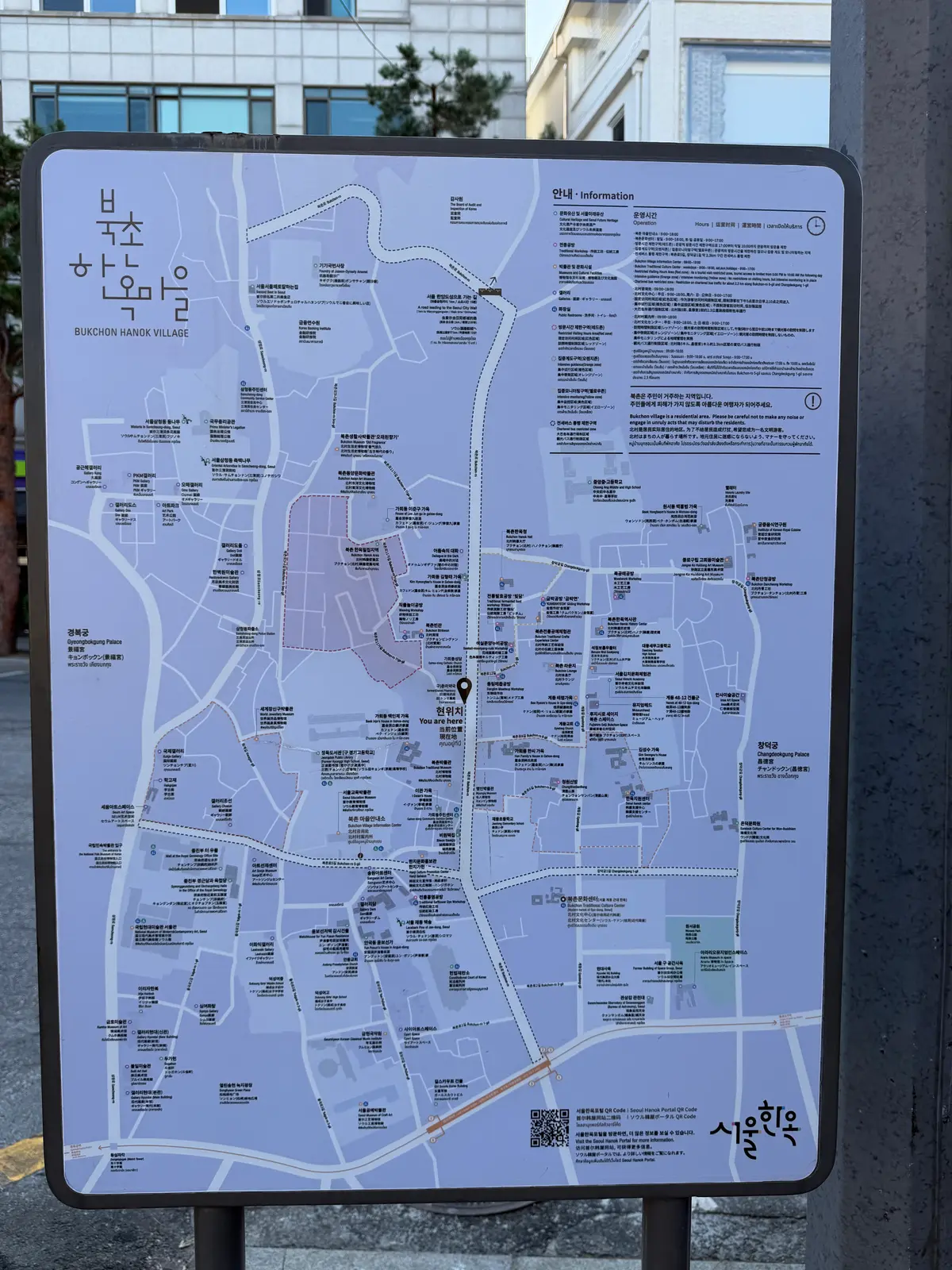
For most Bukchon visitors, the natural post-5 PM move is to walk south along Bukchon-ro or Samcheong-ro back toward Anguk Station, which sits between Insadong and the palaces. From the top of the residential zone this takes roughly ten to fifteen minutes on foot, gently downhill. From Anguk you can reach Samcheong-dong (northwest), Insadong (south across Yulgok-ro), and — with one stop on Line 3 or a short taxi — Jongno 3-ga, which opens onto a very different dining scene of long-standing beef and fish houses.
| Neighbourhood | From Bukchon | Character | Typical dinner window |
|---|---|---|---|
| Samcheong-dong | 5–10 min walk | Hanok restaurants, cafés, wine bars | 17:30–22:00 |
| Anguk / Sogyeok-dong | 5–10 min walk | Noodle houses, bakeries, casual Korean | 11:00–21:00 |
| Insadong | 10–15 min walk | Tea houses, temple cuisine, bossam, hanok BBQ | 11:30–22:00 |
| Jongno 3-ga | 15–20 min walk or 1 stop on Line 3 | Long-standing beef, fish and omakase | 17:30–22:00 |
Samcheong-dong: hanok dining without the crowds
Samcheong-dong is the shortest walk from Bukchon and the most atmospheric option after dark. Restaurants here occupy actual hanok — repaired rather than rebuilt — and the streetscape stays lit well past dinner service.
The northern end of Samcheong-ro shades into a stretch of hanok converted into fine dining rooms, casual Italian counters and traditional tea houses. Hwangsaengga Kalguksu, a knife-cut noodle house that has held a Michelin Bib Gourmand listing since 2017, sits about ten minutes on foot from Anguk Station Exit 1 next to the Blue Bottle Samcheong branch, and is the reliable early-evening choice for a lighter, cleaner meal after a long walk. Its handmade noodles and dumplings are the anchor of the menu, and though it draws a queue at peak hours the two floors of seating move it briskly.
Further up the hill, Samcheong-dong holds a scattering of Korean fine-dining rooms in restored hanok — with soy-marinated crab and hanjeongsik menus that lean on the region's history of aristocratic cuisine. These almost always require reservation for dinner; walking up without one on a Friday night is not a plan. The National Museum of Modern and Contemporary Art (MMCA) is a useful landmark: from its western side, restaurants spread up and along Samcheong-ro for about half a kilometre.
Anguk and Sogyeok-dong: casual, quick, close
If you have children in tow, or simply want dinner within five minutes of the subway, the streets immediately around Anguk Station are the answer. This is the pocket of the city that includes Bukchon-ro 5-gil, Yulgok-ro 3-gil, and the tangle of alleys east of Gyeongbokgung.
Expect casual Korean and comfort food rather than ceremony. Eunseol Seolleongtang draws local office workers for ox-bone soup with the milky, additive-free broth that defines a good seolleongtang, served with the sharp kkakdugi radish kimchi that is the standard side. Mukshidonna Tteokbokki's original branch sits nearby and serves the customisable spicy rice-cake stew that made the chain famous. For dumplings, Kkangtong Mandu — a specialist that has been in the neighbourhood since 1988 — is a low-effort dinner that costs a fraction of hanok dining. All three run continuous service through dinner and none require a reservation for a party of two or three on a weekday.
Insadong: temple cuisine, bossam, tea
Insadong-gil begins directly south of Anguk Station Exit 6 and runs about 630 metres down to the edge of Jongno. It is car-free on Saturdays 14:00–22:00 and Sundays 10:00–22:00, which makes weekend evenings especially pleasant to walk.
Insadong's dinner identity is older and gentler than Samcheong-dong's. Sanchon serves Korean temple cuisine — wild mountain vegetables, porridge, jeon — in a calm, wood-lined room, and remains one of the few places in central Seoul to eat this way at dinner. Insadong Garlic Bossam, in a small alley near Anguk, is the classic choice for boiled pork wrapped in lettuce with a garlic-forward sauce; the room is unpretentious and the service used to English menus. For something quieter, the tea houses along Insadong's side lanes stay open into the evening and offer a natural pause before the walk back to a hotel or a second stop. This is also the natural neighbourhood for a slower Korean set-menu experience, and our half-day walking guide to Insadong covers the tea and stationery detours worth folding in before you sit down.
Jongno: the quiet counter option
Cross Cheonggyecheon and you are in the other Jongno — a working commercial district that hides some of Seoul's most serious beef houses on upper floors. This is where dinner shifts from a walk-in casual meal into something planned.
Jongno historically was the merchants' side of the old city, and its restaurant culture reflects that: long-standing samgyetang houses, century-old ox-bone soup rooms, and a growing cluster of Hanwoo-focused fine dining behind unmarked doors. From Bukchon, Jongno 3-ga is one stop south on Line 3 from Anguk, or about fifteen to twenty minutes on foot along Insadong-gil. Our locals' guide to dinner around Gyeongbokgung and Jongno works through the neighbourhood's classic addresses in more detail — from royal-court kitchens to the century-old soup counters — and is the natural companion to this article if you are willing to walk beyond Anguk for dinner.
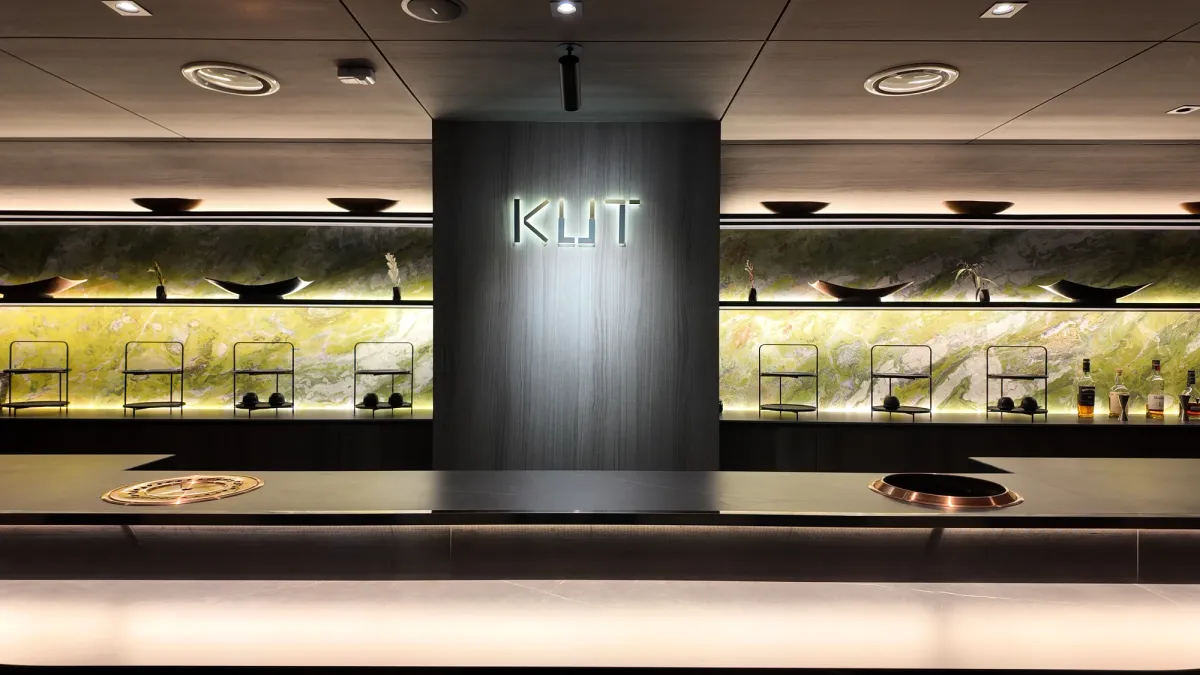
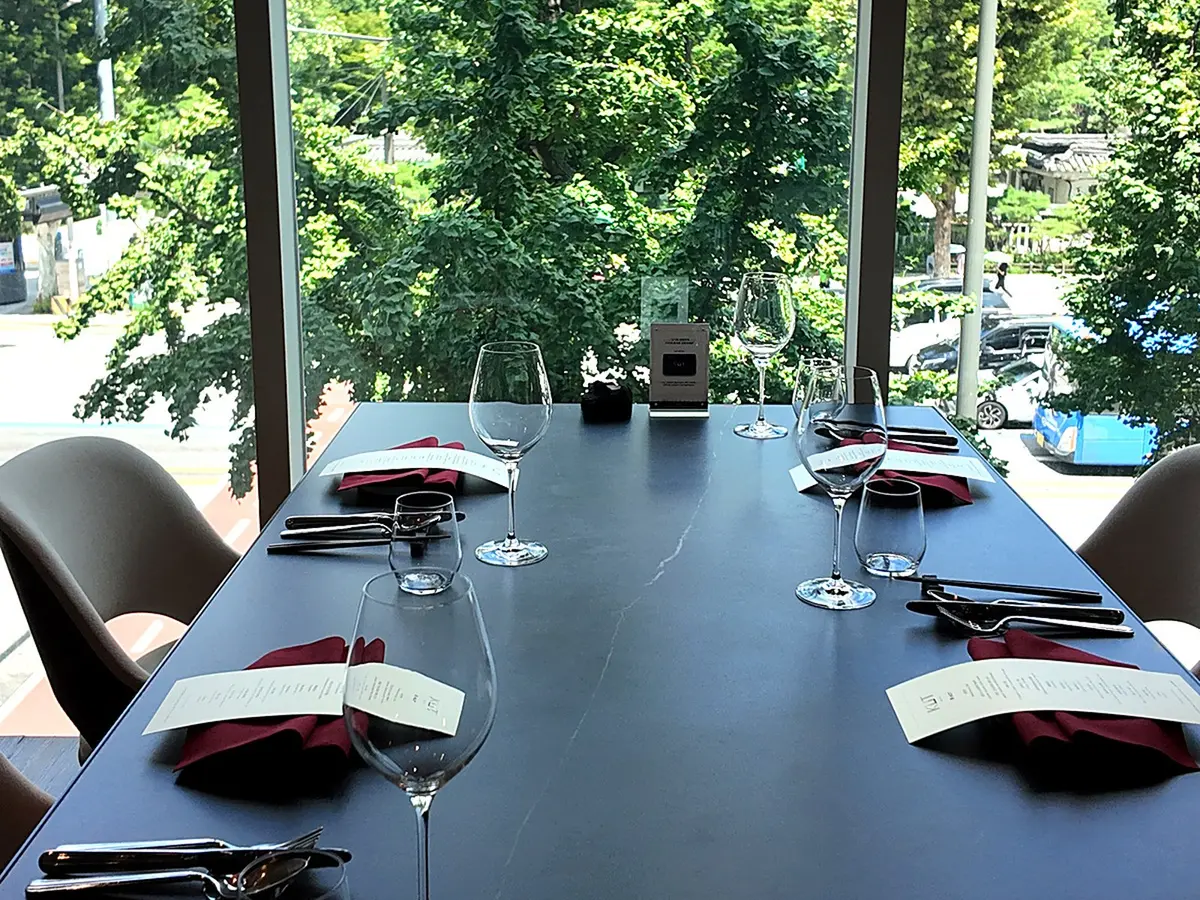
On the Hanwoo end of the spectrum, KUT SEOUL is the most straightforward premium option for anyone coming from Bukchon. It sits on the third floor of Hanol Tower on Jongno, is reservation-only through CatchTable or Naver Booking, and offers both a counter and five private rooms — a useful split when the party is a mix of solo travellers and families.
How do I plan the transition from Bukchon to dinner?
Book first, walk second. Reserve your restaurant for 6:30 or 7:00 PM, plan to leave the residential lanes by 4:45 PM, and use the last daylight for the walk downhill.
A workable rhythm looks like this. Arrive at Bukchon by 2:30 PM at the latest — an afternoon arrival much later than that leaves almost no time inside the Red Zone before the 5 PM cut-off. Spend two hours walking the residential lanes and Bukchon-ro 11-gil, then drift toward the Orange Zone lanes (Bukchon-ro 5-gil, Gyedong-gil) for a coffee or an early aperitif around 4:45. Move to your dinner reservation for 6:30 or 7:00. In autumn and winter this timing lines up with the light: you finish the walk in golden hour, sit down as the streetlamps come on, and leave the restaurant into a quiet neighbourhood rather than a scrum.
One important note on Gyeongbokgung: it is roughly 20 to 25 minutes on foot from Bukchon down to the palace's east gate, and another twenty minutes across to the far side. If you are combining Bukchon with an evening palace visit — Gyeongbokgung runs seasonal night openings, so check the official schedule — dinner is best fitted either before the palace visit or well after, not in between.
Frequently Asked Questions
Ending Your Day in Jongno
KUT SEOUL is about 10 minutes by taxi from Anguk (15+ minutes on foot) — 3F Hanol Tower, 96 Jongno, next to Tapgol Park. Counter seats take the Posh course (₩175,000); private rooms start from Posh at weekday lunch, Signature (₩210,000) at dinner and on weekends, up to Royal (₩280,000); on weekdays the 8-dish ₩69,000 lunch runs 80 minutes at the counter. Reservation only on CatchTable — which seat suits your evening.