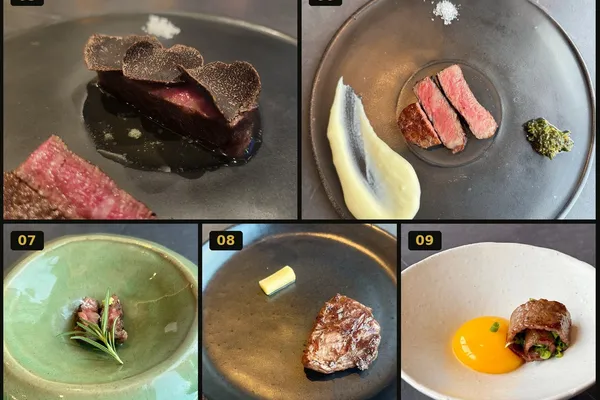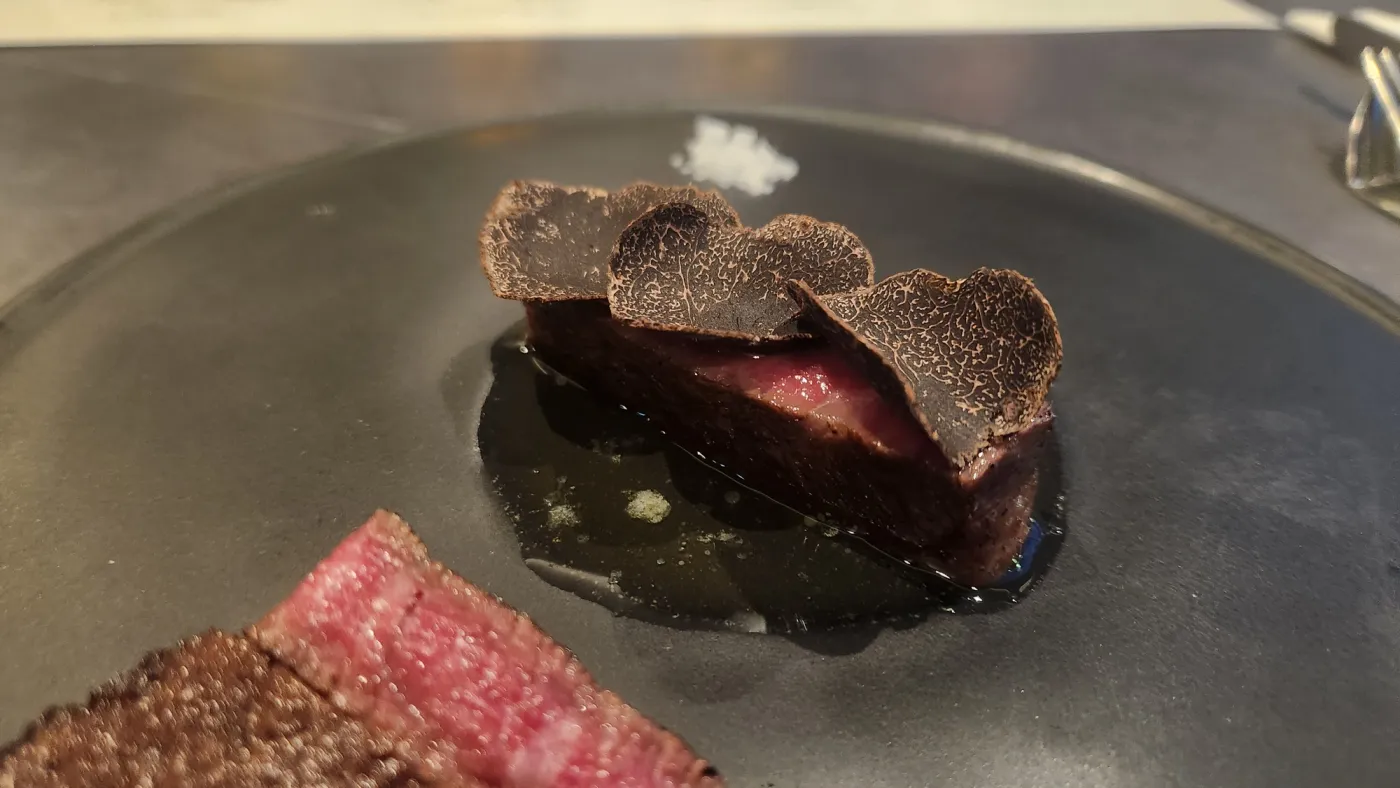
A great bottle at a Hanwoo omakase is not decoration. It is the second voice in a conversation the beef has already started — one that lasts thirteen or fifteen courses, moves from cold tartare through wood-fired Châteaubriand, and asks quite a lot of whatever is in your glass.
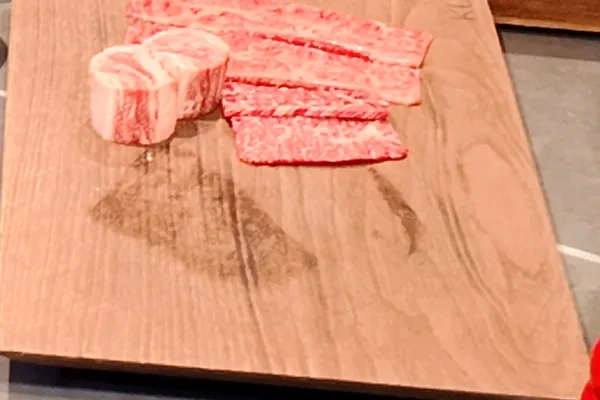
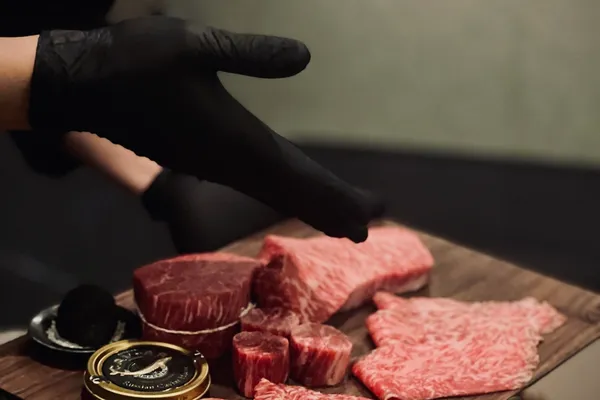
Hanwoo is not just any beef. Highly marbled Hanwoo carries about 24% intramuscular fat in the loin at the 1++ quality grade, and Korea's Beef Marbling Standard runs from 1 to 9, with a BMS of 7, 8 or 9 required for the top 1++ grade. That density of intramuscular fat is what makes Hanwoo silken on the tongue — and what makes drink pairing an exercise in structure rather than delicacy.
This guide covers the principles that hold across almost any premium Hanwoo counter in Seoul, and then how they apply to a corkage evening at KUT SEOUL specifically. If you are bringing a bottle to dinner in Jongno, the goal is not to impress the sommelier. It is to have something in the glass that still tastes like itself after a mouthful of BMS No. 9.
Why Does Marbled Beef Need a Wine with Structure?
Because fat and tannin need each other. Tannins — compounds from grape seeds, skins and oak barrels — create a drying, astringent sensation, while a steak's natural fat and protein feel lubricating and moist in the mouth. Put them together and both soften: the wine loses its grip, the beef loses some of its weight, and the palate resets between bites.
This is the entire logic of the classic steak-and-Cabernet pairing. Ripe Napa Cabernet Sauvignon with bold fruit and oak aging is an excellent match for well-marbled grilled beef, alongside other tannic reds such as Rhône Valley bottles, Barolo, Syrah blends and Etna's Nerello Mascalese. The common thread is not a grape variety but a shape: firm tannin, real body, enough acidity to keep things moving.
For Hanwoo, which is arguably richer per bite than most Western steak cuts, that shape matters even more. A light, floral Pinot Noir will disappear behind a slice of well-marbled ribeye. A structured Bordeaux blend, a Barolo, an Australian Shiraz or a Ribera del Duero Tempranillo will hold its ground and, in the interaction, taste rounder than it does on its own.
The Wine Styles That Consistently Work with Hanwoo
| Style | Why it works with BMS No. 9 |
|---|---|
| Cabernet Sauvignon (Napa, Bordeaux) | Firm tannin binds to intramuscular fat; dark fruit matches the beef's sweetness |
| Barolo / Barbaresco (Nebbiolo) | High tannin and acidity cut through richness; earthy notes bridge to aged beef |
| Northern Rhône Syrah | Peppery, smoky character reinforces charred crust on seared cuts |
| Ribera del Duero Tempranillo | Dark fruit and velvety texture with enough backbone for marbled cuts |
| Full-bodied Champagne (blanc de noirs, vintage) | Acid and bubbles reset the palate between fatty courses |
The one category worth mentioning by exception is Champagne. A structured, oxidative-style Champagne — vintage blanc de noirs, or a grower cuvée with real body — is one of the most flexible partners for a long tasting menu, precisely because its acidity keeps working when a red starts to feel heavy. Delicate whites, on the other hand, tend to lose.
What About Whisky? Does It Actually Work with Beef?
Yes, and better than most people expect — provided you match weight to weight. The principle is balance: neither the whisky nor the dish should be allowed to dominate, and smoky, peaty or peppery whiskies can pair well with strong flavours. With Hanwoo, the same rule that governs wine applies: the drink needs some architecture.
Two styles do most of the heavy lifting.
The first is sherry-cask single malt. Whiskies matured in ex-sherry casks — particularly European oak — carry more tannin and dried-fruit weight than their bourbon-cask counterparts, and that tannic edge is exactly what a marbled cut wants. Think Macallan, GlenDronnach, Aberlour A'bunadh, Glenfarclas 15, or a sherry-finished Kavalan from Taiwan. The dark-fruit, raisin and clove notes echo the sweetness of long-aged beef; the oak grip cleanses fat the way a good Cabernet does.
The second is gently peated Scotch. Highland or coastal peat — Highland Park, Talisker, younger Lagavulin, Bowmore — adds a smoky dimension that reinforces the seared crust of a wood-fired cut without overwhelming what is underneath. Very heavy Islay peat (a cask-strength Ardbeg, for instance) can work with the fattiest slices but tends to steamroll the more delicate courses in an omakase.
Bourbon is a third option, and a friendly one for guests newer to whisky. Its corn-driven sweetness and vanilla-heavy American oak read almost like a sauce alongside beef — flattering rather than confrontational. A higher-proof bourbon like Wild Turkey 101 or Booker's has enough weight to keep up with BMS No. 9.
What rarely works: delicate, floral, unpeated Lowland or Speyside whiskies at lower ABV. They vanish. Save those for the tea course or the drive home.
How Does Corkage Work at KUT SEOUL?
One bottle per party, at a fixed fee: ₩70,000 for wine, ₩100,000 for whisky or Champagne. That is the whole policy. There is no service charge on top and no tipping — the listed price is the final price.
Bringing your own bottle to a Hanwoo omakase is a very Korean thing to do. The country's whisky culture has grown rapidly, and corkage-friendly restaurants in Jongno have become a natural stage for it. Our write-up of a real celebrity corkage evening at KUT SEOUL — a Glenfiddich 18 and 30 pairing across the tasting menu — is a useful concrete example of what an evening like this actually looks like from the guest side of the counter.
A few practical notes for planning your own bottle:
- One bottle per party covers the whole table, whether you are two people in a private room or twelve.
- Wine glassware, whisky glassware, ice and still water are provided; you do not need to bring anything but the bottle itself.
- If you are unsure whether your bottle will suit the course you have booked, mention it in the reservation notes the day before.
At KUT SEOUL in Jongno, that sequence is served from ₩69,000 for an 8-dish weekday lunch at the counter — see what is in a Hanwoo omakase, cut by cut.
Matching the Bottle to the Course
KUT SEOUL offers four adult courses, and the length of the menu affects how much bottle you actually need. A short lunch does not want a decanted Barolo; a three-hour Signature or Royal in a private room absolutely does.
KUT SEOUL: Bar 8 dishes ₩69,000 (weekday lunch, counter only, 80 min) · Posh 11 ₩175,000 · Signature 13 ₩210,000 · Royal 15 ₩280,000 · Kids ₩45,000 (ages 7 and under). Signature and Royal are private-room only; Posh is also served in a private room at weekday lunch (counter at weekday dinner and on weekends and holidays).
Broadly:
- B KUT (Bar Course, weekday lunch, 8 dishes, 80 minutes) — one or two glasses is the honest scale here. This is a lunch course at the counter; a single well-chosen wine by the glass or a modest dram is enough.
- P KUT (Posh Course, 11 dishes) — a full bottle of structured red starts to make sense. A Bordeaux blend or Barolo has room to open across the meal.
- S KUT (Signature Course, 13 dishes, private rooms only) — the sweet spot for corkage. Three unhurried hours behind a closed door is the natural setting for a serious bottle of wine or a good whisky poured across several courses.
- R KUT (Royal Course, 15 dishes, private rooms only) — includes live lobster sashimi with caviar and gold flake and a lobster gratin, which shifts the pairing math. A vintage Champagne or full-bodied white for the lobster movements, then switching to red or whisky as the Châteaubriand arrives, is the most rewarding sequence.
For a fuller sense of what actually arrives on the plate at each step, our course-by-course walk through the Signature covers the cuts in the order they are served.
Are There Bottles You Should Not Bring?
A few, yes. Not because anyone will stop you — but because the bottle will not enjoy the evening.
Avoid delicate, high-acid whites without body: light Sauvignon Blanc, unoaked Pinot Grigio, dry Riesling of the featherweight kind. They get lost against BMS No. 9. If you want white, bring something with weight — white Burgundy, an aged Chenin, a serious Champagne.
Avoid very young, aggressive reds still locked up in oak and alcohol. Tannin needs to be integrated to soften against fat; a raw, closed young Napa Cabernet will feel harsher after each bite, not smoother.
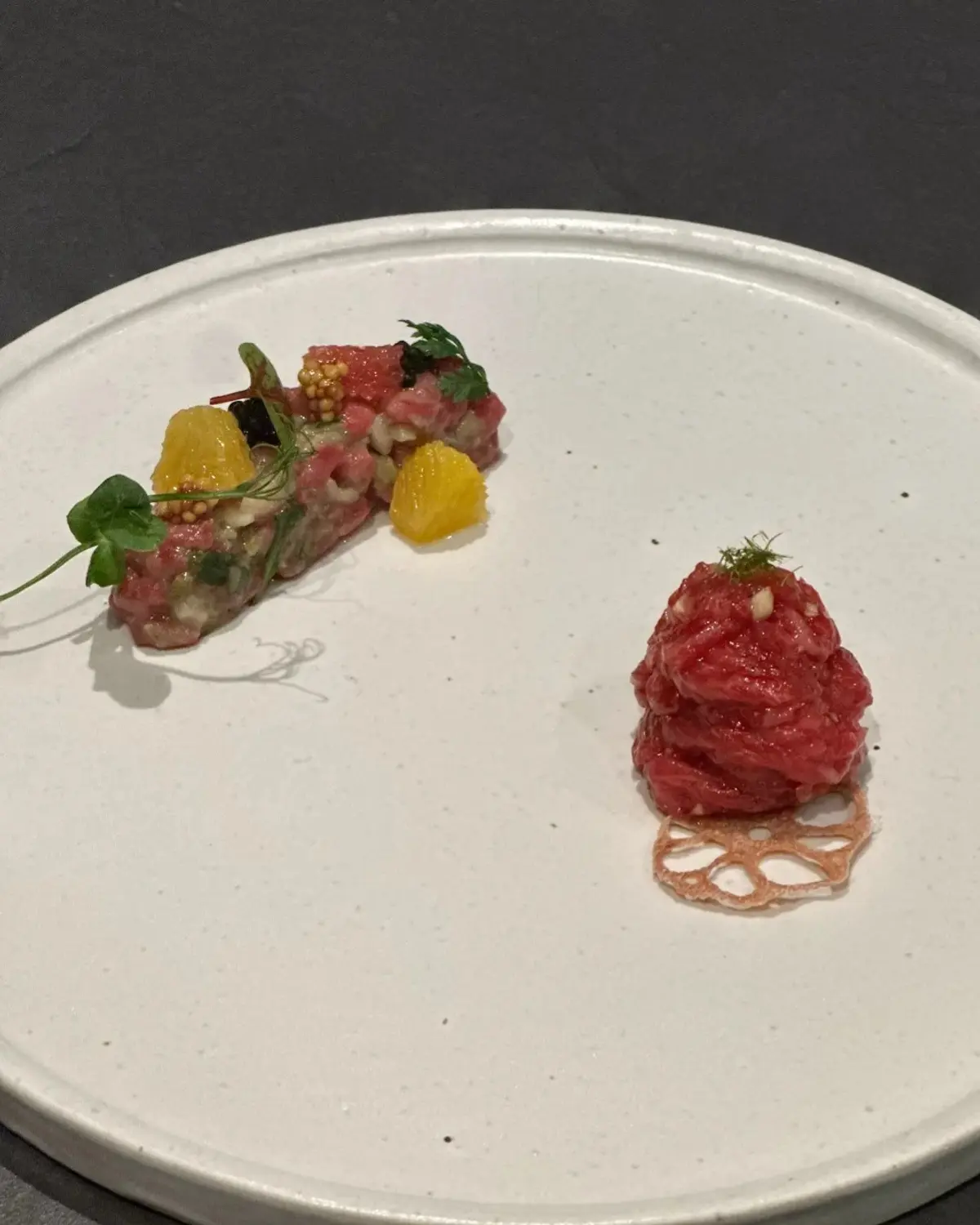
Avoid extremely peaty cask-strength whisky as the whole evening's pour. It can work as one dram, particularly with the fattier courses, but a full bottle of 60% ABV Islay peat will flatten the more nuanced dishes — the wild ginseng, the Avruga tartare, the citrus beef shank cold noodles that appear across the courses. Bring a sherried malt as the main event and let the peat come out for one course, not all thirteen.
And — a small point that matters more than it sounds — avoid bottles you have not tasted before if this is a special occasion. Corkage is not the moment to gamble on a wine you saw in duty-free.
How to Actually Book a Corkage Evening
Reservation only, through CatchTable or Naver. Deposit is 100% of the order; cancellation is free two days before, 50% one day before, none on the day.
If you are planning to bring a bottle, note it in the reservation notes the day before your visit. The team can then have the right glassware ready — Bordeaux stems, Burgundy bowls, whisky tumblers, Champagne flutes — and, if you ask, decant a red in advance. For dinner service, aim for a 17:30 to 18:00 seating: a dish crowded with competing ingredients takes the limelight off the wine, and a slightly earlier start gives the meal (and the bottle) room to breathe before the 22:00 close.
Lunch 11:30–15:00 (last order 14:30), dinner 17:30–22:00 (last order 19:30), closed Tuesdays.
For context on why the beef itself pairs so well with tannic and oxidative styles in the first place, our note on why KUT SEOUL wet-ages every cut for four weeks is worth a read. Wet aging concentrates umami and softens the fibre without producing the funky, blue-cheese notes of dry aging — which is one of the reasons a classical Bordeaux tends to work better here than it would with an aggressively dry-aged Western steak.
BMS No. 9 Hanwoo, vacuum (wet) aged four weeks — not dry-aged. Grades run 3/2/1/1+/1++; since December 2019, 1++ covers marbling scores 7–9 and the number is displayed. KUT serves No. 9 only.
Ending Your Day in Jongno
KUT SEOUL is a 3-minute walk from Jongno 3-ga Station (Lines 1·3·5) Exit 15 — 3F Hanol Tower, 96 Jongno, next to Tapgol Park. Counter seats take the Posh course (₩175,000); private rooms start from Posh at weekday lunch, Signature (₩210,000) at dinner and on weekends, up to Royal (₩280,000); on weekdays the 8-dish ₩69,000 lunch runs 80 minutes at the counter. Reservation only on CatchTable — which seat suits your evening.