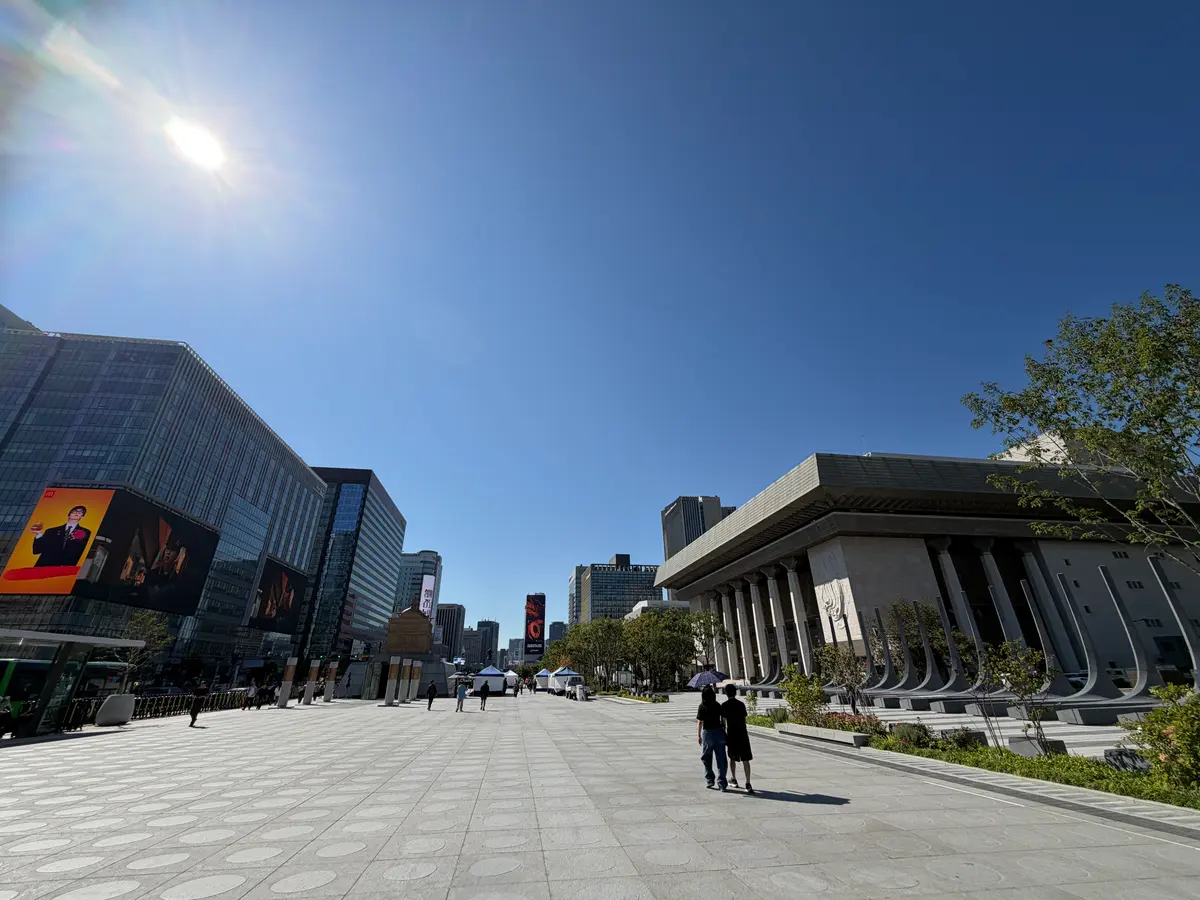
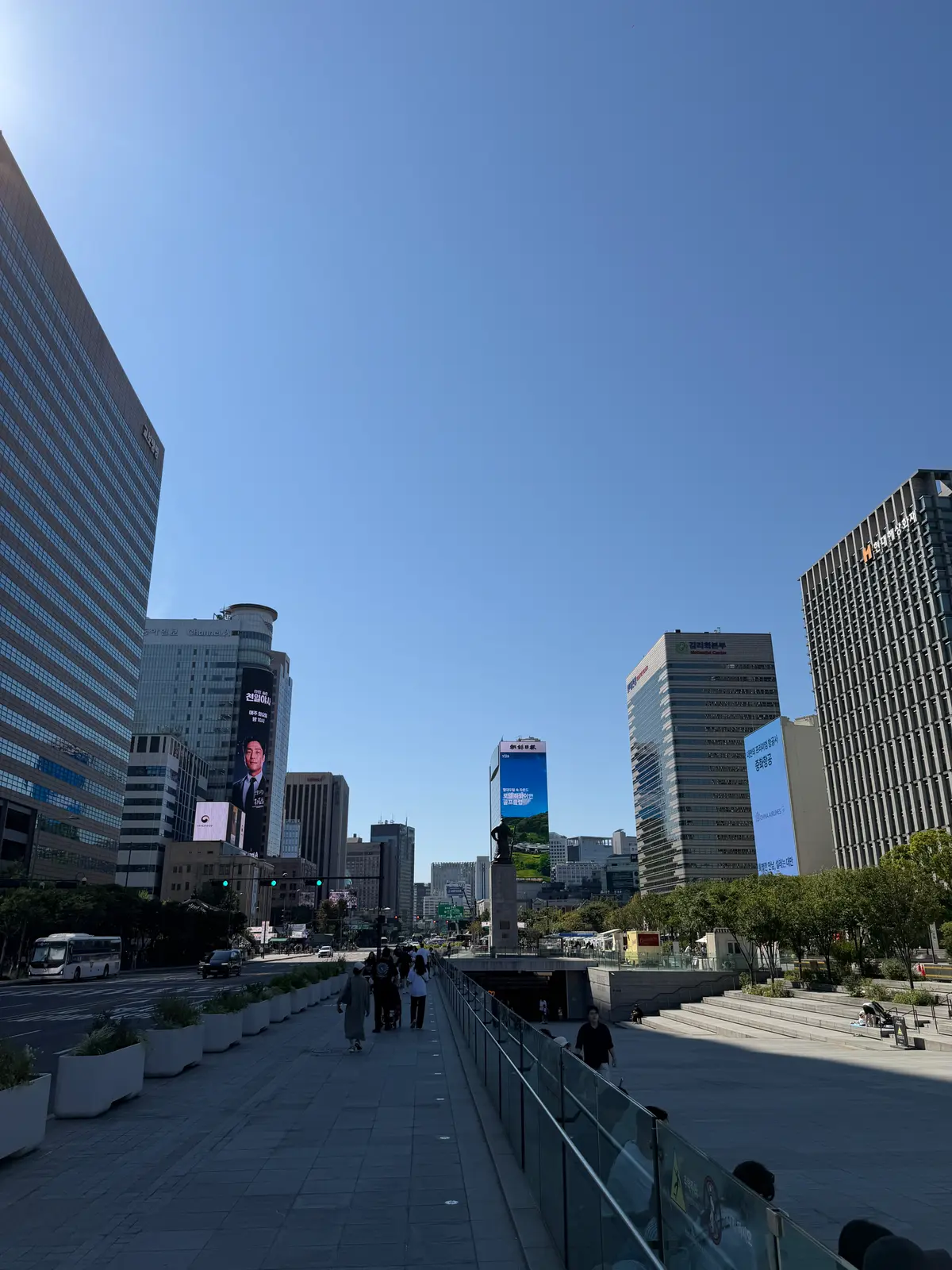
Gwanghwamun Square is the ceremonial spine of central Seoul — a 555-metre pedestrian corridor between Gyeongbokgung Palace to the north and City Hall to the south, framed by the ridge of Bugaksan and, on either flank, government ministries, the Sejong Center for the Performing Arts and the American Embassy. Since the square's 2023 renewal, the walking surface has widened, the greenery has thickened, and the two great bronze figures at its centre — Admiral Yi Sun-sin at the southern end and King Sejong the Great 250 metres behind him — feel less like traffic-island monuments and more like the anchors of an outdoor museum.
Beneath the Sejong statue lies one of Seoul's most underused attractions: a free, quietly excellent underground exhibition that tells the story of the king who invented Hangul, alongside a second hall devoted to the naval commander who defeated the Japanese fleet in the 1590s. Most visitors photograph the statues, cross to Gyeongbokgung, and never realise the stairs are there.
This guide walks you through the square from south to north, into the underground exhibition, and then east along Jongno — the natural direction of travel when Gyeongbokgung is closing and you want dinner somewhere older, quieter and less obviously touristic than the palace side of town.
What Are You Actually Looking At on the Square?
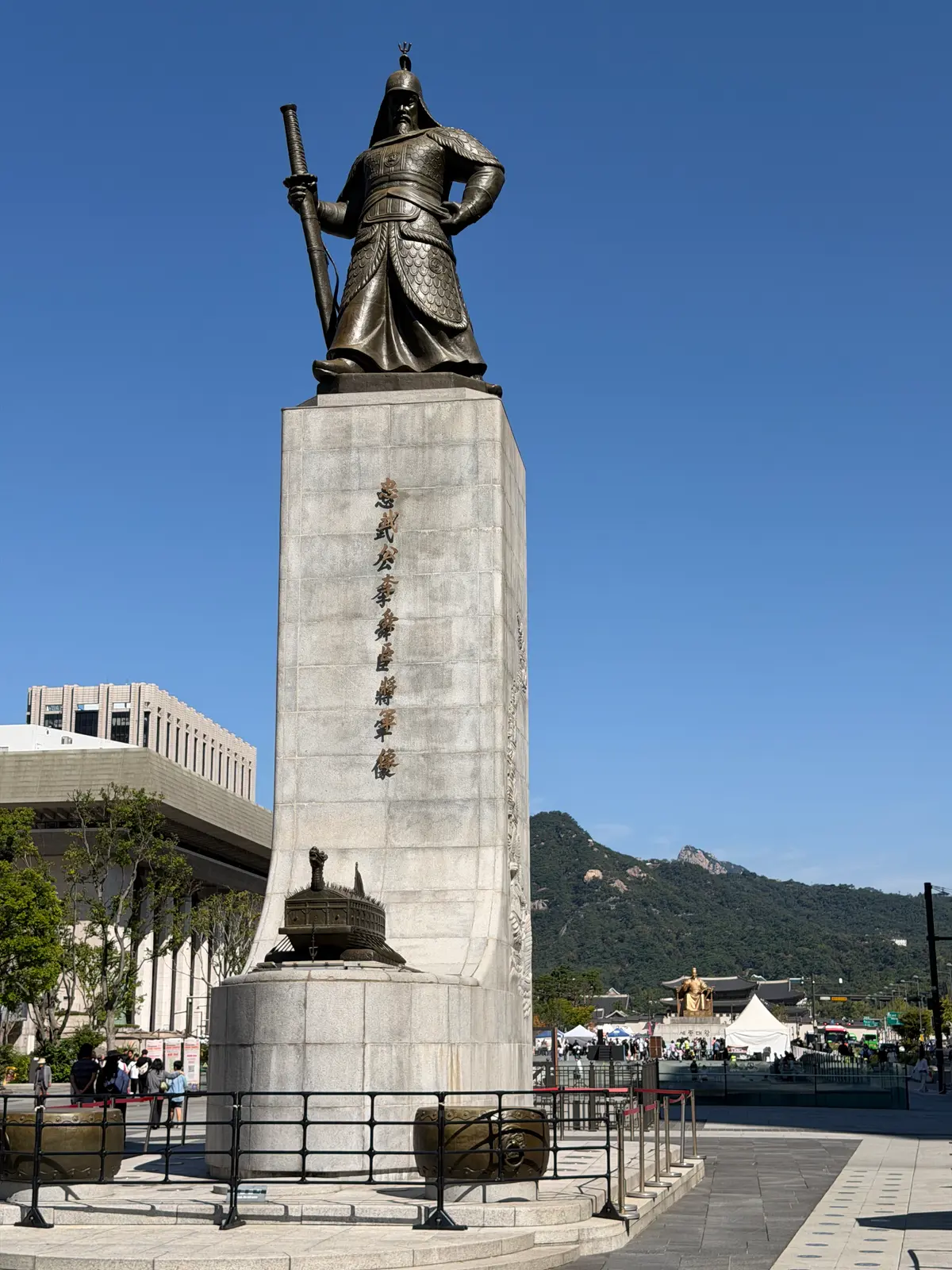
Two statues, one axis. The bronze figure at the southern end is Admiral Yi Sun-sin, the naval commander whose ironclad "turtle ships" broke the Japanese navy during the Imjin War of 1592–1598. Behind him, 250 metres to the north, sits King Sejong the Great, the fourth Joseon monarch and the ruler credited with commissioning the Korean alphabet, Hangul, in the fifteenth century.
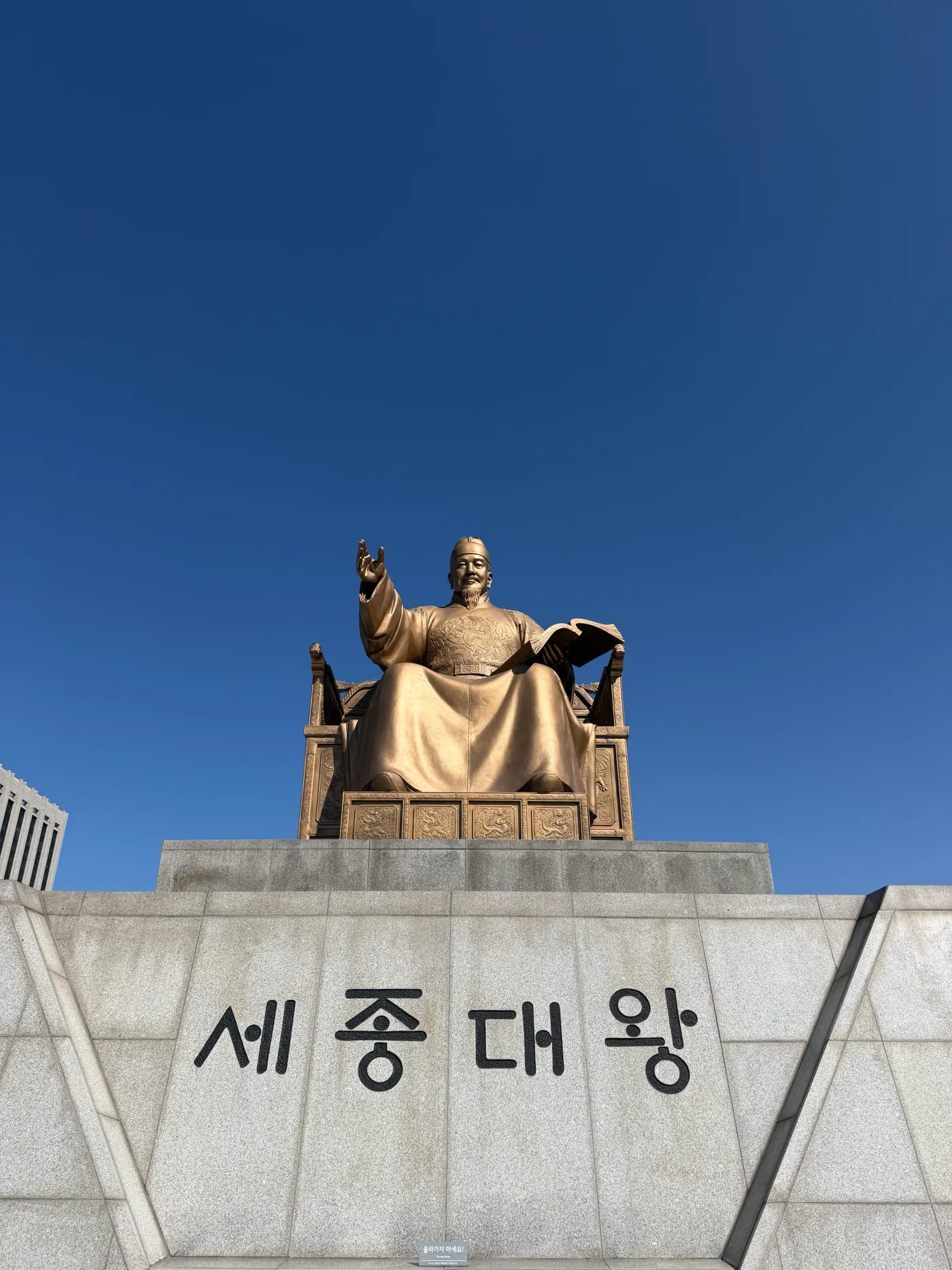
The Sejong statue is the more recent of the two. The 6.2-metre high, 20-ton bronze statue of King Sejong the Great was unveiled on 9 October 2009, located 250 metres behind the statue of Admiral Yi Sun-sin, and dedicated on Hangul Day in celebration of the 563rd anniversary of the invention of the Korean alphabet. He is shown seated on a throne facing south, down the length of the square. In his left hand he holds a copy of the Hunminjeongeum Haeryebon, the book of the writing system he invented, while his right hand is gently raised, expressing his wish for the writing system to be widely taught and used among his people.
In front of the throne, on a shallow granite plaza, sit scale replicas of Joseon-era scientific instruments — a rain gauge, a sundial, a celestial globe — most of them associated with the astronomer-inventor Jang Yeong-sil, who worked under Sejong's patronage. They reward a slow look. The rain gauge in particular predates comparable European instruments by two centuries.
The Yi Sun-sin statue is older and more austere: helmet, sword, a stern southward gaze along Sejong-daero. Beneath both figures, and reached from behind the Sejong throne, is the underground exhibition hall.
Is the Sejong Story Exhibition Worth Going Underground For?
Yes — and it is free. The entrance is a set of stairs directly behind the King Sejong statue, easy to miss because the statue itself is the photograph everyone is taking.
The hall is run by the Sejong Center for the Performing Arts, and it is a proper museum rather than a tourist information point. The exhibition hall of the Story of King Sejong opened on 9 October 2009 to commemorate Hangul Proclamation Day, and the exhibition hall of the story of Admiral Yi Sunshin opened on 28 April 2010, in memory of Admiral Yi Sun-sin's birthday. The two halls connect underground, so a single visit covers both figures at the surface above.
The Sejong hall is arranged across twelve exhibition spaces — The Story of King Sejong, his people-oriented philosophy, a Conversation with King Sejong, King Sejong's Quotes of the Day, The Sound of Korea's Traditional Instruments, Human, King Sejong, Seoul I Visited, the Creation of Hangul, Science and Art, Military Policy, the Hangul Gallery and the Hangul Lounge. The Admiral Yi Sunshin hall runs to six spaces: Life of Great Yi Sunshin, Ships of the Joseon Dynasty, Seven Years of Naval Warfare, Yi Sunshin in Nanjung Ilgi (War Diary), Yi Sunshin's Leadership and a 4D Experience Hall.
The most photographed corners tend to be a full-scale replica of the geobukseon turtle ship in the Yi hall, and the throne replica in the Sejong hall, where visitors are welcome to sit. Signage runs in Korean, English, Chinese and Japanese. The complex attracts about 1.5 million visitors a year and offers a wide variety of experience and educational programs.
Allow forty-five minutes if you are moving briskly, ninety if you read the panels. For current opening times and any Monday-closure or holiday variation, check the Sejong Center's official page before you go.
Practical Notes for the Square and Exhibition
| Feature | Detail |
|---|---|
| Square length | 555 metres along Sejong-daero |
| King Sejong statue | 6.2 m bronze, unveiled 9 October 2009 |
| Distance between statues | 250 m (Yi Sun-sin to Sejong) |
| Sejong Story hall | 12 exhibition spaces |
| Yi Sun-sin hall | 6 exhibition spaces, including a 4D room |
| Admission | Free |
| Nearest station | Gwanghwamun Station, Seoul Metro Line 5 |
| Languages | Korean, English, Chinese, Japanese signage |
Check the official Sejong Center site for current opening hours and any closure days before your visit.
KUT SEOUL is about 20 to 25 minutes on foot from Gwanghwamun, or one stop on Line 5 to Jongno 3-ga — on weekday lunches its 8-dish ₩69,000 Bar course runs 80 minutes at the counter, reservation only.
Which Subway Exit Should You Use?
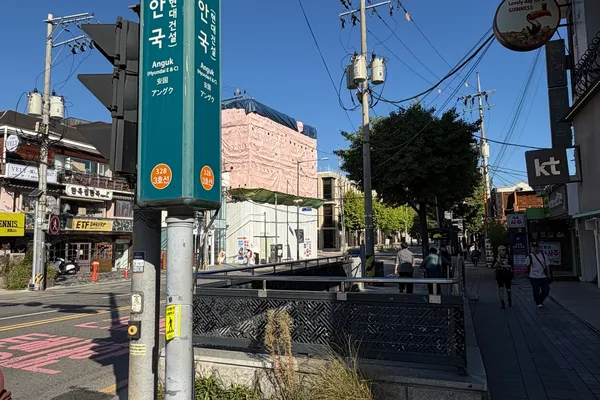
Gwanghwamun Station on Seoul Metro Line 5 is the closest, and the square is essentially built above it — you can surface directly into the plaza from the station's underground concourse without crossing traffic. From the north, Gyeongbokgung Station on Line 3 puts you at the palace gate, from which the square unfurls southward. From the south, City Hall Station on Lines 1 and 2 sits at the far end of Sejong-daero, a pleasant walk if the weather is mild.
For exact current exit numbers and any temporary works, check the Seoul Metro map at the station or the official Gwanghwamun Square site — exit configurations occasionally change with plaza works.
Walking East Toward Jongno for Dinner
Once you have climbed back up from the Sejong Story hall, the natural next move is east. West of the square is Seochon and the palace, both of which close in the early evening; south is business Seoul; north is Gyeongbokgung itself. East, along Jongno, is where old Seoul has always eaten.
The route is straightforward. From the King Sejong statue, walk south to the wide Jongno intersection (Sejong-daero meets Jongno at the corner where the Kyobo Book Centre and the Ilmin Museum stand). Turn left — east — and follow Jongno. Within a block or two you pass Jonggak, the great bell pavilion that once rang the closing of the city gates each night at curfew and is still rung ceremonially on New Year's Eve.
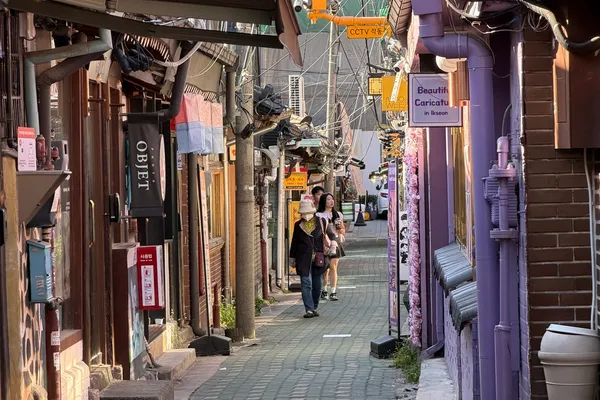
Continue east along Jongno and you enter one of the most quietly interesting stretches of central Seoul: on the right, the low grey ribbon of Cheonggyecheon two blocks south; on the left, the alleys that lead up into Insadong and, further along, Ikseon-dong. This is the Jongno 3-ga district — a neighbourhood of tiled roofs, hand-painted signs, brass workshops and, above the shopfronts, the third-floor rooms where Seoul's chefs have quietly built some of the city's most considered kitchens. It is a walk of substance rather than spectacle, and it delivers you to dinner in the right frame of mind.
For a longer take on this route and the neighbourhood at its end, see our perfect day in Jongno, from Gyeongbokgung to Cheonggyecheon, which follows a similar arc across a full afternoon and evening.
Where to Have Dinner Near Gwanghwamun?
Directly around Gwanghwamun Square, dinner tends to mean office-worker set menus, chain barbecue and hotel dining rooms — perfectly adequate, rarely memorable. The more considered rooms lie a short walk east, in the older grid of Jongno.
The reason is historical. Jongno was the commercial heart of Joseon-era Seoul; the streets around Tapgol Park and Insadong preserve pre-modern lot sizes and mid-century buildings that later became galleries, tea houses and small restaurants. Rents remained moderate long enough for chefs to invest in the sort of long-form tasting menus that would be impossible in Gangnam. For a broader survey of the neighbourhood, our local's picks for dinner near Gyeongbokgung and Jongno covers samgyetang, century-old ox-bone soup houses and royal-court cuisine alongside more modern rooms.
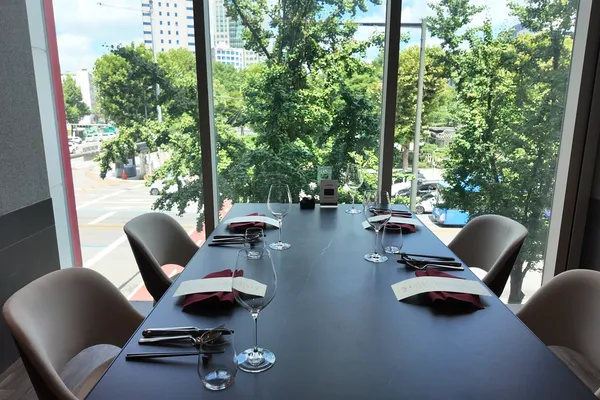
Among those rooms, KUT SEOUL sits east of Gwanghwamun in Jongno 3-ga — the direction the walk naturally takes you. It is a Hanwoo omakase restaurant on the third floor of Hanol Tower, on Jongno directly opposite the southern end of Insadong-gil and next door to Tapgol Park. From Gwanghwamun Square, one option is simply to walk it — a straight line east along Jongno past Jonggak — and another is to drop into the metro for a single stop on Line 5 to Jongno 3-ga Station.
3F Hanol Tower, 96 Jongno — 3 minutes from Jongno 3-ga Station (Lines 1·3·5) Exit 15 or Jonggak Station (Line 1) Exit 4; next to Tapgol Park; 20–25 minutes on foot from Gyeongbokgung.
BMS No. 9 Hanwoo, vacuum (wet) aged four weeks — not dry-aged. Grades run 3/2/1/1+/1++; since December 2019, 1++ covers marbling scores 7–9 and the number is displayed. KUT serves No. 9 only.
The kitchen serves five set courses. A weekday-lunch-only Bar Course of eight dishes sits at the counter; three longer courses — Posh, Signature and Royal — run at lunch and dinner in a mix of counter and private-room settings; and a Kids Course is available in the rooms.
KUT SEOUL: Bar 8 dishes ₩69,000 (weekday lunch, counter only, 80 min) · Posh 11 ₩175,000 · Signature 13 ₩210,000 · Royal 15 ₩280,000 · Kids ₩45,000 (ages 7 and under). Signature and Royal are private-room only; Posh is also served in a private room at weekday lunch (counter at weekday dinner and on weekends and holidays).
Lunch 11:30–15:00 (last order 14:30), dinner 17:30–22:00 (last order 19:30), closed Tuesdays.
Reservation only, through CatchTable or Naver. Deposit is 100% of the order; cancellation is free two days before, 50% one day before, none on the day.
If you would like to think through which course and seat suit your evening before you book, our first-timer's guide to choosing a Hanwoo omakase course walks through each tier in turn.
When Is the Best Time to Do This as a Combined Walk?
Late afternoon into evening is the answer for most of the year. The square is at its most photogenic in the last hour of daylight, when the Sejong statue catches the west light and Bugaksan behind Gyeongbokgung glows briefly copper. The Sejong Story hall is entirely indoors and climate-controlled, which makes it a rewarding refuge on a hot August afternoon or a January cold snap.
A workable rhythm is to enter the square around 16:00, spend an hour above ground with the statues and the scientific instruments, then drop underground for 45 minutes at a brisk pace (up to 90 minutes if you read every panel) with the Sejong and Yi Sun-sin exhibitions, and begin the walk east toward Jongno 3-ga by about 17:45 to 18:15. That places you at the door of a Jongno dinner room by roughly 18:15 to 18:45 — early enough to sit down at the start of the service, late enough that the office crowd has dispersed. If you are booking a private-room course, aim for a 17:30 or 18:00 seating rather than later; the longer courses run three hours behind a closed door, and you will want to leave the room before the restaurant closes for the night.
On Mondays, note that the Sejong Story hall is typically closed while the square itself remains open — worth checking the official site if a Monday visit is your only option.
Ending Your Day in Jongno
KUT SEOUL is about 20 to 25 minutes on foot from Gwanghwamun, or one stop on Line 5 to Jongno 3-ga — 3F Hanol Tower, 96 Jongno, next to Tapgol Park. Counter seats take the Posh course (₩175,000); private rooms start from Posh at weekday lunch, Signature (₩210,000) at dinner and on weekends, up to Royal (₩280,000); on weekdays the 8-dish ₩69,000 lunch runs 80 minutes at the counter. Reservation only on CatchTable — which seat suits your evening.