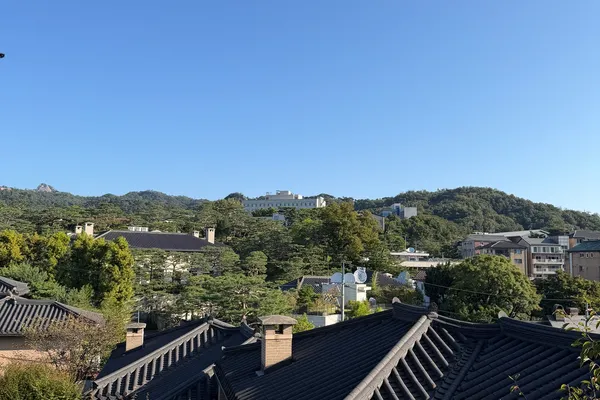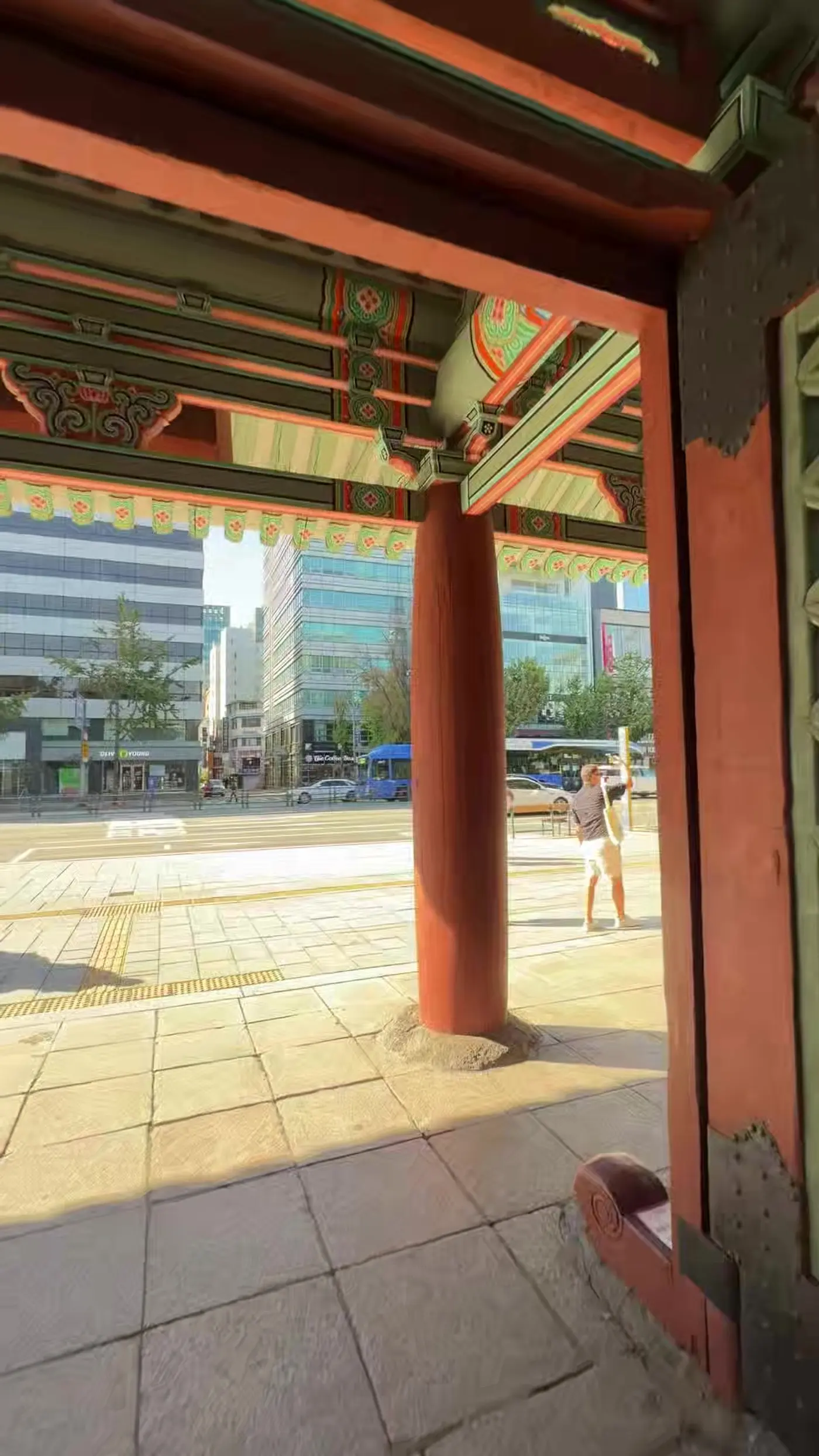
Jongmyo is the quietest UNESCO site in central Seoul. There are no gilded thrones and no changing-of-the-guard spectacle — only long, low tiled roofs, gravel courtyards, and a forest that muffles the traffic on Jongno. It is the royal ancestral shrine of the Joseon dynasty, and for more than five centuries it was the most sacred address in the kingdom.
For a traveller, that seriousness is the point. You come to Jongmyo not to be dazzled but to slow down. An hour on the spirit-path, a bow at the main hall, a walk through the pines — and then, as the light softens over Jongno-gu, the natural next move is dinner. Jongno 3-ga, the neighbourhood immediately south-west of the shrine, is a ten-minute walk of noodle houses, old teashops, and — three minutes from the station — a Hanwoo omakase counter and five private rooms called KUT SEOUL.
This guide covers the shrine itself, the short walk between the two, and how to build the day so that history and dinner belong to the same evening.
What exactly is Jongmyo Shrine, and why is it a UNESCO site?
Jongmyo is the royal Confucian shrine of the Joseon dynasty, built to house the spirit tablets of its kings and queens and to serve as the setting for the ancestral rites performed on their behalf. It is a symbolic structure that conveys the legitimacy of the royal family, where the king visited regularly to participate in the ancestral rites to wish for the safety and security of the people and state.
The shrine was built in 1395 by King Taejo, founder of the dynasty, on a site chosen for its geomantic balance. It was originally built in the late 14th century, but was destroyed during the Japanese invasion during the 16th century, and was rebuilt in the early 17th century with a few expansions made to the buildings thereafter. The reconstruction of 1601 has, remarkably, survived largely intact — which is why UNESCO calls it the oldest and most authentic Confucian royal ancestral shrine in existence.
The inscription came in 1995. Designated a UNESCO World Heritage site in 1995, it is widely regarded as the world's oldest and most intact Confucian royal ancestral shrine, with its original layout preserved. A separate UNESCO recognition — Intangible Cultural Heritage — was later granted to the ritual itself, the Jongmyo Jerye, and its accompanying court music, Jongmyo Jeryeak.
The compound is larger than most visitors expect. Jongmyo and its grounds occupy a 19.4 ha oval site. The buildings are set in valleys and surrounded by low hills, with artificial additions built to reinforce the site's balance of natural elements, in accordance with traditional pungsu principles. That planning is why the walk from the entrance to the main hall feels like moving through a forest first and a monument second.
What you actually see
The two anchors of the site are the great halls where the tablets are kept. The tablets are kept in two shrines, Jeongjeon Hall (the main shrine) and Yeongnyeongjeon Hall (the Hall of Eternal Peace). Currently, Jeongjeon Hall holds 49 tablets and Yeongnyeongjeon Hall holds 34 tablets. Jeongjeon, in particular, is one of the longest wooden structures in East Asia — a single, unbroken roofline that reads, at a distance, more like a horizon than a building.
Do not expect to see the tablets themselves. Its main raison d'être is to hold the spirit tablets of the Joseon kings and queens — but these are all hidden away in spirit chambers in the main buildings where no tourists will ever see them. The experience is architectural and atmospheric: the raised stone spirit-path (only spirits and, historically, the king may walk its central line), the courtyards, and the deliberate austerity of the woodwork. Its architecture, characterized by its solemn and austere design, reflects Confucian dignity and authority. Indeed, it stands in sharp contrast to the colorful decoration typical of Korea's royal palaces.
When should you visit Jongmyo, and how long should you stay?
Allow ninety minutes. That is enough time to enter through the main gate at Jongno, walk the pine-shaded approach, spend proper time at Jeongjeon and Yeongnyeongjeon, and loop back past the smaller auxiliary buildings without hurrying.
Jongmyo operates on seasonal opening hours and, historically, has restricted entry on certain days to timed or guided visits — the policy has changed more than once in recent years. Rather than quote a figure that may already be out of date, check the current hours before visiting via the Korea Heritage Service or the Korea Tourism Organization's official pages. The same goes for admission fees and any language-specific tour schedule.
A few practical notes that do not change:
- The site is walkable but hilly in places; comfortable shoes matter more than at a palace.
- Photography is permitted in the outer grounds; discretion is expected near the halls, and drones are not allowed.
- The spirit-path — the raised central stone line running down the middle of the walkways — is not for visitors. Walk to either side.
- The one weekend not to plan a casual visit is the first Sunday of May. The ritual is practised once a year on the first Sunday in May and is organized by the descendants of the royal family. The Jongmyo Daeje is a spectacular sight but the grounds are crowded and access is restricted.
Late afternoon is the loveliest time. The light drops low behind the pines, the crowds thin, and — conveniently — you finish just as Jongno 3-ga's restaurants are opening for dinner service.
KUT SEOUL is about 7 minutes on foot from Jongmyo Shrine, to the east of Tapgol Park — on weekday lunches its 8-dish ₩69,000 Bar course (as of 2026-09) runs 80 minutes at the counter, reservation only.
The walk from Jongmyo to Jongno 3-ga
Jongmyo's main entrance sits directly on Jongno, one of Seoul's oldest east-west arteries. Turn right (west) out of the gate and you are pointed straight at Jongno 3-ga Station and, beyond it, Tapgol Park.
The walk is short. Jongno 3-ga Station lies roughly seven to ten minutes from the shrine's front gate on foot, depending on which of its many exits you are heading for. Tapgol Park — the small green square with the Wongaksa Pagoda at its centre, sometimes described as the birthplace of the March First Independence Movement — sits about a block west of the station.
A useful piece of orientation for the return leg: the KUT SEOUL building at 96 Jongno is on the north side of Jongno, immediately beside Tapgol Park, and its third-floor windows overlook the park itself. If you can see the pagoda, you are essentially at the door.
| Landmark | From Jongmyo (walking) |
|---|---|
| Jongno 3-ga Station (Lines 1·3·5) | 7–10 minutes |
| Tapgol Park | 8–10 minutes |
| KUT SEOUL (96 Jongno, 3F Hanol Tower) | about 7 minutes |
| Insadong-gil (southern end) | 10–12 minutes |
| Cheonggyecheon stream | 8–10 minutes |
If you have time before dinner, two detours are worth building in. The southern end of Insadong-gil — traditional teashops, hanji stationery, small galleries — is a five-minute stroll from Tapgol Park; a fuller route is set out in our half-day walking guide to Insadong. And Cheonggyecheon, the restored stream two blocks south of Jongno, is at its best in the last hour of daylight, when the lanterns along the water come on.
Why finish the day with Hanwoo?
There is a symmetry to it. Jongmyo is the Joseon dynasty's most formal expression of respect; Hanwoo — Korea's native beef, graded by marbling from 1 up to 1++ (with BMS scores of 7, 8 and 9 at the top of that band) — is the modern country's most formal expression of hospitality. Both take their time, both reward attention, and both are meant to be shared.
Jongno 3-ga has more than its share of well-known meat restaurants, and Time Out named it the world's coolest neighbourhood of 2026. For an evening that mirrors the pace of the shrine visit rather than the noise of the barbecue alleys, an omakase counter is the more considered choice. Our first-timer's guide to choosing a Hanwoo omakase course walks through how the five tiers at KUT SEOUL differ in length, seat and formality.
KUT SEOUL in one paragraph
KUT SEOUL: Bar 8 dishes ₩69,000 (weekday lunch, counter only, 80 min) · Posh 11 ₩175,000 · Signature 13 ₩210,000 · Royal 15 ₩280,000 · Kids ₩45,000 (ages 7 and under). Signature and Royal are private-room only; Posh is also served in a private room at weekday lunch (counter at weekday dinner and on weekends and holidays).
BMS No. 9 Hanwoo, vacuum (wet) aged four weeks — not dry-aged. Grades run 3/2/1/1+/1++; since December 2019, 1++ covers marbling scores 7–9 and the number is displayed. KUT serves No. 9 only.
Lunch 11:30–15:00 (last order 14:30), dinner 17:30–22:00 (last order 19:30), closed Tuesdays.
Reservation only, through CatchTable or Naver. Deposit is 100% of the order; cancellation is free two days before, 50% one day before, none on the day.
One small planning note. A private-room course at KUT SEOUL runs about three hours, so if you want a room for the Signature or Royal Course after Jongmyo, aim for a 17:30 or 18:00 seating rather than a later start — dinner service ends at 22:00. For a shorter evening, the counter runs closer to two hours.
A suggested afternoon-into-evening plan
A realistic sequence, built for a first-time visitor with an interest in both history and food:
- 15:00 — Enter Jongmyo through the main gate on Jongno. Walk the pine approach slowly.
- 15:30 — Time at Jeongjeon Hall, then Yeongnyeongjeon.
- 16:30 — Exit; walk west along Jongno toward Jongno 3-ga Station.
- 16:45 — Optional loop: cross into the southern end of Insadong-gil for tea, or drop down to Cheonggyecheon for a short stream walk.
- 17:30 — Arrive at KUT SEOUL, 96 Jongno, 3F Hanol Tower, in time for the first dinner seating.
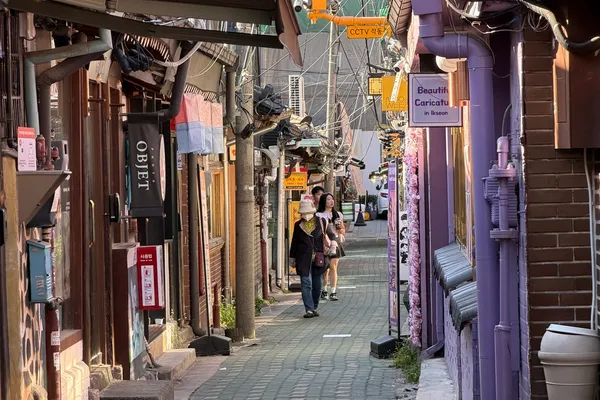
- 20:30 — Coffee or a nightcap in Ikseon-dong, a ten-minute walk north-east of Jongno 3-ga Station.
The pleasure of Jongno as a base is exactly this compression. In four hours you can move from a sixteenth-century shrine to a first-Sunday-in-May UNESCO ritual site to a private dining room with four-week-aged Hanwoo — without once needing a taxi.
Ending Your Day in Jongno
KUT SEOUL is about 7 minutes on foot from Jongmyo Shrine, to the east of Tapgol Park — 3F Hanol Tower, 96 Jongno, next to Tapgol Park. Counter seats take the Posh course (₩175,000); private rooms start from Posh at weekday lunch, Signature (₩210,000) at dinner and on weekends, up to Royal (₩280,000); on weekdays the 8-dish ₩69,000 lunch (as of 2026-09) runs 80 minutes at the counter. Reservation only on CatchTable — which seat suits your evening.