Price note (as of November 5, 2026): the prices on this page apply to visits through November 30. Course prices change for visits from December 1; see the price notice. From December 24 to 27 only a Christmas special course is served; see the Christmas notice.
Ask a visitor to Seoul what *omakase* means and the answer still tends to be sushi — a chef in whites, a cedar counter, small pieces of raw fish set down one after another. That image is accurate, but incomplete. Over the past decade, Seoul has quietly extended the omakase idea to its own national ingredient, and the Hanwoo beef omakase has become one of the most considered ways to eat Korean food in the city.
The format sits somewhere between a Tokyo sushi counter and a Seoul grill house, but belongs to neither. You do not choose cuts. You do not cook. You sit for 8 to 15 courses while the chef moves one BMS No. 9 Hanwoo through its full spectrum — raw, seared, torched, braised, grilled over charcoal, finished with rice and a dessert.
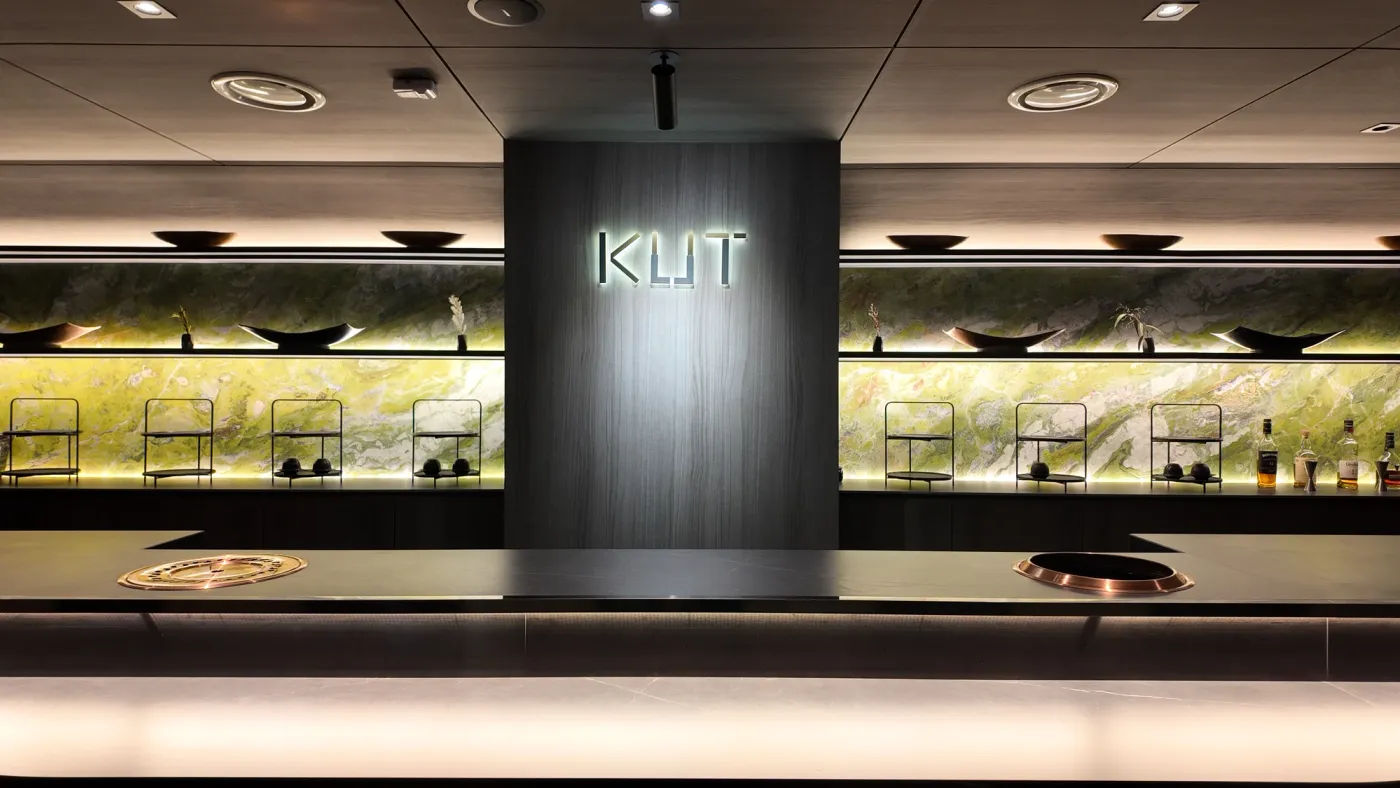
This guide explains what *omakase* means in a Seoul context, how a Hanwoo beef course actually works, how it differs from sushi omakase and from Korean BBQ, and how KUT SEOUL in Jongno runs the service.
What does omakase mean in Seoul?
In Seoul today, *omakase* (오마카세) is used for any chef-led tasting menu where you entrust the selection to the kitchen. It no longer implies sushi by default. You will see the word on hanwoo signage, on hanu-omakase (한우오마카세) counters, on hansik tasting menus, and in Japanese-leaning sushi bars across Gangnam, Jongno and Seongsu.
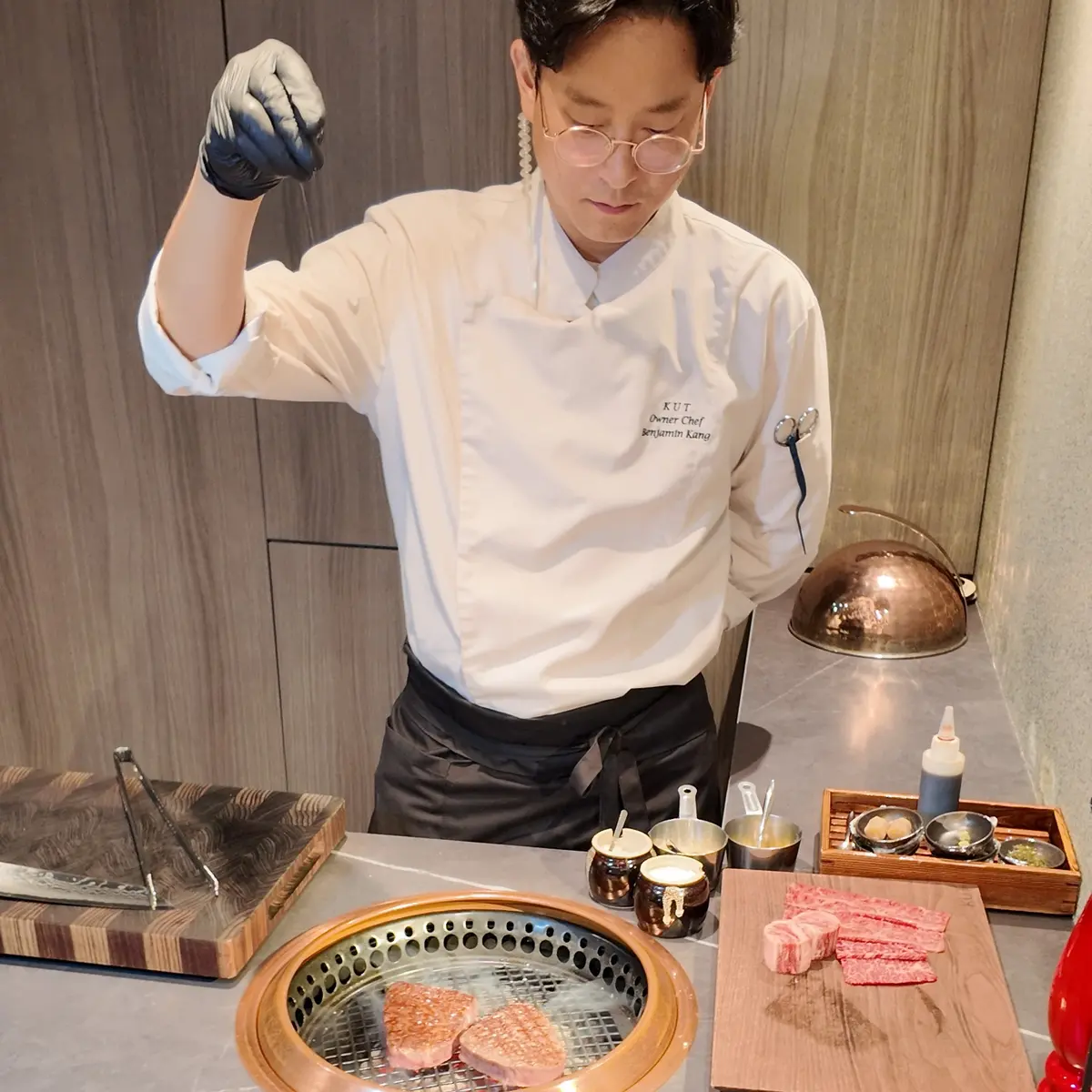
The word arrived with Japan's sushi culture in the 2000s, matured in Seoul's Cheongdam and Apgujeong districts, and then migrated to Korean beef around the late 2010s. The logic was simple: if a sushi chef could compose a story from one morning's fish, a hanwoo chef could do the same from one carcass. A modern Seoul hanwoo-omakase menu usually opens with cold starters, moves through tartare and seared cuts, builds to a grilled centrepiece, and closes with rice, soup and dessert — the shape of a kaiseki, rendered in Korean beef.
What matters for a first-time guest is that *omakase* in Seoul now signals three things regardless of cuisine: a fixed per-person price, no ordering from a menu, and the chef in control of pace.
How does a Hanwoo beef omakase work?
A Hanwoo beef omakase is a sequence of 8 to 15 small courses built around a single grade of Korean beef, served either at an open counter or in a private room. The chef chooses the cuts, the cooking methods and the order; you sit, and each plate arrives when the previous is cleared.
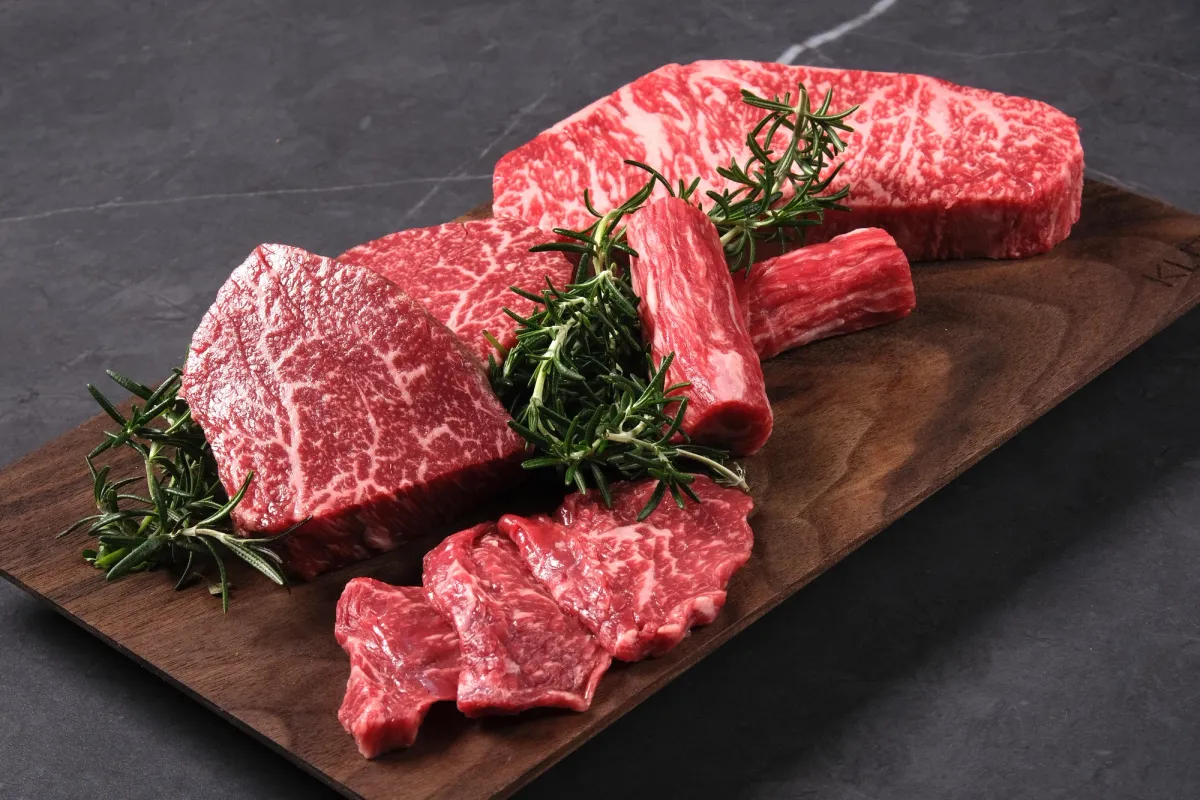
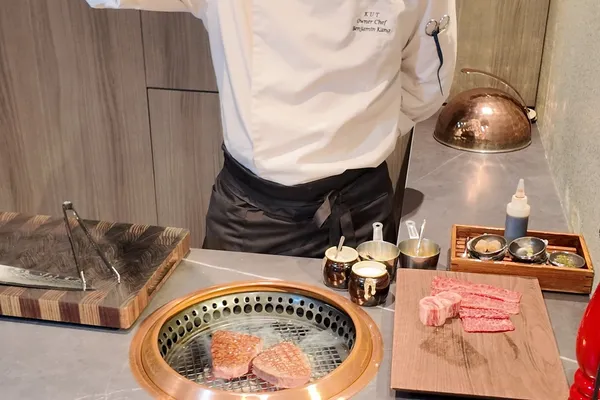
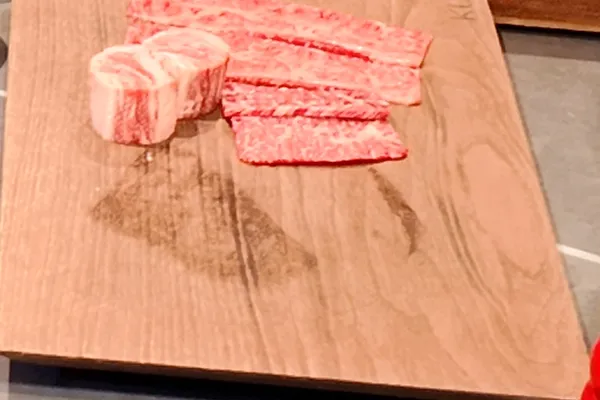
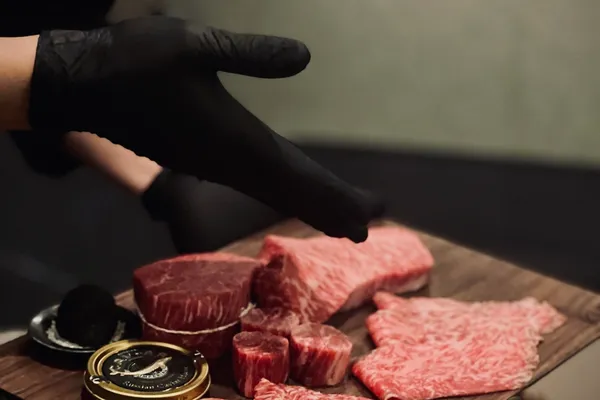
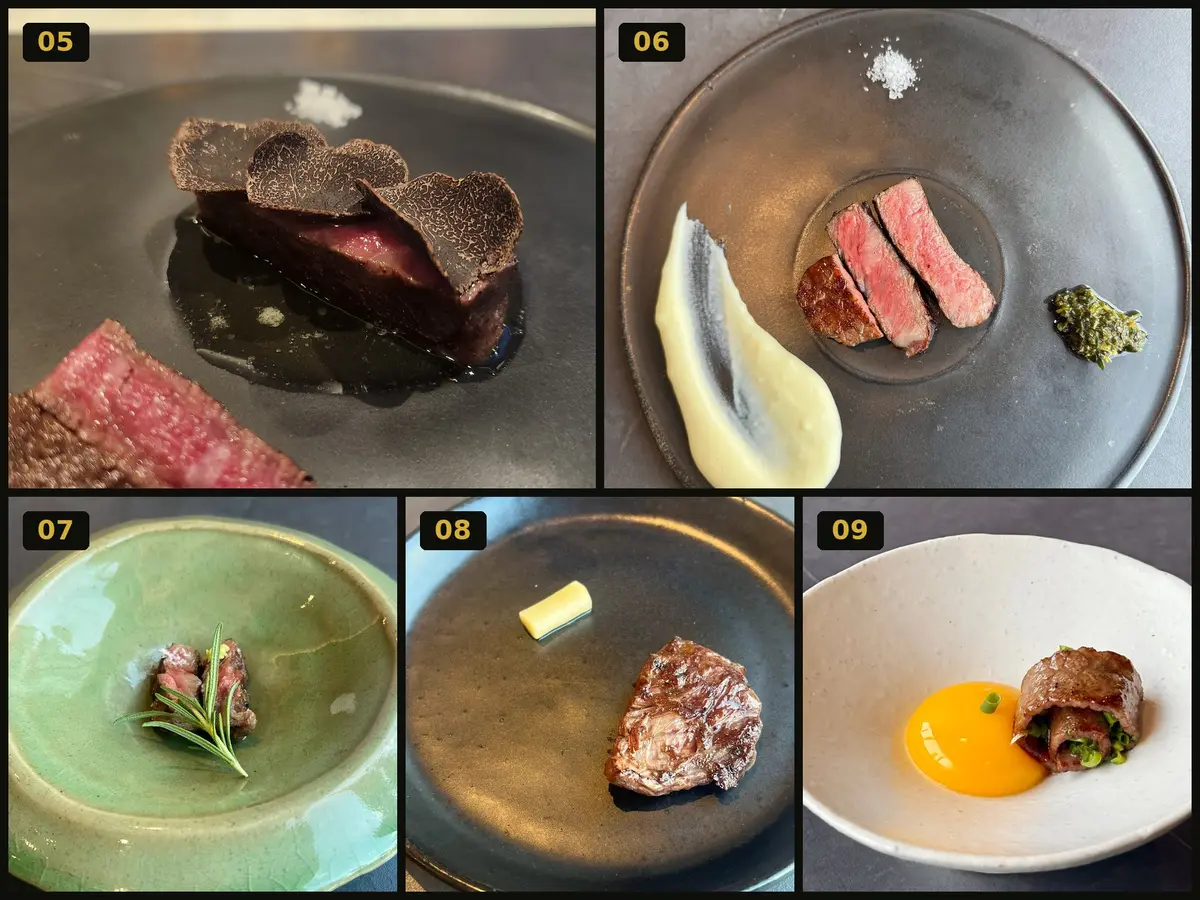
A typical arc runs roughly like this. Cold or warm starters set the palate — a seasonal namul, a broth, perhaps a small tartare. Raw and lightly cured preparations follow: beef tartare, seared tataki, a thin slice of chuck flap brushed with soy. The middle of the course is where the premium cuts appear — tenderloin, sirloin, ribeye cap, and on higher courses the Châteaubriand, cooked at the counter or carried in from an open kitchen. A rice course and a clear beef soup usually mark the transition, and a dessert — sometimes with a free lettering plate for anniversaries — closes the meal.
For a sense of how many cuts actually move through one course and in what order, our guide to every cut served at KUT SEOUL walks through a full dinner plate by plate.
The pacing is deliberate. Lunch 11:30–15:00 (last order 14:30), dinner 18:00–22:00 (last order 19:30), closed Tuesdays.
How is it different from sushi omakase?
The shape is similar — a counter, a chef, a fixed sequence — but the substance is different in three ways: the protein, the temperature, and the rhythm.
A sushi omakase is built on variety within one category: tuna, white fish, shellfish, shiny fish, each in a small bite of vinegared rice, often ten to twenty pieces served in under an hour. Most pieces are raw or lightly cured. The counter rhythm is fast — a piece arrives, you eat it with your hands, the next is being shaped already.
A Hanwoo beef omakase inverts that. The *variety* comes from one animal shown in many preparations rather than many species shown in one preparation. Temperature swings widely across the meal: cold tartare, warm broth, seared tataki, flame-grilled sirloin, rice hot from the pot. The rhythm is slower because meat needs resting and a grill needs attention — a counter dinner runs about two hours, and a private room around three.
The third difference is the service footprint. A sushi counter seats eight to twelve guests around one chef. A Hanwoo omakase counter does the same for the opening and intermediate courses, but the grilled centrepieces are often finished tableside or in an adjacent kitchen, which is why private rooms are part of the format in Seoul and almost never in Tokyo sushi.
How is it different from Korean BBQ?
Korean BBQ and Hanwoo omakase share one ingredient and almost nothing else. BBQ is a social, self-cooked meal: you order cuts à la carte, a server lays them on a central grill, and the table shares scissors, tongs, lettuce leaves, ssamjang and soju. The bill scales with how much you order, and the meal is as long or short as the table decides.
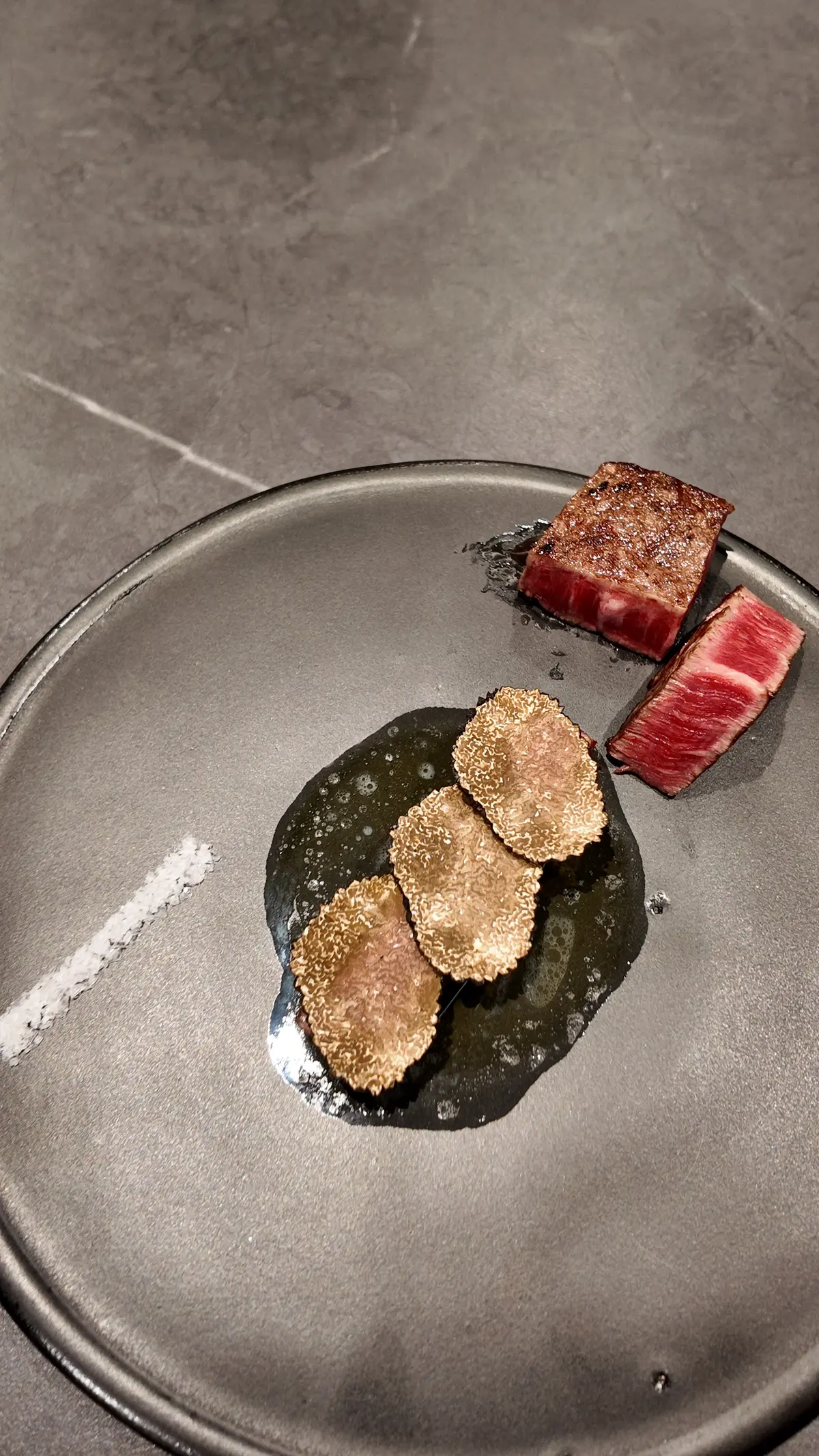
A Hanwoo omakase is a fixed, chef-cooked sequence. You do not choose cuts, you do not touch the grill, and the per-person price is set before you sit down. Side dishes are smaller and more composed — not the dozen banchan of a grill house, but two or three precise accompaniments per plate. Rooms are quieter, and the typical party size is smaller, two to six rather than six to twelve.
For a full side-by-side comparison on eight practical axes — cost, pacing, atmosphere, who it suits — see our dedicated piece on Korean BBQ vs Hanwoo omakase. The short version: BBQ is the better choice for a group night out, and omakase for a date, an anniversary, a business dinner or anyone who wants to taste the beef rather than organise the grill.
| Format | Who cooks | Course count | Typical duration | Pricing |
|---|---|---|---|---|
| Sushi omakase | Chef, at counter | 10–20 pieces | 60–90 min | Fixed per person |
| Hanwoo beef omakase | Chef, counter or kitchen | 8–15 dishes | 80 min – 3 h | Fixed per person |
| Korean BBQ | Guests, at table grill | À la carte | As you like | Per cut, per portion |
What Hanwoo does KUT SEOUL use?
BMS No. 9 Hanwoo, vacuum (wet) aged four weeks — not dry-aged. Grades run 3/2/1/1+/1++; since December 2019, 1++ covers marbling scores 7–9 and the number is displayed. KUT serves No. 9 only.
Hanwoo (한우) is the native Korean cattle breed, graded separately from Japanese Wagyu on a Korean scale that runs from 3 up to 1++. Since December 2019, the top 1++ grade has been split further by marbling score — BMS No. 7, 8 and 9 — and the score must be printed on the label. BMS No. 9 is the highest tier of the highest grade.
All of KUT SEOUL's beef is vacuum-aged (wet-aged) for four weeks in a dedicated refrigerator. Wet-aging keeps moisture in the muscle and produces a cleaner, more lactic finish than dry-aging; the cuts stay juicy at the medium temperatures used across a tasting course. If you want the technical reasons behind the choice, we explain the method in detail in why KUT SEOUL wet-ages its Hanwoo rather than dry-aging. For context on how Hanwoo differs from Wagyu as a breed, see our Wagyu vs Hanwoo primer.
The restaurant holds a 4.9 rating on both Google and CatchTable, across more than 1,743 reviews on Google, CatchTable and Naver combined (as of September 2026).
Which KUT SEOUL course should I choose?
KUT SEOUL offers five courses, each matched to a seat and a time of day. Choose by occasion and by how much of the Hanwoo spectrum you want to see.
KUT SEOUL: Bar 8 dishes ₩69,000 (weekday lunch, counter only, 80 min) · Posh 11 ₩175,000 · Signature 13 ₩210,000 · Royal 15 ₩280,000 · Kids ₩45,000 (ages 7 and under). Signature and Royal are private-room only; Posh is also served in a private room at weekday lunch (counter at weekday dinner and on weekends and holidays).
The shortest route in is the B KUT Bar Course, eight dishes at the counter, weekday lunch only — an introduction with the chef's choice of cut on the day. The P KUT Posh Course adds tenderloin, sirloin and several premium cuts over eleven dishes, and is served at the counter for dinner and weekend/holiday lunch, or in a private room at weekday lunch. The S KUT Signature Course, thirteen dishes, is the room-only course that most first-time private-room guests choose — wild ginseng, Avruga caviar and Châteaubriand sit at its centre. The R KUT Royal Course adds live lobster sashimi with caviar and gold flake, a truffle Châteaubriand and a lobster gratin across fifteen dishes. The Kids KUT is a single plate of six items for children aged seven and under, served only in rooms.
If you are deciding between the counter and a private room, our first-timer's guide to choosing a Hanwoo omakase course walks through party size, occasion and service style in more detail.
How do I book?
Reservation only, through CatchTable or Naver. Deposit is 100% of the order; cancellation is free two days before, 50% one day before, none on the day.
KUT SEOUL is reservation-only. Bookings go through CatchTable (English, Japanese and Chinese pages) or Naver Booking (Korean), with a 100% deposit at the time of reservation. Cancellation is free up to two days before the visit, 50% refundable one day before, and non-refundable on the day or as a no-show; guests arriving 20 minutes or more late are treated as a no-show. There is no service charge and no tipping — the course price is the final price.
A few requests can be added to the booking notes the day before the visit: a free lettering plate for anniversaries and birthdays, dietary allergies to work around within the course, and corkage for one bottle per party (₩70,000 for wine, ₩100,000 for whisky or champagne). There is no vegetarian course, and decorations beyond the lettering plate should be discussed with the restaurant before you order anything in.
3F Hanol Tower, 96 Jongno — 5–7 minutes from Jongno 3-ga Station (Lines 1·3·5) Exit 15 or Jonggak Station (Line 1) Exit 4; next to Tapgol Park; 20–25 minutes on foot from Gyeongbokgung.
To book, visit the KUT SEOUL reservation page and choose a date, course and seating — the platform handles English, Japanese, Chinese and Korean, and accepts foreign cards.
A quieter way to eat Korean beef
The easiest way to understand Hanwoo beef omakase is to think of it as the counter format of Korean beef — the same ingredient Seoul has grilled at home and in restaurants for a century, now presented in the shape of a tasting menu. You lose the smoke and the sociability of a BBQ night. You gain the chef's hand on every plate, a defined arc from cold to hot to sweet, and the chance to see one animal from tartare to Châteaubriand in a single sitting. For anyone who already knows what Hanwoo tastes like from a grill house, the omakase is the next room in the same building.