Ask a Seoul cab driver about Hanwoo and you'll get a small speech. Ask a Tokyo sushi chef about Wagyu and you'll get a longer one. The two beefs are often lumped together as "Asian premium beef," and travelers who have eaten one arrive expecting the other. They are not the same animal, not the same grading system, and — once you sit down in front of them — not the same eating experience.
This guide is written for the traveler standing in Jongno or Gangnam with a reservation to make. It compares the two beefs on the things that actually matter at the table: what the animal is, how it is graded, how it tastes, and how it is served. For the deeper mechanics of Korea's grading scale, our guide to Hanwoo grades and BMS No. 9 goes further; for the question of Korean BBQ versus a Hanwoo omakase, see our comparison of the two Korean formats.
What exactly is Wagyu, and what is Hanwoo?
Wagyu is a category. Hanwoo is a breed. That single distinction explains most of the confusion.
"Wagyu" (和牛) is Japanese for "Japanese cattle," and it is not the name of a single breed. It refers to four established Japanese breeds of beef cattle: the Japanese Black, Japanese Brown, Japanese Polled, and Japanese Shorthorn. All four were characterised in the early twentieth century by cross-breeding native Japanese cattle with imported European stock, and the four strains were formally recognised as breeds in 1944. In practice, when you eat Wagyu in Japan you are almost certainly eating Japanese Black — the Kuroge Washu — which accounts for the vast majority of the national herd and produces virtually all the beef sold under famous prefectural brand names such as Kobe, Matsusaka and Omi.
Hanwoo is a single indigenous Korean breed, classified scientifically as *Bos taurus coreanae*. It has been on the Korean peninsula for a very long time — one PMC-published study puts adaptation to Korea's four-season climate at around 4,000 years, while other reviews trace its history as a draft animal back roughly 5,000 years. For most of that history it pulled ploughs and carts. Full-scale production of Hanwoo as a meat-type breed only began in the 1960s with the rapid growth of the Korean economy, and modern breeding programmes — performance tests, artificial insemination, genomic selection — were initiated by the government in the 1980s, with a specific focus on increasing intramuscular fat.
There is a genetic thread between the two. Hanwoo and the Japanese Black share a common origin, though geographical selection and centuries of breeding for different purposes have led to genetic divergence. So Wagyu is not "Japanese Hanwoo," and Hanwoo is emphatically not "Korean Wagyu" — a phrase you'll see in careless travel writing and should mentally correct every time.
How is each one graded?
Both countries grade every carcass on two axes — yield and quality — but the scales are different, the ceilings are different, and the vocabulary you'll see on a menu is different.
Japan's system is run by the Japan Meat Grading Association (JMGA). Every carcass gets a letter (A, B or C) for yield grade and a number (1 to 5) for quality grade — 15 possible combinations in total, of which A3 through A5 are considered premium. The quality number is determined by four factors: marbling, meat colour, fat colour, and firmness and texture. Crucially, the overall quality grade equals the lowest score among the four, so a carcass must excel in every category to reach 5. Marbling itself is scored on the Beef Marbling Standard from 1 to 12, and a quality grade of 5 requires a BMS of 8 or above.
Korea's system is run by the Korea Institute for Animal Products Quality Evaluation (KAPE) under the Ministry of Agriculture. It has been in place since 1992 and uses five quality grades — from best to lowest, 1++, 1+, 1, 2 and 3 — plus three yield grades (A, B, C). Marbling is assessed on a BMS scale running from 1 (devoid) to 9 (abundant), and since December 2019 the top grade 1++ has been subdivided so that the actual marbling score (7, 8 or 9) must be displayed on the label. That is why you'll see cuts sold as "1++ No. 9" in serious Seoul restaurants — it is the very top of the Korean scale, and it is understood by industry sources to account for roughly one percent of national production.
| Attribute | Wagyu (Japan) | Hanwoo (Korea) |
|---|---|---|
| Category | Umbrella term for four breeds | Single indigenous breed |
| Dominant breed | Japanese Black (Kuroge), ~90% | Hanwoo (*Bos taurus coreanae*) |
| Grading body | JMGA | KAPE |
| Quality grades | 1 to 5 (best: 5) | 3, 2, 1, 1+, 1++ (best: 1++) |
| Yield grades | A, B, C | A, B, C |
| Marbling scale (BMS) | 1 to 12 | 1 to 9 |
| Top-of-scale label | A5 BMS 12 | 1++ No. 9 |
| Established | 1944 (breeds recognised) | 1992 (current grading system) |
A point that trips up almost everyone: the two BMS scales are not interchangeable. Japanese BMS 9 is not Korean BMS 9. They are separate national standards, assessed by separate agencies against separate reference photos. "1++ No. 9" in Seoul and "A5 BMS 9" in Tokyo are both apex products in their own systems, but you cannot line them up on a spreadsheet.
At KUT SEOUL in Jongno, that sequence is served from ₩69,000 for an 8-dish weekday lunch at the counter — see what is in a Hanwoo omakase, cut by cut.
Which one tastes better?
Neither. The honest answer is that the two are aiming at slightly different targets, and the "better" one is the one that fits how you like to eat.
Japanese Black Wagyu — and especially the Tajima strain behind Kobe — is bred for the densest, finest, most lace-like intramuscular fat in the beef world. That fat melts at low temperatures and produces the buttery, almost dessert-like mouthfeel that A5 is famous for. Even Japanese connoisseurs will tell you that A5 at BMS 10 or above is best appreciated in small, focused tastings; many prefer A4 for larger portions because the beef character reads more clearly against the fat.
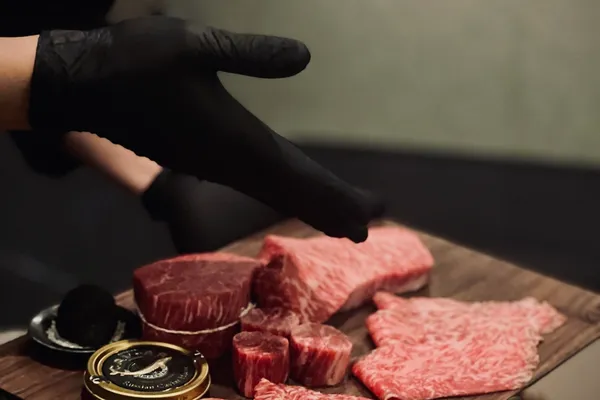
Hanwoo, by contrast, has been bred toward a slightly different silhouette. Top-tier 1++ No. 9 carries dense marbling, but the fat profile is characteristically high in oleic acid — the same monounsaturated fatty acid that gives olive oil its melting quality — which lowers the melting point and produces what Korean palates describe as a cleaner, more savoury finish. Hanwoo also tends to arrive on the plate cut differently: Korea traditionally butchers a carcass into up to 120 distinct cuts, against roughly 22 in the American tradition, which is why a Hanwoo omakase can serve you five or six cuts from the same animal in a single sitting without repeating a texture.
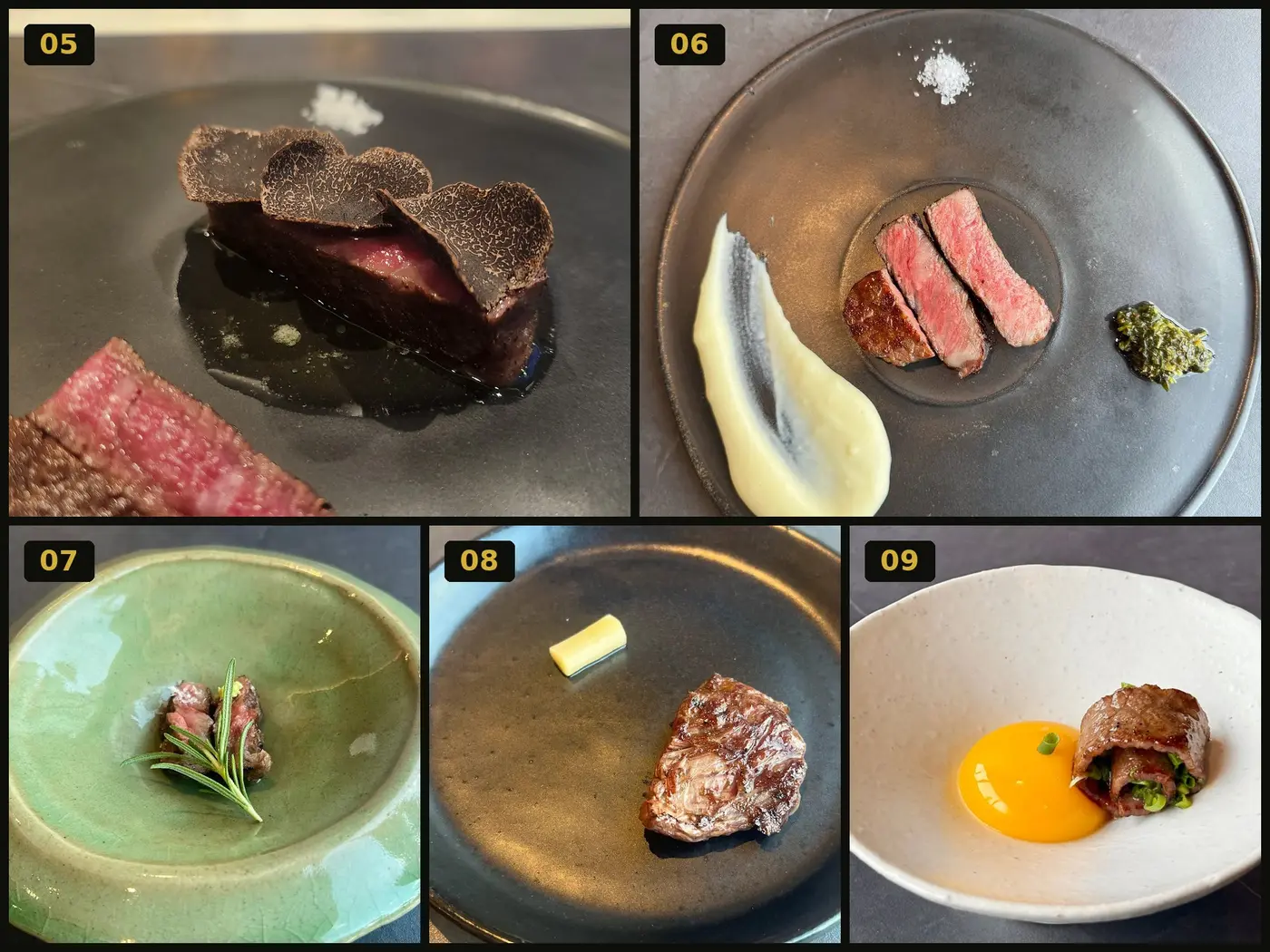
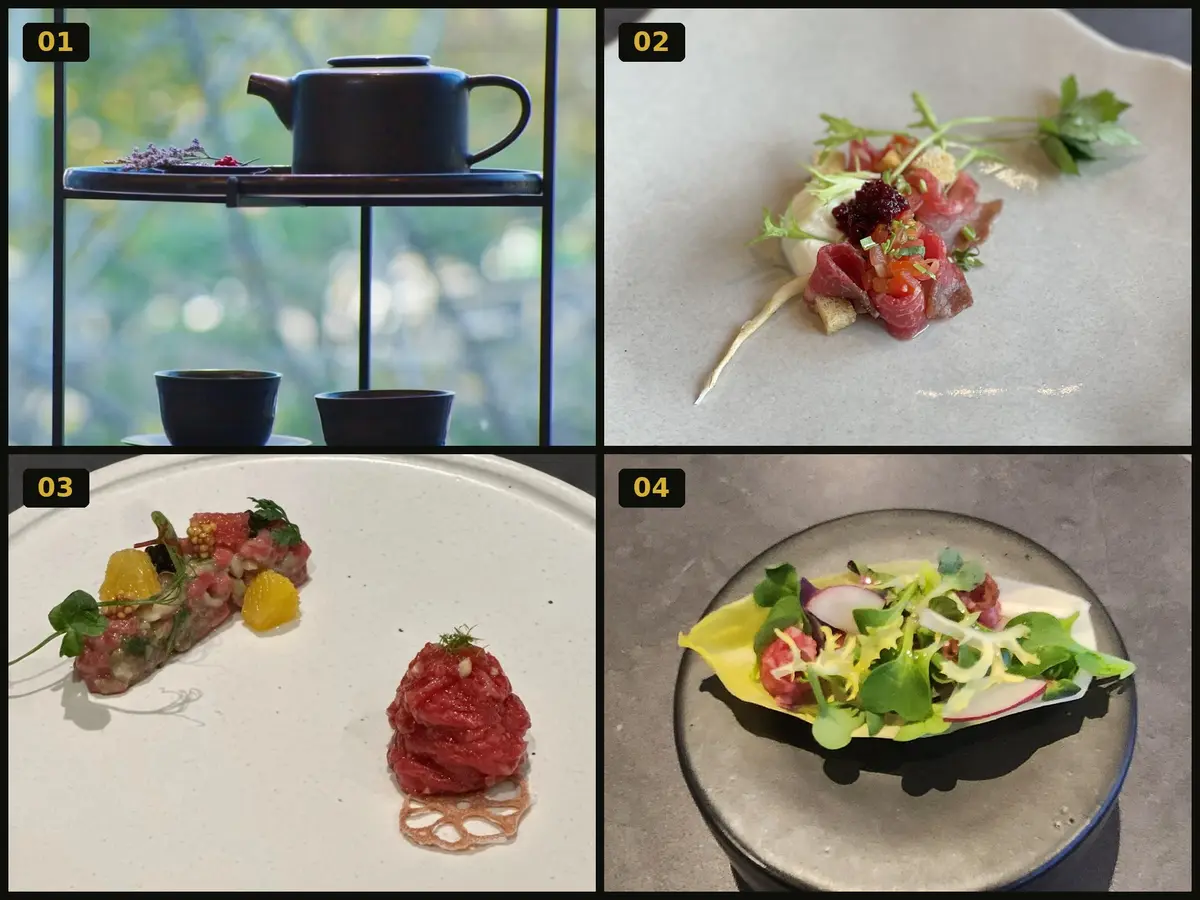
The practical difference at the table: two or three slices of A5 Kuroge on a hot iron plate is a full sensory experience, sometimes to the point of richness fatigue. A thirteen-course Hanwoo tasting through tenderloin, sirloin, chuck flap, Châteaubriand and rib finger reads more like a long tasting menu that happens to be built around one animal.
Should you eat Wagyu or Hanwoo in Seoul?
In Seoul, Hanwoo. This is not a nationalist point — it is a logistics one.
Authentic Japanese Wagyu in Seoul is expensive because it is imported, refrigerated across borders, and priced accordingly. The Hanwoo you are eating at a serious Jongno or Gangnam restaurant was in a Korean pasture recently, was graded by KAPE, and reaches your table through the shortest possible supply chain. You are eating the beef in the country where it was raised, at a price that reflects domestic distribution rather than international air freight.
There is also a cultural argument. Hanwoo culture is centred on communal grill and on the omakase-style tasting menus that have grown up in Jongno and Gangnam over the past decade. Wagyu culture — teppanyaki, sukiyaki, sushi-counter cuts of A5 — belongs to Japan and is best experienced there. If Tokyo or Osaka is on your itinerary, save the Wagyu for that leg. In Seoul, order Hanwoo.
For first-time visitors deciding between the two Korean formats — a hands-on grill dinner versus a chef-led tasting — our guide to choosing between Korean BBQ and Hanwoo omakase walks through the differences in service style, price, and what you actually cook yourself.
What about aging?
Aging is where Wagyu and Hanwoo often diverge in the kitchen, and where a lot of English-language menus mislead travellers.
Japanese Wagyu is usually served fresh or lightly aged. The marbling is the point; the beef is not typically taken through a long dry-aging programme because the fat itself carries the flavour. Some Wagyu-specialist restaurants in Japan do climate-controlled aging in-house, but it is a stylistic choice rather than a standard.
Hanwoo, especially at the higher grades, benefits noticeably from aging because the leaner muscle fibres tenderise and the flavour deepens. Serious Hanwoo restaurants in Seoul age their beef in one of two ways: dry aging in humidity-controlled cabinets, or wet aging in vacuum bags in a dedicated refrigerator. The two methods produce different results — dry aging concentrates and adds funk; wet aging tenderises and keeps the profile clean — and neither is objectively superior. For a fuller explanation of why a Hanwoo specialist might choose one over the other, see our note on wet aging versus dry aging.
Ending Your Day in Jongno
KUT SEOUL is a 3-minute walk from Jongno 3-ga Station (Lines 1·3·5) Exit 15 — 3F Hanol Tower, 96 Jongno, next to Tapgol Park. Counter seats take the Posh course (₩175,000); private rooms start from Posh at weekday lunch, Signature (₩210,000) at dinner and on weekends, up to Royal (₩280,000); on weekdays the 8-dish ₩69,000 lunch runs 80 minutes at the counter. Reservation only on CatchTable — which seat suits your evening.