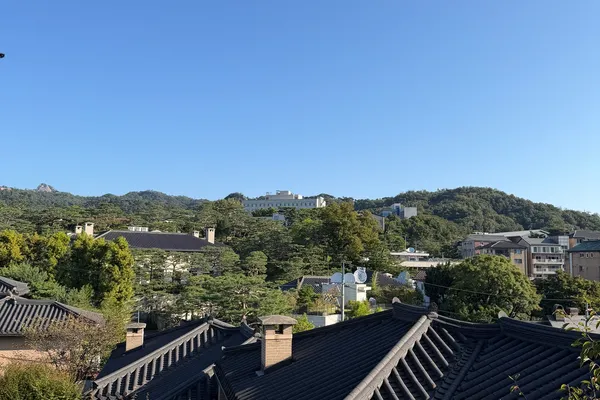
Rain changes Jongno more than it changes most Seoul neighbourhoods. The old district lives outdoors — palace courtyards, the long axis of Gwanghwamun Square, the stone stream of Cheonggyecheon, the alleys of Insadong and Ikseon-dong. When a grey ceiling settles low over Bugaksan and the granite of Gyeongbokgung darkens under water, the usual itinerary loses its shape. Umbrellas snap open, hanbok hems trail across wet flagstones, and the queue for the Changing of the Guard thins to a rumour.
The good news is that Jongno hides more indoor architecture than a first visit suggests. Beneath the square there are museums. Behind Insadong's shopfronts there are galleries, tea rooms and a four-storey spiral of craft shops. Two blocks south, the food alleys of Gwangjang Market are roofed and warm. And when evening comes, a private room in a Hanwoo omakase counts as the driest, warmest destination of all.
This is a route for a wet day — the kind of day when you want to stay dry between doorways, take your time, and let the weather do the work of slowing you down.
What's the best indoor stop right in the middle of Jongno?
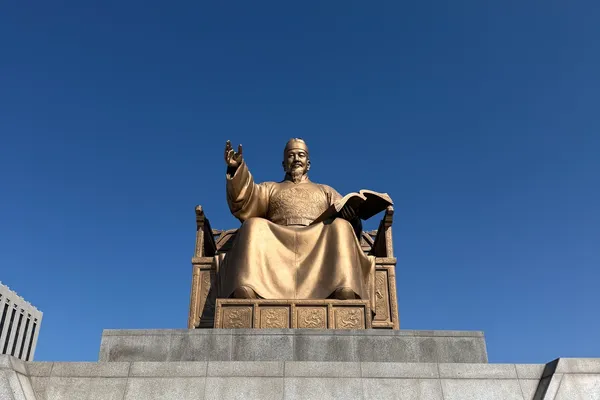
Start underneath Gwanghwamun Square. The Story of King Sejong and the Story of Admiral Yi Sunshin share one large, air-conditioned exhibition hall directly below the two statues, and admission is free. According to Visit Seoul, these are exhibition halls dedicated to two of Korea's most beloved national heroes, King Sejong the Great — inventor of Hangeul — and Admiral Yi Sun-sin, the naval commander who repelled the Japanese invasions of the 1590s. The Sejong side covers his scientific, artistic, military and political achievements; the Yi Sun-sin side displays a walk-in replica of the geobukseon turtle ship.
The entrance sits behind the seated King Sejong statue on the square. Once you are inside, the halls connect underground to the Sejong Center for the Performing Arts on one side and the KT building on the other, so you can move between three buildings without setting foot back outside. That underground link is the single most useful piece of rainy-day architecture in central Jongno.
Hours generally run from mid-morning to early evening, with the halls closed on Mondays; check the official site for current details before you set out, particularly on public holidays.
KUT SEOUL is a 3-minute walk from Jongno 3-ga Station (Lines 1·3·5) Exit 15 — on weekday lunches its 8-dish ₩69,000 Bar course runs 80 minutes at the counter, reservation only.
Where can you see serious art or history without getting wet?
A five-minute walk north of the square brings you to the National Museum of Korean Contemporary History, tucked beside Gyeongbokgung in the former USAID north building. Admission is free. According to the Korea Tourism Organization's Visit Korea listing, regular hours are 10:00–18:00, with extended opening until 21:00 on Wednesdays and Saturdays and last admission thirty minutes before closing.
The museum walks you through Korea from the late nineteenth century — the opening to the world, the colonial period, liberation, the Korean War, industrialisation, democratisation — across four permanent halls. English signage is present throughout. The eighth-floor rooftop terrace looks straight down onto Gyeongbokgung's tiled roofs, and even in rain the view is worth the ride up.
If you prefer contemporary art, the MMCA Seoul branch on Samcheong-ro is a short covered dash from Anguk Station and keeps late hours on Wednesdays and Saturdays as well. And on the palace grounds themselves, the National Folk Museum of Korea sits indoors and is free with palace admission — a way to keep learning about Joseon culture without walking wet courtyards.
| Indoor stop | Admission | Notes |
|---|---|---|
| Story of King Sejong / Yi Sunshin (under Gwanghwamun Square) | Free | Underground link to Sejong Center and KT building |
| National Museum of Korean Contemporary History | Free | 10:00–18:00; Wed and Sat until 21:00 |
| National Folk Museum of Korea | Free with palace ticket | Inside Gyeongbokgung grounds |
| Ssamziegil (Insadong) | Free entry | Four-floor spiral, 10:30–20:30 |
| Gwangjang Market food alley | Free entry | Roofed alleys, food stalls late into the evening |
Is Insadong worth visiting in the rain?
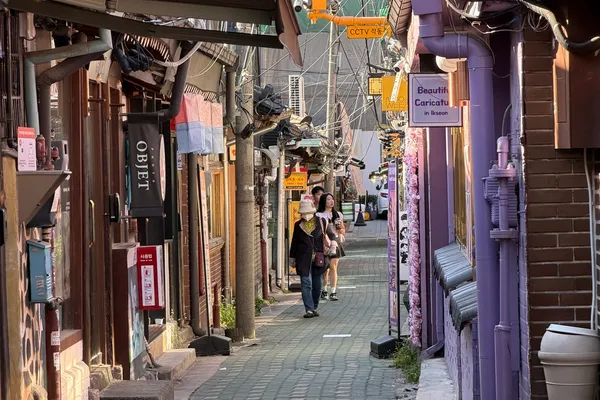
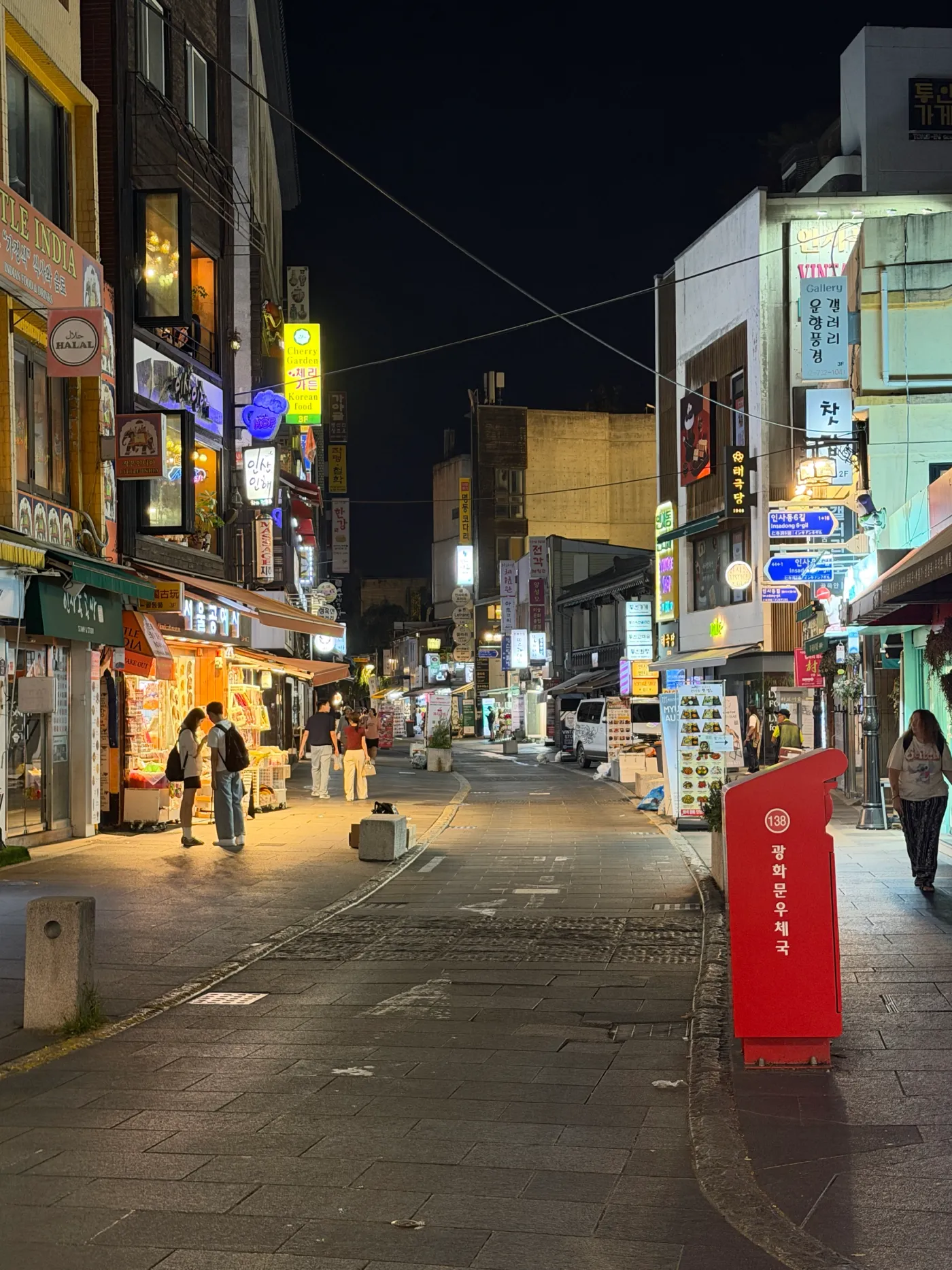
Insadong may actually be at its best in the rain. The main street thins out, the tea houses fill with the smell of roasted grain and pine needle infusion, and the covered arcades of small galleries feel unexpectedly intimate. At the centre of it sits Ssamziegil, the four-storey spiral of craft shops that has anchored Insadong since 2004.
Ssamziegil is arranged as a continuous ramp rather than a stairwell, so all four floors of over seventy shops — handicraft studios, souvenir stalls, small galleries, workshops and cafés — link by gentle slope from the ground-floor courtyard up to a rooftop garden. The mall is generally open daily from 10:30 to 20:30. Craft workshops in the basement offer drop-in and time-slotted classes: metal work, leather, pottery, custom stamps, personalised jewellery. It is the closest thing central Seoul has to a covered creative bazaar.
For a slower pace, look for one of Insadong's hanok tea houses off the side alleys. A pot of omija or ssanghwa-cha under a low wooden ceiling, with rain drumming on the tile above, is one of the quiet pleasures of the district that only rain reveals. Our half-day walking guide to Insadong traces a route through the galleries, tea houses and hanji stationery shops that works particularly well when the weather turns.
One practical note: Insadong-gil closes to cars on Saturday afternoons and all day Sunday (as of 2026-09), so on those days the road itself becomes a covered-adjacent pedestrian walk — you can weave between awnings without dodging traffic.
Where should you eat when the street food stalls are wet?
Gwangjang Market, at the eastern edge of Jongno, is roofed. Established in 1905 as Korea's first permanent market, it sprawls across roughly 42,000 square metres with more than 5,000 vendors, but the point on a rainy day is the food alley — a network of covered lanes where vendors prepare bindaetteok (mung bean pancakes), mayak gimbap, sundae, yukhoe and hand-cut noodles at counters lined with plastic stools. Restaurant and food-stall hours generally run from morning until late evening; check the official site for current details on any specific stall.
The warmth, the sizzle of the pancake griddles and the low ceiling make Gwangjang one of Seoul's most weatherproof food experiences. Bring cash — many stalls do not take cards — and expect crowds around lunchtime and again from about six in the evening. From KUT SEOUL's block it is about a fifteen-minute walk east along Jongno, or two stops on Line 1 to Jongno 5-ga, Exit 8.
For a more sheltered coffee stop, Ikseon-dong — the tight cluster of hanok alleys behind Jongno 3-ga Station — has grown a generation of tiny cafés carved into old courtyard houses. Even where the alleys themselves are open to sky, most of the cafés are a step across a threshold and into a warm, low-lit room. Our Ikseon-dong Hanok Alley guide covers the best hours and exits.
What about the palaces — should you skip them entirely?
Not entirely, but adjust. Gyeongbokgung, Changdeokgung and Jongmyo all stay open in rain (Gyeongbokgung is closed Tuesdays), and Korea Heritage Service does not automatically cancel visits for weather. The Royal Guard Changing Ceremony at Gwanghwamun Gate, however, is cancelled in heavy rain or snow (as of 2026-09) — so if that is your reason for going, phone ahead or reschedule.
The real hazard is underfoot. Palace courtyards are laid with old flat stone or gravel that turns genuinely slippery when wet, particularly the polished thresholds and stepping stones inside the pavilions. Wear grippy shoes, mind the raised sills, and treat the courtyards the way you would treat a temple stone floor.
If you have a Huwon Secret Garden reservation for Changdeokgung, note that the tour goes ahead in light rain — the walk is largely on soft paths under trees, and umbrellas are provided at the ticket office when supply allows. See our first-timer's guide to the Huwon tour for how the two-ticket system works.
Practical notes for a wet Jongno day
Umbrellas are easy to find. Every convenience store — CU, GS25, 7-Eleven, Emart24, all densely spaced in Jongno — sells a clear plastic umbrella for a few thousand won, and most subway stations and larger buildings station umbrella-bag dispensers at the entrance so you can wrap a wet umbrella before walking on carpet. Many cafés and museums also offer umbrella stands or lockers by the door.
Jongno's subway line is a covered blessing. Line 1 runs the length of the district from Seoul Station through Jonggak, Jongno 3-ga and Jongno 5-ga, and the underground passages at Jongno 3-ga in particular are extensive — you can move between Lines 1, 3 and 5 and reach several street exits without surfacing. If you plan carefully, you can string together Gwanghwamun Square, Insadong, Ikseon-dong and Gwangjang Market with only short outdoor stretches.
A final small thing: taxis in central Jongno become scarce during rush-hour rain. If you need one to reach the airport or a distant hotel, book through Kakao T rather than waving from the kerb. For the airport specifically, our Incheon Airport to Jongno guide explains when the AREX train, limousine bus or taxi makes most sense.
Ending Your Day in Jongno
KUT SEOUL is a 3-minute walk from Jongno 3-ga Station (Lines 1·3·5) Exit 15 — 3F Hanol Tower, 96 Jongno, next to Tapgol Park. Counter seats take the Posh course (₩175,000); private rooms start from Posh at weekday lunch, Signature (₩210,000) at dinner and on weekends, up to Royal (₩280,000); on weekdays the 8-dish ₩69,000 lunch runs 80 minutes at the counter. Reservation only on CatchTable — which seat suits your evening.